

11.4.2 Analysis of Accidental Events by Reactor Type
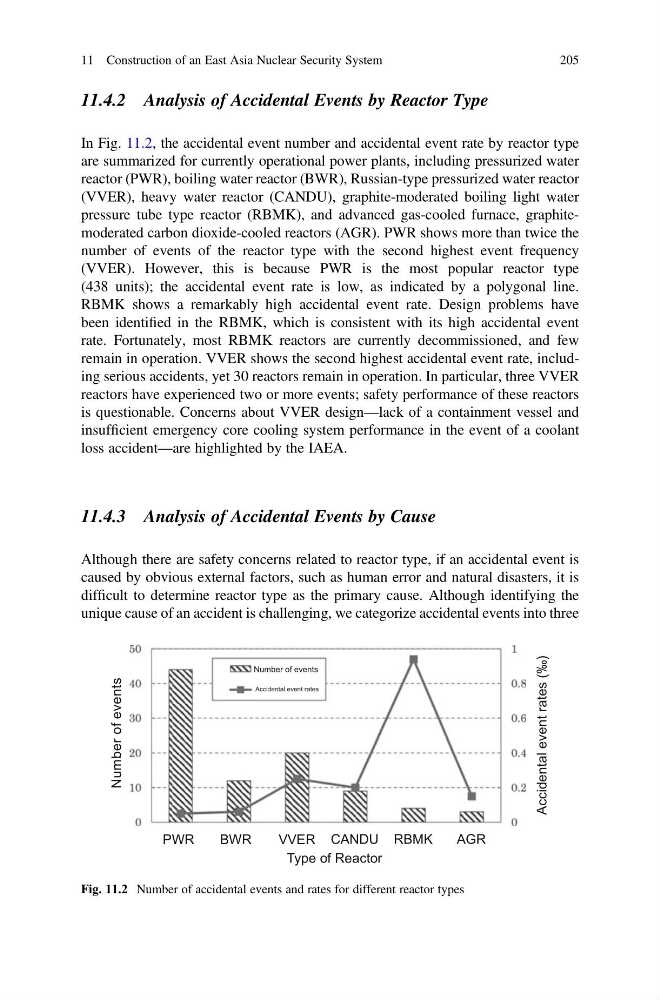
In Fig. 11.2, the accidental event number and accidental event rate by reactor type
are summarized for currently operational power plants, including pressurized water
reactor (PWR), boiling water reactor (BWR), Russian-type pressurized water reactor
(VVER), heavy water reactor (CANDU), graphite-moderated boiling light water
pressure tube type reactor (RBMK), and advanced gas-cooled furnace, graphitemoderated carbon dioxide-cooled reactors (AGR). PWR shows more than twice the
number of events of the reactor type with the second highest event frequency
(VVER). However, this is because PWR is the most popular reactor type
(438 units); the accidental event rate is low, as indicated by a polygonal line.
RBMK shows a remarkably high accidental event rate. Design problems have
been identified in the RBMK, which is consistent with its high accidental event
rate. Fortunately, most RBMK reactors are currently decommissioned, and few
remain in operation. VVER shows the second highest accidental event rate, including serious accidents, yet 30 reactors remain in operation. In particular, three VVER
reactors have experienced two or more events; safety performance of these reactors
is questionable. Concerns about VVER design—lack of a containment vessel and
insufficient emergency core cooling system performance in the event of a coolant
loss accident—are highlighted by the IAEA.
11.4.3 Analysis of Accidental Events by Cause
Although there are safety concerns related to reactor type, if an accidental event is
caused by obvious external factors, such as human error and natural disasters, it is
difficult to determine reactor type as the primary cause. Although identifying the
unique cause of an accident is challenging, we categorize accidental events into three
s
t
n
e
v
e
f
o
r
e
b
m
u
N
PWR
BWR
VVER CANDU RBMK
AGR
Accidental event rates (‰)
Number of events
Accidental event rates
Type of Reactor
Fig. 11.2 Number of accidental events and rates for different reactor types
11 Construction of an East Asia Nuclear Security System
205
In Fig. 11.2, the accidental event number and accidental event rate by reactor type
are summarized for currently operational power plants, including pressurized water
reactor (PWR), boiling water reactor (BWR), Russian-type pressurized water reactor
(VVER), heavy water reactor (CANDU), graphite-moderated boiling light water
pressure tube type reactor (RBMK), and advanced gas-cooled furnace, graphitemoderated carbon dioxide-cooled reactors (AGR). PWR shows more than twice the
number of events of the reactor type with the second highest event frequency
(VVER). However, this is because PWR is the most popular reactor type
(438 units); the accidental event rate is low, as indicated by a polygonal line.
RBMK shows a remarkably high accidental event rate. Design problems have
been identified in the RBMK, which is consistent with its high accidental event
rate. Fortunately, most RBMK reactors are currently decommissioned, and few
remain in operation. VVER shows the second highest accidental event rate, including serious accidents, yet 30 reactors remain in operation. In particular, three VVER
reactors have experienced two or more events; safety performance of these reactors
is questionable. Concerns about VVER design—lack of a containment vessel and
insufficient emergency core cooling system performance in the event of a coolant
loss accident—are highlighted by the IAEA.
11.4.3 Analysis of Accidental Events by Cause
Although there are safety concerns related to reactor type, if an accidental event is
caused by obvious external factors, such as human error and natural disasters, it is
difficult to determine reactor type as the primary cause. Although identifying the
unique cause of an accident is challenging, we categorize accidental events into three
s
t
n
e
v
e
f
o
r
e
b
m
u
N
PWR
BWR
VVER CANDU RBMK
AGR
Accidental event rates (‰)
Number of events
Accidental event rates
Type of Reactor
Fig. 11.2 Number of accidental events and rates for different reactor types
11 Construction of an East Asia Nuclear Security System
205