

civilizations. Based on ancient records, the cuneiform writing of Mesopotamia, the
hieroglyphs of ancient Egypt, and the writings of ancient Indian civilization have all
entered the history museum. However, although the oracle bone inscriptions of the
Shang Dynasty in China evolved into the regular script of today through the seal and
official scripts, the structure of the characters has remained unchanged, and the “LIU
SHU (Chinese character classification )” is still the root of Chinese characters.
However, the phenomenon of the “partial fracture” had occurred in the origin of
ancient Chinese civilization, and some ancient bronze civilizations also declined.
The former includes the Liangzhu culture in the mid and lower reaches of the
Yangtze River in China, the Pujiang Shangshan culture in the Qiantang basin, and
the Shandong Longshan culture in the lower Yellow River area. The latter includes
the developed Sanxingdui bronze civilization in China’s Sichuan basin. Like other
civilizations, the Chinese civilization, which repeats the rise and fall of the dynasty,
has not been able to escape the threat of climate change and environmental
destruction.
1.2.3.1 China’s Recent 5000 Years of Climate Change
Chinese geographer and meteorologist, Kezhen Zhu, published an article in 1972
titled, “A Preliminary Study on China’s Climate Change in the Past Five Thousand
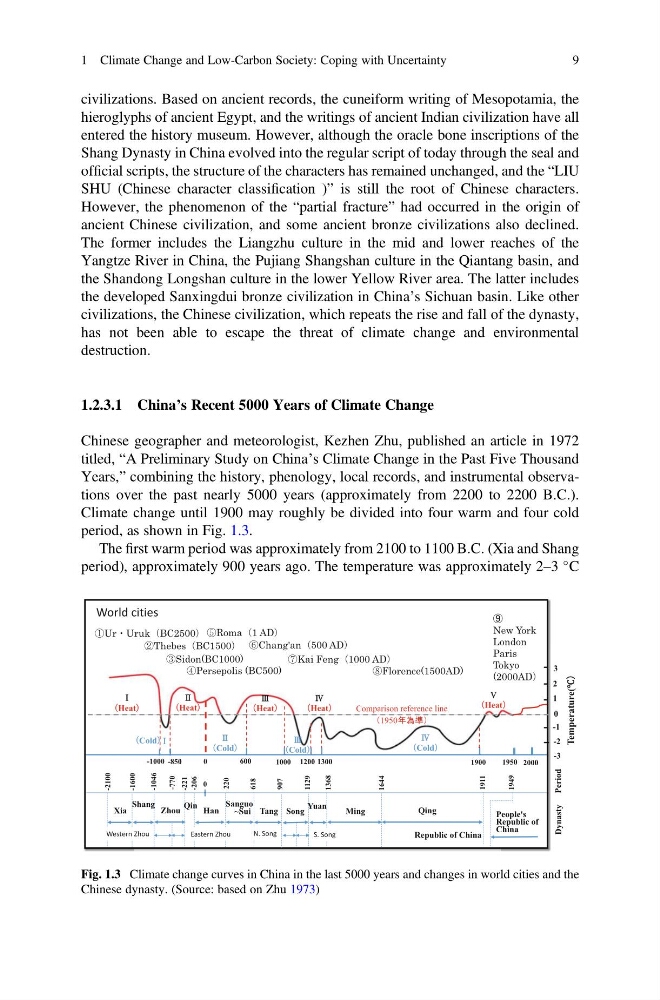
Years,” combining the history, phenology, local records, and instrumental observations over the past nearly 5000 years (approximately from 2200 to 2200 B.C.).
Climate change until 1900 may roughly be divided into four warm and four cold
period, as shown in Fig. 1.3.
The first warm period was approximately from 2100 to 1100 B.C. (Xia and Shang
period), approximately 900 years ago. The temperature was approximately 2–3
C
Xia
Shang
Zhou
Qin Han
Sanguo
~Sui Tang Song
Ming
Yuan
Qing
Republic of China
People's
Republic of
China
-2100
-1600
-1046
-206
220
618
907
1129
1368
1644
1911
1949
Ϩ Ϩ
㸦Heat㸧
㸦Cold㸧 Ϩ
ϩ
㸦Cold㸧
Ϫ
㸦Heat㸧
ϫ
㸦Heat㸧
Ϫ
㸦Cold㸧
ϫ
㸦Cold㸧
ϩ
㸦Heat㸧
Comparison reference line
䠄1950ᖺⅭ‽䠅
Ϭ
㸦Heat㸧
-1000
0
Dynasty Period
0
1
3
2
-1
-2
-3
600
1000 1200 1300
1900
1950
Temperature(
䠅
-850
ձUr࣭Uruk㸦BC2500㸧
ղThebes㸦BC1500㸧
ճSidon(BC1000)
մPersepolis (BC500)
յRoma㸦1 AD㸧
նChang'an㸦500 AD㸧
շKai Feng㸦1000 AD㸧
ոFlorence(1500AD)
䐧
New York
London
Paris
Tokyo
(2000AD㸧
0
2000
Western Zhou
-770
-221
Eastern Zhou
S. Song
N. Song
World cities
Fig. 1.3 Climate change curves in China in the last 5000 years and changes in world cities and the
Chinese dynasty. (Source: based on Zhu 1973)
1 Climate Change and Low-Carbon Society: Coping with Uncertainty
9
hieroglyphs of ancient Egypt, and the writings of ancient Indian civilization have all
entered the history museum. However, although the oracle bone inscriptions of the
Shang Dynasty in China evolved into the regular script of today through the seal and
official scripts, the structure of the characters has remained unchanged, and the “LIU
SHU (Chinese character classification )” is still the root of Chinese characters.
However, the phenomenon of the “partial fracture” had occurred in the origin of
ancient Chinese civilization, and some ancient bronze civilizations also declined.
The former includes the Liangzhu culture in the mid and lower reaches of the
Yangtze River in China, the Pujiang Shangshan culture in the Qiantang basin, and
the Shandong Longshan culture in the lower Yellow River area. The latter includes
the developed Sanxingdui bronze civilization in China’s Sichuan basin. Like other
civilizations, the Chinese civilization, which repeats the rise and fall of the dynasty,
has not been able to escape the threat of climate change and environmental
destruction.
1.2.3.1 China’s Recent 5000 Years of Climate Change
Chinese geographer and meteorologist, Kezhen Zhu, published an article in 1972
titled, “A Preliminary Study on China’s Climate Change in the Past Five Thousand
Years,” combining the history, phenology, local records, and instrumental observations over the past nearly 5000 years (approximately from 2200 to 2200 B.C.).
Climate change until 1900 may roughly be divided into four warm and four cold
period, as shown in Fig. 1.3.
The first warm period was approximately from 2100 to 1100 B.C. (Xia and Shang
period), approximately 900 years ago. The temperature was approximately 2–3
C
Xia
Shang
Zhou
Qin Han
Sanguo
~Sui Tang Song
Ming
Yuan
Qing
Republic of China
People's
Republic of
China
-2100
-1600
-1046
-206
220
618
907
1129
1368
1644
1911
1949
Ϩ Ϩ
㸦Heat㸧
㸦Cold㸧 Ϩ
ϩ
㸦Cold㸧
Ϫ
㸦Heat㸧
ϫ
㸦Heat㸧
Ϫ
㸦Cold㸧
ϫ
㸦Cold㸧
ϩ
㸦Heat㸧
Comparison reference line
䠄1950ᖺⅭ‽䠅
Ϭ
㸦Heat㸧
-1000
0
Dynasty Period
0
1
3
2
-1
-2
-3
600
1000 1200 1300
1900
1950
Temperature(
䠅
-850
ձUr࣭Uruk㸦BC2500㸧
ղThebes㸦BC1500㸧
ճSidon(BC1000)
մPersepolis (BC500)
յRoma㸦1 AD㸧
նChang'an㸦500 AD㸧
շKai Feng㸦1000 AD㸧
ոFlorence(1500AD)
䐧
New York
London
Paris
Tokyo
(2000AD㸧
0
2000
Western Zhou
-770
-221
Eastern Zhou
S. Song
N. Song
World cities
Fig. 1.3 Climate change curves in China in the last 5000 years and changes in world cities and the
Chinese dynasty. (Source: based on Zhu 1973)
1 Climate Change and Low-Carbon Society: Coping with Uncertainty
9