

10.3.3.2 Structure of Electricity Generation
Electricity used by the production sector and households is a CES composite of
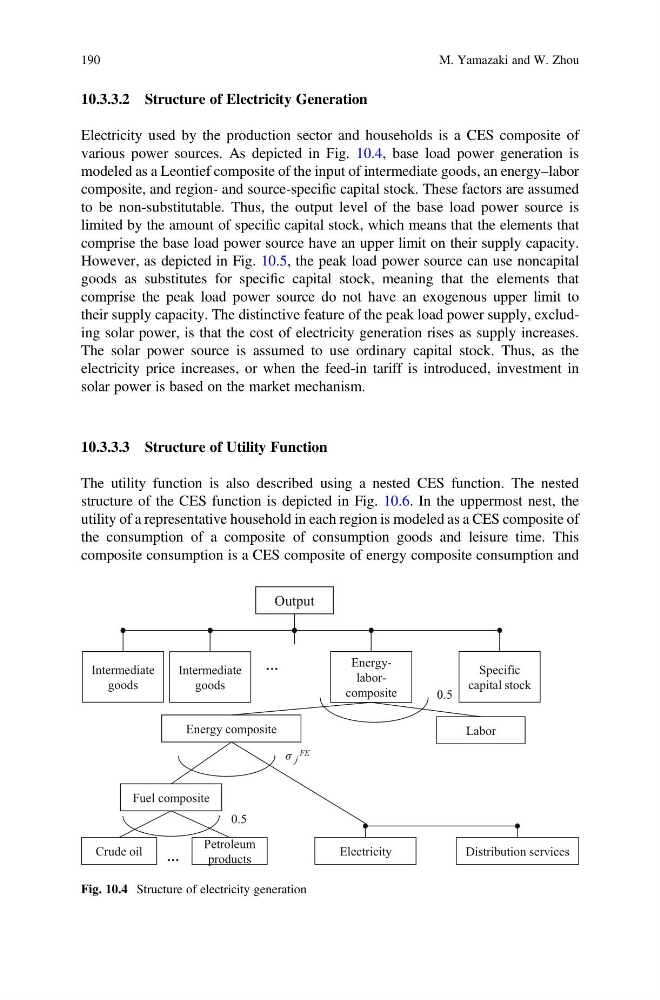
various power sources. As depicted in Fig. 10.4, base load power generation is
modeled as a Leontief composite of the input of intermediate goods, an energy–labor
composite, and region- and source-specific capital stock. These factors are assumed
to be non-substitutable. Thus, the output level of the base load power source is
limited by the amount of specific capital stock, which means that the elements that
comprise the base load power source have an upper limit on their supply capacity.
However, as depicted in Fig. 10.5, the peak load power source can use noncapital
goods as substitutes for specific capital stock, meaning that the elements that
comprise the peak load power source do not have an exogenous upper limit to
their supply capacity. The distinctive feature of the peak load power supply, excluding solar power, is that the cost of electricity generation rises as supply increases.
The solar power source is assumed to use ordinary capital stock. Thus, as the
electricity price increases, or when the feed-in tariff is introduced, investment in
solar power is based on the market mechanism.
10.3.3.3 Structure of Utility Function
The utility function is also described using a nested CES function. The nested
structure of the CES function is depicted in Fig. 10.6. In the uppermost nest, the
utility of a representative household in each region is modeled as a CES composite of
the consumption of a composite of consumption goods and leisure time. This
composite consumption is a CES composite of energy composite consumption and
Output
Intermediate
goods
Intermediate
goods
…
Energy composite
Labor
Fuel composite
Crude oil
Petroleum
products
Electricity
0.5
0.5
Distribution services
Specific
capital stock
laborcomposite
σ
FE
…
Fig. 10.4 Structure of electricity generation
190
M. Yamazaki and W. Zhou
Electricity used by the production sector and households is a CES composite of
various power sources. As depicted in Fig. 10.4, base load power generation is
modeled as a Leontief composite of the input of intermediate goods, an energy–labor
composite, and region- and source-specific capital stock. These factors are assumed
to be non-substitutable. Thus, the output level of the base load power source is
limited by the amount of specific capital stock, which means that the elements that
comprise the base load power source have an upper limit on their supply capacity.
However, as depicted in Fig. 10.5, the peak load power source can use noncapital
goods as substitutes for specific capital stock, meaning that the elements that
comprise the peak load power source do not have an exogenous upper limit to
their supply capacity. The distinctive feature of the peak load power supply, excluding solar power, is that the cost of electricity generation rises as supply increases.
The solar power source is assumed to use ordinary capital stock. Thus, as the
electricity price increases, or when the feed-in tariff is introduced, investment in
solar power is based on the market mechanism.
10.3.3.3 Structure of Utility Function
The utility function is also described using a nested CES function. The nested
structure of the CES function is depicted in Fig. 10.6. In the uppermost nest, the
utility of a representative household in each region is modeled as a CES composite of
the consumption of a composite of consumption goods and leisure time. This
composite consumption is a CES composite of energy composite consumption and
Output
Intermediate
goods
Intermediate
goods
…
Energy composite
Labor
Fuel composite
Crude oil
Petroleum
products
Electricity
0.5
0.5
Distribution services
Specific
capital stock
laborcomposite
σ
FE
…
Fig. 10.4 Structure of electricity generation
190
M. Yamazaki and W. Zhou