

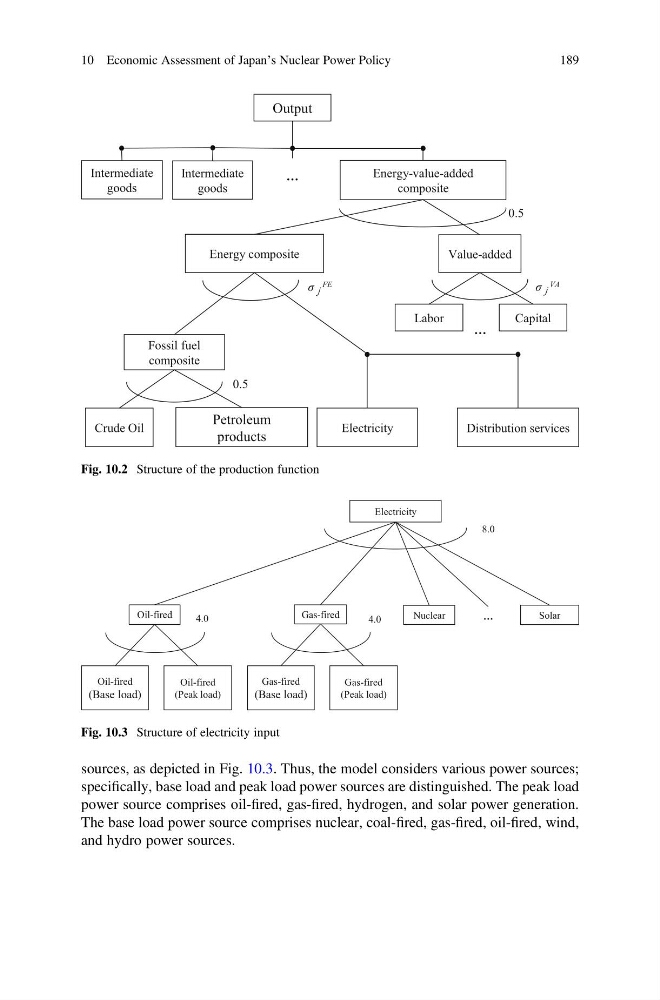
sources, as depicted in Fig. 10.3. Thus, the model considers various power sources;
specifically, base load and peak load power sources are distinguished. The peak load
power source comprises oil-fired, gas-fired, hydrogen, and solar power generation.
The base load power source comprises nuclear, coal-fired, gas-fired, oil-fired, wind,
and hydro power sources.
Output
Intermediate
goods
Intermediate
goods
…
Energy composite
Value-added
Fossil fuel
composite
Labor
Capital
Crude Oil
Petroleum
products
Electricity
0.5
σ
VA
0.5
…
Distribution services
Energy-value-added
composite
σ
FE
Fig. 10.2 Structure of the production function
Electricity
Solar
Nuclear
…
4.0
Gas-fired
(Peak load)
Gas-fired
(Base load)
Gas-fired
Oil-fired
(Peak load)
Oil-fired
(Base load)
Oil-fired
4.0
8.0
Fig. 10.3 Structure of electricity input
10 Economic Assessment of Japan’s Nuclear Power Policy
189
specifically, base load and peak load power sources are distinguished. The peak load
power source comprises oil-fired, gas-fired, hydrogen, and solar power generation.
The base load power source comprises nuclear, coal-fired, gas-fired, oil-fired, wind,
and hydro power sources.
Output
Intermediate
goods
Intermediate
goods
…
Energy composite
Value-added
Fossil fuel
composite
Labor
Capital
Crude Oil
Petroleum
products
Electricity
0.5
σ
VA
0.5
…
Distribution services
Energy-value-added
composite
σ
FE
Fig. 10.2 Structure of the production function
Electricity
Solar
Nuclear
…
4.0
Gas-fired
(Peak load)
Gas-fired
(Base load)
Gas-fired
Oil-fired
(Peak load)
Oil-fired
(Base load)
Oil-fired
4.0
8.0
Fig. 10.3 Structure of electricity input
10 Economic Assessment of Japan’s Nuclear Power Policy
189