

8.2.2 Life Cycle of Carbon Capture Technology
The concept of technology life cycles as a means to measure technological changes
was proposed by Little (1981). The life cycle of a technology includes two dimensions and four stages. The two dimensions are competitive impact and integration in
products or processes—a patent can be regarded as a product of innovation. The four
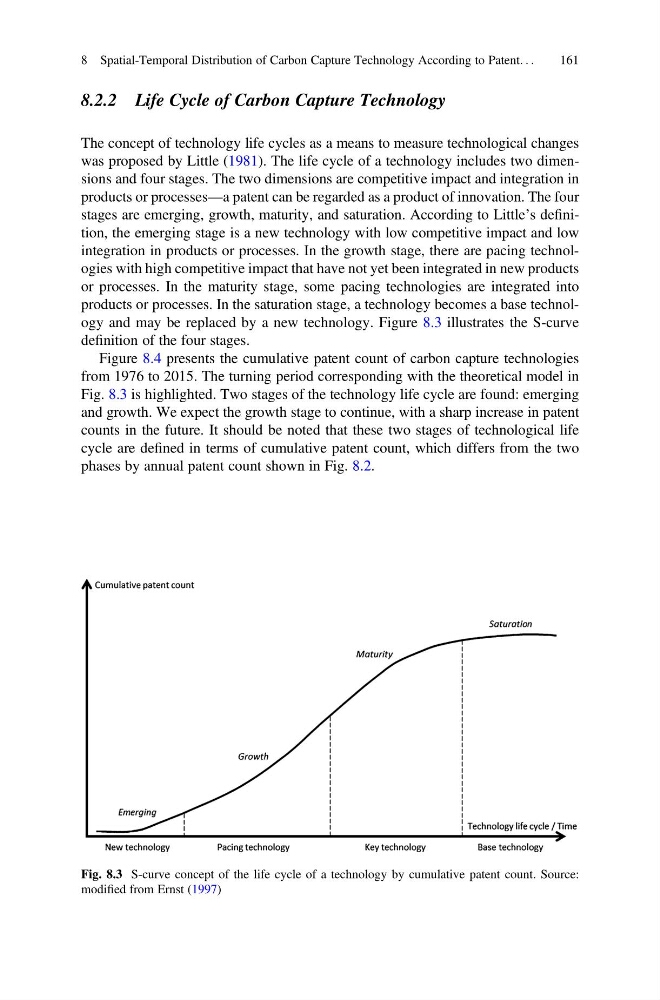
stages are emerging, growth, maturity, and saturation. According to Little’s definition, the emerging stage is a new technology with low competitive impact and low
integration in products or processes. In the growth stage, there are pacing technologies with high competitive impact that have not yet been integrated in new products
or processes. In the maturity stage, some pacing technologies are integrated into
products or processes. In the saturation stage, a technology becomes a base technology and may be replaced by a new technology. Figure 8.3 illustrates the S-curve
definition of the four stages.
Figure 8.4 presents the cumulative patent count of carbon capture technologies
from 1976 to 2015. The turning period corresponding with the theoretical model in
Fig. 8.3 is highlighted. Two stages of the technology life cycle are found: emerging
and growth. We expect the growth stage to continue, with a sharp increase in patent
counts in the future. It should be noted that these two stages of technological life
cycle are defined in terms of cumulative patent count, which differs from the two
phases by annual patent count shown in Fig. 8.2.
Fig. 8.3 S-curve concept of the life cycle of a technology by cumulative patent count. Source:
modified from Ernst (1997)
8 Spatial-Temporal Distribution of Carbon Capture Technology According to Patent. . .
161
The concept of technology life cycles as a means to measure technological changes
was proposed by Little (1981). The life cycle of a technology includes two dimensions and four stages. The two dimensions are competitive impact and integration in
products or processes—a patent can be regarded as a product of innovation. The four
stages are emerging, growth, maturity, and saturation. According to Little’s definition, the emerging stage is a new technology with low competitive impact and low
integration in products or processes. In the growth stage, there are pacing technologies with high competitive impact that have not yet been integrated in new products
or processes. In the maturity stage, some pacing technologies are integrated into
products or processes. In the saturation stage, a technology becomes a base technology and may be replaced by a new technology. Figure 8.3 illustrates the S-curve
definition of the four stages.
Figure 8.4 presents the cumulative patent count of carbon capture technologies
from 1976 to 2015. The turning period corresponding with the theoretical model in
Fig. 8.3 is highlighted. Two stages of the technology life cycle are found: emerging
and growth. We expect the growth stage to continue, with a sharp increase in patent
counts in the future. It should be noted that these two stages of technological life
cycle are defined in terms of cumulative patent count, which differs from the two
phases by annual patent count shown in Fig. 8.2.
Fig. 8.3 S-curve concept of the life cycle of a technology by cumulative patent count. Source:
modified from Ernst (1997)
8 Spatial-Temporal Distribution of Carbon Capture Technology According to Patent. . .
161