

8.1 Basic Principles of Mitigation and Adaptation
Technology
8.1.1 Climate Change and CCS
The warmest year ever recorded was 2015 (WMO 2016). Most of the observed
increase in global average temperatures since the mid-twentieth century is very
likely (>90% probability) due to observed increases in anthropogenic greenhouse
gas (GHG) concentrations (IPCC 2008). The climate will continue to change over
the coming decades as increasing amounts of heat-trapping GHGs emitted by
anthropogenic activities accumulate in the atmosphere. If costs are disregarded,
excessive GHG concentrations can be reduced by 15 available technologies, including carbon dioxide capture and storage (CCS) (Socolow and Pacala 2006). CCS is a
currently available technology that can allow industrial sectors (e.g., fossil fuel
power generation, iron, steel, and cement manufacture, natural gas processing, oil
refining) to meet ambitious emission reduction goals. CCS can contribute one-sixth
of the CO 2 emission reductions required by 2050 and can contribute 14% of
cumulative emissions reductions between 2015 and 2050 compared to a businessas-usual approach, which would correspond to a 6
C rise in average global
temperature (IEA 2012).
CCS is not a single technology but involves integrated implementation of the
following processes: separation of CO 2 from mixtures of gases (e.g., flue gases from
a power station or a stream of CO 2 -rich natural gas) and compression of this CO 2 to a
liquid-like state; transport of the CO 2 to a suitable storage site; and injection of the
CO 2 into a geologic formation where it is retained by a natural (or engineered)
trapping mechanism and monitored as necessary (IEA 2013). To enhance CO 2
usage, it is integrated into CCS as CCUS in some countries, allowing CO 2 to be
used in fields such as enhanced oil recovery (EOR), enhanced coal-bed methane
(ECBM), CO 2 chemical utilization, and CO 2 biotransformation. There is essentially
no difference between CCS and CCUS.
Many CCS technologies are commercially available and can be applied across
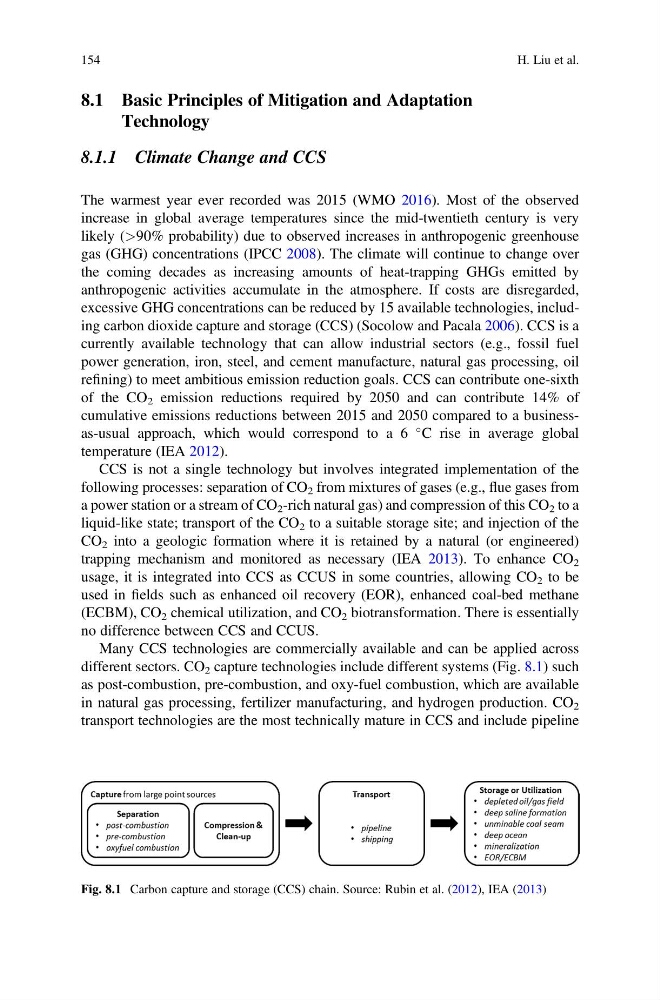
different sectors. CO 2 capture technologies include different systems (Fig. 8.1) such
as post-combustion, pre-combustion, and oxy-fuel combustion, which are available
in natural gas processing, fertilizer manufacturing, and hydrogen production. CO 2
transport technologies are the most technically mature in CCS and include pipeline
Fig. 8.1 Carbon capture and storage (CCS) chain. Source: Rubin et al. (2012), IEA (2013)
154
H. Liu et al.
Technology
8.1.1 Climate Change and CCS
The warmest year ever recorded was 2015 (WMO 2016). Most of the observed
increase in global average temperatures since the mid-twentieth century is very
likely (>90% probability) due to observed increases in anthropogenic greenhouse
gas (GHG) concentrations (IPCC 2008). The climate will continue to change over
the coming decades as increasing amounts of heat-trapping GHGs emitted by
anthropogenic activities accumulate in the atmosphere. If costs are disregarded,
excessive GHG concentrations can be reduced by 15 available technologies, including carbon dioxide capture and storage (CCS) (Socolow and Pacala 2006). CCS is a
currently available technology that can allow industrial sectors (e.g., fossil fuel
power generation, iron, steel, and cement manufacture, natural gas processing, oil
refining) to meet ambitious emission reduction goals. CCS can contribute one-sixth
of the CO 2 emission reductions required by 2050 and can contribute 14% of
cumulative emissions reductions between 2015 and 2050 compared to a businessas-usual approach, which would correspond to a 6
C rise in average global
temperature (IEA 2012).
CCS is not a single technology but involves integrated implementation of the
following processes: separation of CO 2 from mixtures of gases (e.g., flue gases from
a power station or a stream of CO 2 -rich natural gas) and compression of this CO 2 to a
liquid-like state; transport of the CO 2 to a suitable storage site; and injection of the
CO 2 into a geologic formation where it is retained by a natural (or engineered)
trapping mechanism and monitored as necessary (IEA 2013). To enhance CO 2
usage, it is integrated into CCS as CCUS in some countries, allowing CO 2 to be
used in fields such as enhanced oil recovery (EOR), enhanced coal-bed methane
(ECBM), CO 2 chemical utilization, and CO 2 biotransformation. There is essentially
no difference between CCS and CCUS.
Many CCS technologies are commercially available and can be applied across
different sectors. CO 2 capture technologies include different systems (Fig. 8.1) such
as post-combustion, pre-combustion, and oxy-fuel combustion, which are available
in natural gas processing, fertilizer manufacturing, and hydrogen production. CO 2
transport technologies are the most technically mature in CCS and include pipeline
Fig. 8.1 Carbon capture and storage (CCS) chain. Source: Rubin et al. (2012), IEA (2013)
154
H. Liu et al.