

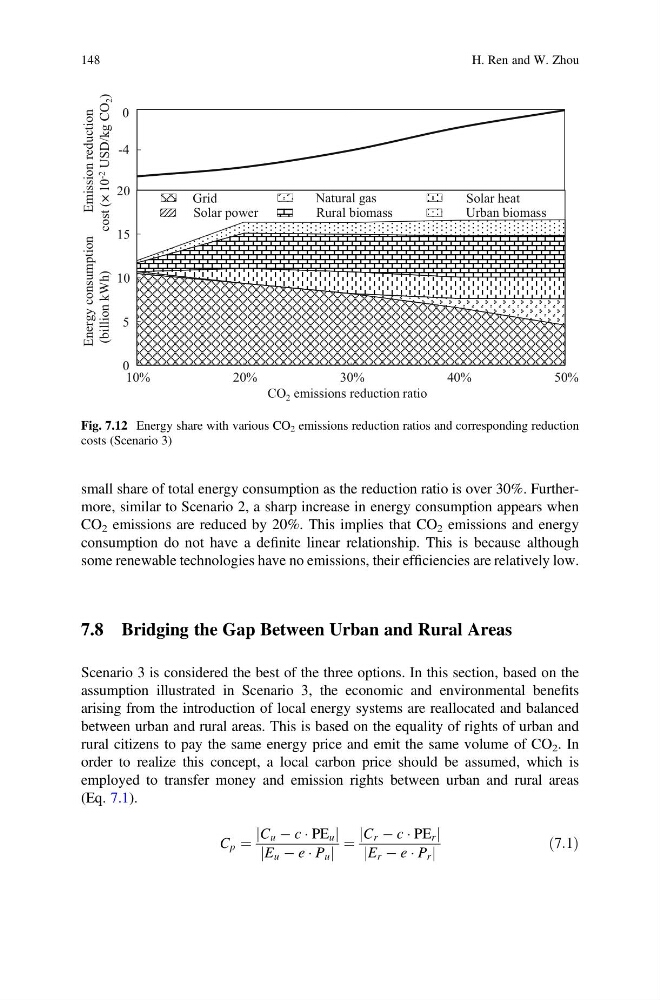
small share of total energy consumption as the reduction ratio is over 30%. Furthermore, similar to Scenario 2, a sharp increase in energy consumption appears when
CO 2 emissions are reduced by 20%. This implies that CO 2 emissions and energy
consumption do not have a definite linear relationship. This is because although
some renewable technologies have no emissions, their efficiencies are relatively low.
7.8 Bridging the Gap Between Urban and Rural Areas
Scenario 3 is considered the best of the three options. In this section, based on the
assumption illustrated in Scenario 3, the economic and environmental benefits
arising from the introduction of local energy systems are reallocated and balanced
between urban and rural areas. This is based on the equality of rights of urban and
rural citizens to pay the same energy price and emit the same volume of CO 2 . In
order to realize this concept, a local carbon price should be assumed, which is
employed to transfer money and emission rights between urban and rural areas
(Eq. 7.1).
C p ¼
C u À c Á PE u
j
j
E u À e Á P u
j
j
¼
C r À c Á PE r
j
j
E r À e Á P r
j
j
ð7:1Þ
0
5
10
15
20
10%
20%
30%
40%
50%
CO 2 emissions reduction ratio
-4
0
Grid
Natural gas
Solar heat
Solar power
Rural biomass
Urban biomass
Energy consumption
(billion kWh)
Emission reduction
cost (× 10 -2
USD/kg CO
2 )
Fig. 7.12 Energy share with various CO 2 emissions reduction ratios and corresponding reduction
costs (Scenario 3)
148
H. Ren and W. Zhou
CO 2 emissions are reduced by 20%. This implies that CO 2 emissions and energy
consumption do not have a definite linear relationship. This is because although
some renewable technologies have no emissions, their efficiencies are relatively low.
7.8 Bridging the Gap Between Urban and Rural Areas
Scenario 3 is considered the best of the three options. In this section, based on the
assumption illustrated in Scenario 3, the economic and environmental benefits
arising from the introduction of local energy systems are reallocated and balanced
between urban and rural areas. This is based on the equality of rights of urban and
rural citizens to pay the same energy price and emit the same volume of CO 2 . In
order to realize this concept, a local carbon price should be assumed, which is
employed to transfer money and emission rights between urban and rural areas
(Eq. 7.1).
C p ¼
C u À c Á PE u
j
j
E u À e Á P u
j
j
¼
C r À c Á PE r
j
j
E r À e Á P r
j
j
ð7:1Þ
0
5
10
15
20
10%
20%
30%
40%
50%
CO 2 emissions reduction ratio
-4
0
Grid
Natural gas
Solar heat
Solar power
Rural biomass
Urban biomass
Energy consumption
(billion kWh)
Emission reduction
cost (× 10 -2
USD/kg CO
2 )
Fig. 7.12 Energy share with various CO 2 emissions reduction ratios and corresponding reduction
costs (Scenario 3)
148
H. Ren and W. Zhou