

6.4 Constraints
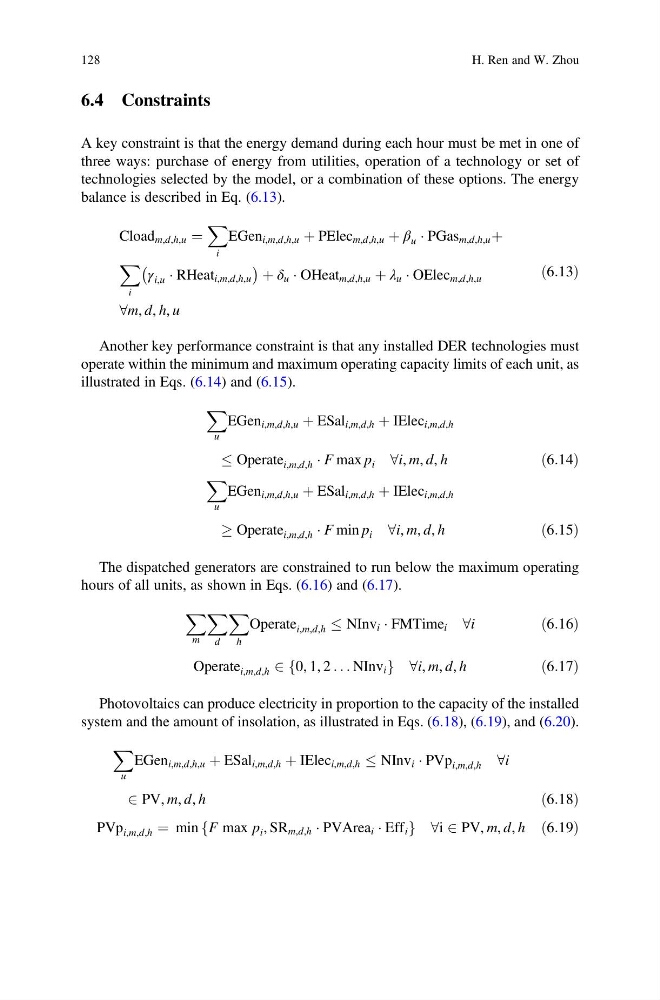
A key constraint is that the energy demand during each hour must be met in one of
three ways: purchase of energy from utilities, operation of a technology or set of
technologies selected by the model, or a combination of these options. The energy
balance is described in Eq. (6.13).
Cload m,d,h,u ¼
X
i
EGen i,m,d,h,u þ PElec m,d,h,u þ β u Á PGas m,d,h,u þ
X
i
γ i,u Á RHeat i,m,d,h,u
À
Á þ δ u Á OHeat m,d,h,u þ λ u Á OElec m,d,h,u
8m, d, h, u
ð6:13Þ
Another key performance constraint is that any installed DER technologies must
operate within the minimum and maximum operating capacity limits of each unit, as
illustrated in Eqs. (6.14) and (6.15).
X
u
EGen i,m,d,h,u þ ESal i,m,d,h þ IElec i,m,d,h
Operate i,m,d,h Á F max p i 8i, m, d, h
ð6:14Þ
X
u
EGen i,m,d,h,u þ ESal i,m,d,h þ IElec i,m,d,h
! Operate i,m,d,h Á F min p i 8i, m, d, h
ð6:15Þ
The dispatched generators are constrained to run below the maximum operating
hours of all units, as shown in Eqs. (6.16) and (6.17).
X
m
X
d
X
h
Operate i,m,d,h NInv i Á FMTime i 8i
ð6:16Þ
Operate i,m,d,h 2 0, 1, 2 . . . NInv i
f
g 8i, m, d, h
ð6:17Þ
Photovoltaics can produce electricity in proportion to the capacity of the installed
system and the amount of insolation, as illustrated in Eqs. (6.18), (6.19), and (6.20).
X
u
EGen i,m,d,h,u þ ESal i,m,d,h þ IElec i,m,d,h NInv i Á PVp i,m,d,h 8i
2 PV, m, d, h
ð6:18Þ
PVp i,m,d,h ¼ min F max p i , SR m,d,h Á PVArea i Á Eff i
f
g 8i 2 PV, m, d, h ð6:19Þ
128
H. Ren and W. Zhou
A key constraint is that the energy demand during each hour must be met in one of
three ways: purchase of energy from utilities, operation of a technology or set of
technologies selected by the model, or a combination of these options. The energy
balance is described in Eq. (6.13).
Cload m,d,h,u ¼
X
i
EGen i,m,d,h,u þ PElec m,d,h,u þ β u Á PGas m,d,h,u þ
X
i
γ i,u Á RHeat i,m,d,h,u
À
Á þ δ u Á OHeat m,d,h,u þ λ u Á OElec m,d,h,u
8m, d, h, u
ð6:13Þ
Another key performance constraint is that any installed DER technologies must
operate within the minimum and maximum operating capacity limits of each unit, as
illustrated in Eqs. (6.14) and (6.15).
X
u
EGen i,m,d,h,u þ ESal i,m,d,h þ IElec i,m,d,h
Operate i,m,d,h Á F max p i 8i, m, d, h
ð6:14Þ
X
u
EGen i,m,d,h,u þ ESal i,m,d,h þ IElec i,m,d,h
! Operate i,m,d,h Á F min p i 8i, m, d, h
ð6:15Þ
The dispatched generators are constrained to run below the maximum operating
hours of all units, as shown in Eqs. (6.16) and (6.17).
X
m
X
d
X
h
Operate i,m,d,h NInv i Á FMTime i 8i
ð6:16Þ
Operate i,m,d,h 2 0, 1, 2 . . . NInv i
f
g 8i, m, d, h
ð6:17Þ
Photovoltaics can produce electricity in proportion to the capacity of the installed
system and the amount of insolation, as illustrated in Eqs. (6.18), (6.19), and (6.20).
X
u
EGen i,m,d,h,u þ ESal i,m,d,h þ IElec i,m,d,h NInv i Á PVp i,m,d,h 8i
2 PV, m, d, h
ð6:18Þ
PVp i,m,d,h ¼ min F max p i , SR m,d,h Á PVArea i Á Eff i
f
g 8i 2 PV, m, d, h ð6:19Þ
128
H. Ren and W. Zhou