

5.2 Atomic Case
89
As evident from the functional form, two solutions of ω
2
≥ 0 exist depending on the
sign for each q. These respective solutions as continuous functions of q are called
branches. The appearance of two branches originates in the presence of two atoms
in a unit periodicity a. Indeed, if m = M, the two branches smoothly connect at
q = π/a, resulting in the same dispersion relation as Eq. 5.6 after the transformation
a
2
→ a.
The eigenvector of Eq. 5.17 determines a relative magnitude between r
0 and R
0 as
a function of q. For example, at q = 0, unnormalized eigenvectors corresponding to
ω − = 0 and ω + = [k(m + M)/m M]
1/2 are (1, 1), and (1, −m/M), respectively. The
ω − branch is usually called the acoustic branch because it represents a compression
wave (sound wave) at a long wavelength compared to the atomic spacing a/2. The
dispersion relation of the sound wave must be connected to the uniform translation
of the array at q = 0. Consequently, only a single acoustic branch exists irrespective
of the number of atoms in unit periodicity. The phase velocity of the branch at q = 0
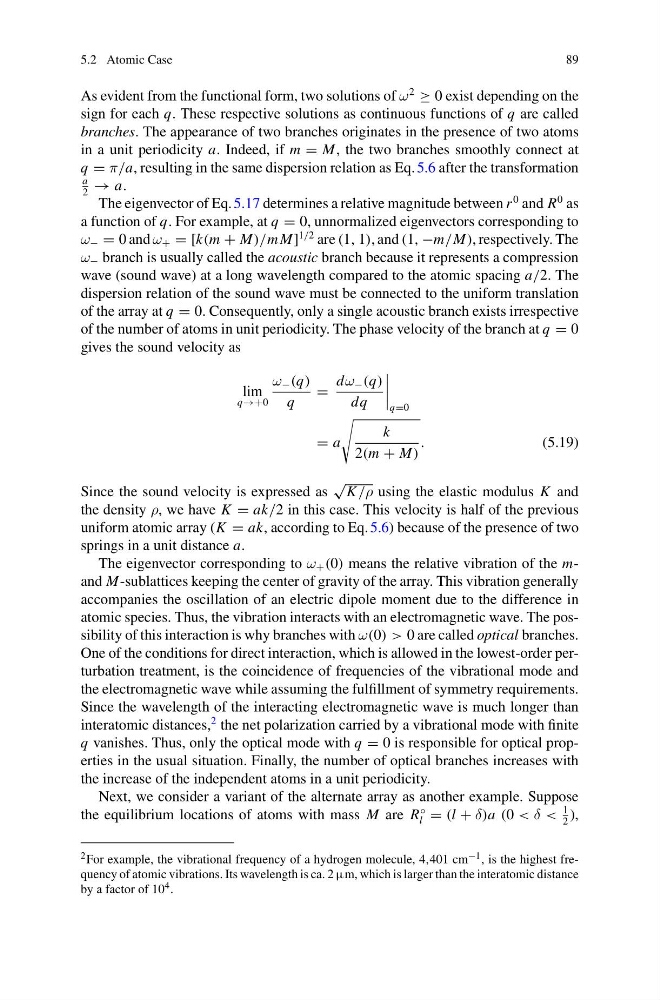
gives the sound velocity as
lim
q→+0
ω − (q)
q
=
dω − (q)
dq
q=0
= a
k
2(m + M)
.
(5.19)
Since the sound velocity is expressed as
√
K /ρ using the elastic modulus K and
the density ρ, we have K = ak/2 in this case. This velocity is half of the previous
uniform atomic array (K = ak, according to Eq. 5.6) because of the presence of two
springs in a unit distance a.
The eigenvector corresponding to ω + (0) means the relative vibration of the mand M-sublattices keeping the center of gravity of the array. This vibration generally
accompanies the oscillation of an electric dipole moment due to the difference in
atomic species. Thus, the vibration interacts with an electromagnetic wave. The possibility of this interaction is why branches with ω(0) > 0 are called optical branches.
One of the conditions for direct interaction, which is allowed in the lowest-order perturbation treatment, is the coincidence of frequencies of the vibrational mode and
the electromagnetic wave while assuming the fulfillment of symmetry requirements.
Since the wavelength of the interacting electromagnetic wave is much longer than
interatomic distances,
2 the net polarization carried by a vibrational mode with finite
q vanishes. Thus, only the optical mode with q = 0 is responsible for optical properties in the usual situation. Finally, the number of optical branches increases with
the increase of the independent atoms in a unit periodicity.
Next, we consider a variant of the alternate array as another example. Suppose
the equilibrium locations of atoms with mass M are R
◦
l = (l + δ)a (0 < δ <
1
2
),
2 For example, the vibrational frequency of a hydrogen molecule, 4,401 cm −1 , is the highest frequency of atomic vibrations. Its wavelength is ca. 2 µm, which is larger than the interatomic distance
by a factor of 10 4 .
89
As evident from the functional form, two solutions of ω
2
≥ 0 exist depending on the
sign for each q. These respective solutions as continuous functions of q are called
branches. The appearance of two branches originates in the presence of two atoms
in a unit periodicity a. Indeed, if m = M, the two branches smoothly connect at
q = π/a, resulting in the same dispersion relation as Eq. 5.6 after the transformation
a
2
→ a.
The eigenvector of Eq. 5.17 determines a relative magnitude between r
0 and R
0 as
a function of q. For example, at q = 0, unnormalized eigenvectors corresponding to
ω − = 0 and ω + = [k(m + M)/m M]
1/2 are (1, 1), and (1, −m/M), respectively. The
ω − branch is usually called the acoustic branch because it represents a compression
wave (sound wave) at a long wavelength compared to the atomic spacing a/2. The
dispersion relation of the sound wave must be connected to the uniform translation
of the array at q = 0. Consequently, only a single acoustic branch exists irrespective
of the number of atoms in unit periodicity. The phase velocity of the branch at q = 0
gives the sound velocity as
lim
q→+0
ω − (q)
q
=
dω − (q)
dq
q=0
= a
k
2(m + M)
.
(5.19)
Since the sound velocity is expressed as
√
K /ρ using the elastic modulus K and
the density ρ, we have K = ak/2 in this case. This velocity is half of the previous
uniform atomic array (K = ak, according to Eq. 5.6) because of the presence of two
springs in a unit distance a.
The eigenvector corresponding to ω + (0) means the relative vibration of the mand M-sublattices keeping the center of gravity of the array. This vibration generally
accompanies the oscillation of an electric dipole moment due to the difference in
atomic species. Thus, the vibration interacts with an electromagnetic wave. The possibility of this interaction is why branches with ω(0) > 0 are called optical branches.
One of the conditions for direct interaction, which is allowed in the lowest-order perturbation treatment, is the coincidence of frequencies of the vibrational mode and
the electromagnetic wave while assuming the fulfillment of symmetry requirements.
Since the wavelength of the interacting electromagnetic wave is much longer than
interatomic distances,
2 the net polarization carried by a vibrational mode with finite
q vanishes. Thus, only the optical mode with q = 0 is responsible for optical properties in the usual situation. Finally, the number of optical branches increases with
the increase of the independent atoms in a unit periodicity.
Next, we consider a variant of the alternate array as another example. Suppose
the equilibrium locations of atoms with mass M are R
◦
l = (l + δ)a (0 < δ <
1
2
),
2 For example, the vibrational frequency of a hydrogen molecule, 4,401 cm −1 , is the highest frequency of atomic vibrations. Its wavelength is ca. 2 µm, which is larger than the interatomic distance
by a factor of 10 4 .