

90
5 Lattice Dynamics of Molecular Crystals
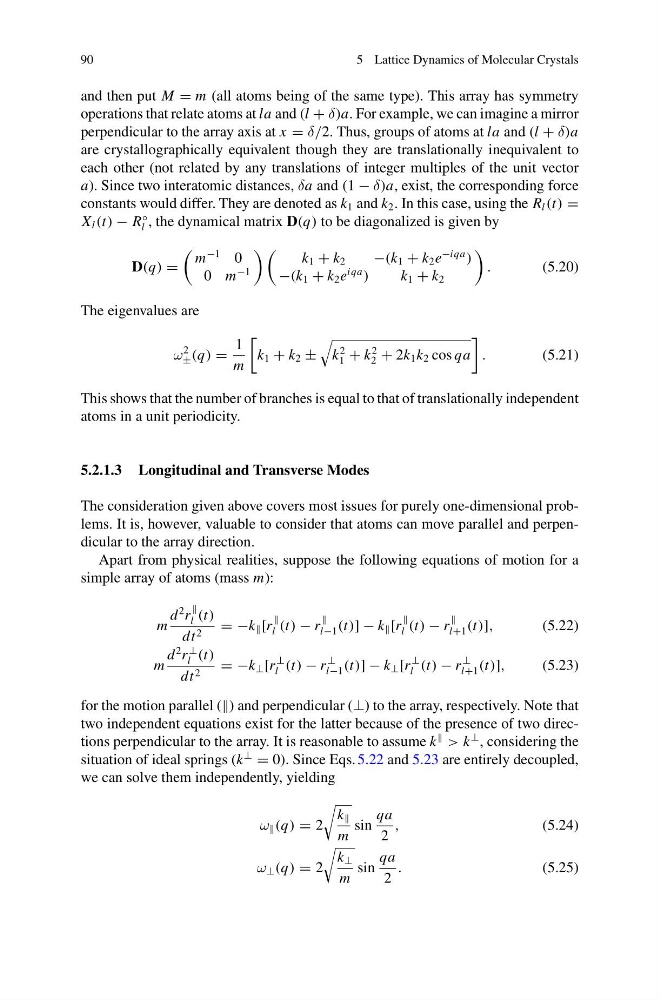
and then put M = m (all atoms being of the same type). This array has symmetry
operations that relate atoms at la and (l + δ)a. For example, we can imagine a mirror
perpendicular to the array axis at x = δ/2. Thus, groups of atoms at la and (l + δ)a
are crystallographically equivalent though they are translationally inequivalent to
each other (not related by any translations of integer multiples of the unit vector
a). Since two interatomic distances, δa and (1 − δ)a, exist, the corresponding force
constants would differ. They are denoted as k 1 and k 2 . In this case, using the R l (t) =
X l (t) − R
◦
l , the dynamical matrix D(q) to be diagonalized is given by
D(q) =
m
−1 0
0 m
−1
k 1 + k 2
−(k 1 + k 2 e
−iqa
)
−(k 1 + k 2 e
iqa
)
k 1 + k 2
.
(5.20)
The eigenvalues are
ω
2
± (q) =
1
m
k 1 + k 2 ±
k
2
1 + k
2
2 + 2k 1 k 2 cos qa
.
(5.21)
This shows that the number of branches is equal to that of translationally independent
atoms in a unit periodicity.
5.2.1.3 Longitudinal and Transverse Modes
The consideration given above covers most issues for purely one-dimensional problems. It is, however, valuable to consider that atoms can move parallel and perpendicular to the array direction.
Apart from physical realities, suppose the following equations of motion for a
simple array of atoms (mass m):
m
d
2 r
l (t)
dt 2 = −k [r
l (t) − r
l−1 (t)] − k [r
l (t) − r
l+1 (t)],
(5.22)
m
d
2 r
⊥
l (t)
dt 2 = −k ⊥ [r
⊥
l (t) − r
⊥
l−1 (t)] − k ⊥ [r
⊥
l (t) − r
⊥
l+1 (t)],
(5.23)
for the motion parallel () and perpendicular (⊥) to the array, respectively. Note that
two independent equations exist for the latter because of the presence of two directions perpendicular to the array. It is reasonable to assume k
> k
⊥ , considering the
situation of ideal springs (k
⊥
= 0). Since Eqs. 5.22 and 5.23 are entirely decoupled,
we can solve them independently, yielding
ω (q) = 2
k
m
sin
qa
2
,
(5.24)
ω ⊥ (q) = 2
k ⊥
m
sin
qa
2
.
(5.25)
5 Lattice Dynamics of Molecular Crystals
and then put M = m (all atoms being of the same type). This array has symmetry
operations that relate atoms at la and (l + δ)a. For example, we can imagine a mirror
perpendicular to the array axis at x = δ/2. Thus, groups of atoms at la and (l + δ)a
are crystallographically equivalent though they are translationally inequivalent to
each other (not related by any translations of integer multiples of the unit vector
a). Since two interatomic distances, δa and (1 − δ)a, exist, the corresponding force
constants would differ. They are denoted as k 1 and k 2 . In this case, using the R l (t) =
X l (t) − R
◦
l , the dynamical matrix D(q) to be diagonalized is given by
D(q) =
m
−1 0
0 m
−1
k 1 + k 2
−(k 1 + k 2 e
−iqa
)
−(k 1 + k 2 e
iqa
)
k 1 + k 2
.
(5.20)
The eigenvalues are
ω
2
± (q) =
1
m
k 1 + k 2 ±
k
2
1 + k
2
2 + 2k 1 k 2 cos qa
.
(5.21)
This shows that the number of branches is equal to that of translationally independent
atoms in a unit periodicity.
5.2.1.3 Longitudinal and Transverse Modes
The consideration given above covers most issues for purely one-dimensional problems. It is, however, valuable to consider that atoms can move parallel and perpendicular to the array direction.
Apart from physical realities, suppose the following equations of motion for a
simple array of atoms (mass m):
m
d
2 r
l (t)
dt 2 = −k [r
l (t) − r
l−1 (t)] − k [r
l (t) − r
l+1 (t)],
(5.22)
m
d
2 r
⊥
l (t)
dt 2 = −k ⊥ [r
⊥
l (t) − r
⊥
l−1 (t)] − k ⊥ [r
⊥
l (t) − r
⊥
l+1 (t)],
(5.23)
for the motion parallel () and perpendicular (⊥) to the array, respectively. Note that
two independent equations exist for the latter because of the presence of two directions perpendicular to the array. It is reasonable to assume k
> k
⊥ , considering the
situation of ideal springs (k
⊥
= 0). Since Eqs. 5.22 and 5.23 are entirely decoupled,
we can solve them independently, yielding
ω (q) = 2
k
m
sin
qa
2
,
(5.24)
ω ⊥ (q) = 2
k ⊥
m
sin
qa
2
.
(5.25)