

80
4 Molecular Crystals
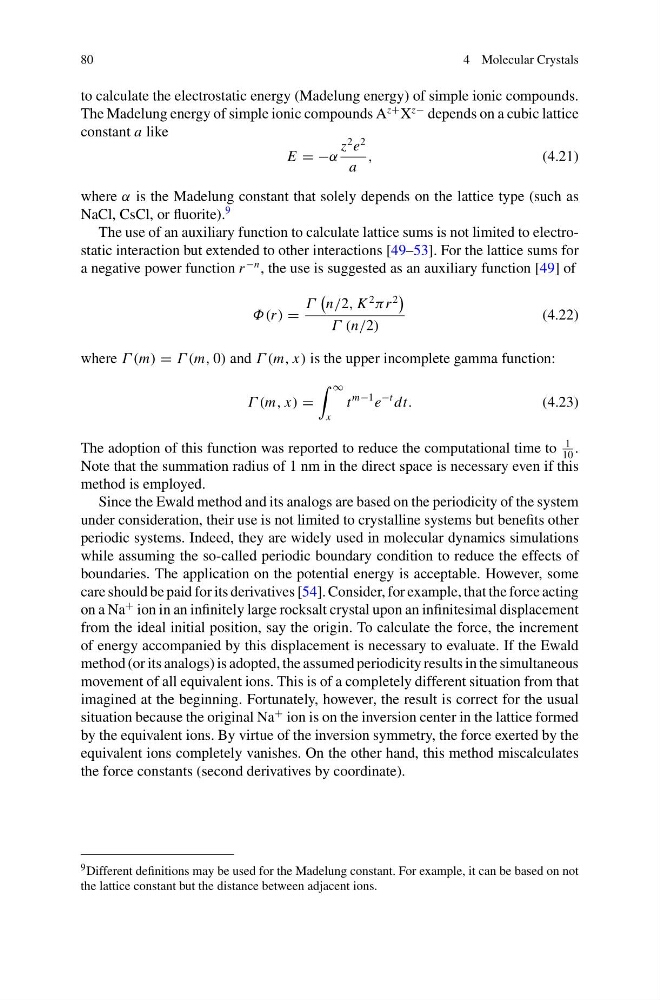
to calculate the electrostatic energy (Madelung energy) of simple ionic compounds.
The Madelung energy of simple ionic compounds A
z+ X
z− depends on a cubic lattice
constant a like
E = −α
z
2 e
2
a
,
(4.21)
where α is the Madelung constant that solely depends on the lattice type (such as
NaCl, CsCl, or fluorite).
9
The use of an auxiliary function to calculate lattice sums is not limited to electrostatic interaction but extended to other interactions [49–53]. For the lattice sums for
a negative power function r
−n , the use is suggested as an auxiliary function [49] of
Φ(r ) =
Γ
n/2, K
2
πr
2
Γ (n/2)
(4.22)
where Γ (m) = Γ (m, 0) and Γ (m, x) is the upper incomplete gamma function:
Γ (m, x) =
∞
x
t
m−1 e
−t dt.
(4.23)
The adoption of this function was reported to reduce the computational time to
1
10
.
Note that the summation radius of 1 nm in the direct space is necessary even if this
method is employed.
Since the Ewald method and its analogs are based on the periodicity of the system
under consideration, their use is not limited to crystalline systems but benefits other
periodic systems. Indeed, they are widely used in molecular dynamics simulations
while assuming the so-called periodic boundary condition to reduce the effects of
boundaries. The application on the potential energy is acceptable. However, some
care should be paid for its derivatives [54]. Consider, for example, that the force acting
on a Na
+ ion in an infinitely large rocksalt crystal upon an infinitesimal displacement
from the ideal initial position, say the origin. To calculate the force, the increment
of energy accompanied by this displacement is necessary to evaluate. If the Ewald
method (or its analogs) is adopted, the assumed periodicity results in the simultaneous
movement of all equivalent ions. This is of a completely different situation from that
imagined at the beginning. Fortunately, however, the result is correct for the usual
situation because the original Na
+ ion is on the inversion center in the lattice formed
by the equivalent ions. By virtue of the inversion symmetry, the force exerted by the
equivalent ions completely vanishes. On the other hand, this method miscalculates
the force constants (second derivatives by coordinate).
9 Different definitions may be used for the Madelung constant. For example, it can be based on not
the lattice constant but the distance between adjacent ions.
4 Molecular Crystals
to calculate the electrostatic energy (Madelung energy) of simple ionic compounds.
The Madelung energy of simple ionic compounds A
z+ X
z− depends on a cubic lattice
constant a like
E = −α
z
2 e
2
a
,
(4.21)
where α is the Madelung constant that solely depends on the lattice type (such as
NaCl, CsCl, or fluorite).
9
The use of an auxiliary function to calculate lattice sums is not limited to electrostatic interaction but extended to other interactions [49–53]. For the lattice sums for
a negative power function r
−n , the use is suggested as an auxiliary function [49] of
Φ(r ) =
Γ
n/2, K
2
πr
2
Γ (n/2)
(4.22)
where Γ (m) = Γ (m, 0) and Γ (m, x) is the upper incomplete gamma function:
Γ (m, x) =
∞
x
t
m−1 e
−t dt.
(4.23)
The adoption of this function was reported to reduce the computational time to
1
10
.
Note that the summation radius of 1 nm in the direct space is necessary even if this
method is employed.
Since the Ewald method and its analogs are based on the periodicity of the system
under consideration, their use is not limited to crystalline systems but benefits other
periodic systems. Indeed, they are widely used in molecular dynamics simulations
while assuming the so-called periodic boundary condition to reduce the effects of
boundaries. The application on the potential energy is acceptable. However, some
care should be paid for its derivatives [54]. Consider, for example, that the force acting
on a Na
+ ion in an infinitely large rocksalt crystal upon an infinitesimal displacement
from the ideal initial position, say the origin. To calculate the force, the increment
of energy accompanied by this displacement is necessary to evaluate. If the Ewald
method (or its analogs) is adopted, the assumed periodicity results in the simultaneous
movement of all equivalent ions. This is of a completely different situation from that
imagined at the beginning. Fortunately, however, the result is correct for the usual
situation because the original Na
+ ion is on the inversion center in the lattice formed
by the equivalent ions. By virtue of the inversion symmetry, the force exerted by the
equivalent ions completely vanishes. On the other hand, this method miscalculates
the force constants (second derivatives by coordinate).
9 Different definitions may be used for the Madelung constant. For example, it can be based on not
the lattice constant but the distance between adjacent ions.