

4.4 Cohesive Energy
79
E = 2 ·
e
2
4ππ 0
−
1
a
+
1
2a
−
1
3a
+
1
4a
+ ...
(4.17)
= 2 ·
e
2
4ππ 0
∞
j=1
(−1)
n 1
ja
= −
e
2
2ππ 0 a
ln 2
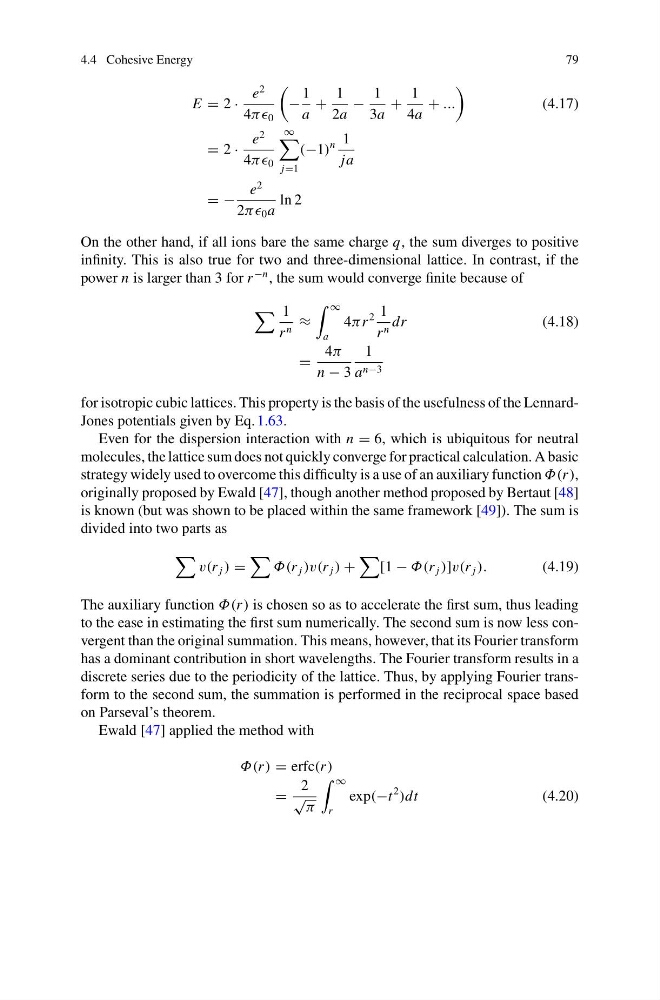
On the other hand, if all ions bare the same charge q, the sum diverges to positive
infinity. This is also true for two and three-dimensional lattice. In contrast, if the
power n is larger than 3 for r
−n , the sum would converge finite because of
1
r n ≈
∞
a
4πr
2 1
r n dr
(4.18)
=
4π
n − 3
1
a n−3
for isotropic cubic lattices. This property is the basis of the usefulness of the LennardJones potentials given by Eq. 1.63.
Even for the dispersion interaction with n = 6, which is ubiquitous for neutral
molecules, the lattice sum does not quickly converge for practical calculation. A basic
strategy widely used to overcome this difficulty is a use of an auxiliary function Φ(r ),
originally proposed by Ewald [47], though another method proposed by Bertaut [48]
is known (but was shown to be placed within the same framework [49]). The sum is
divided into two parts as
v(r j ) =
Φ(r j )v(r j ) +
[1 − Φ(r j )]v(r j ).
(4.19)
The auxiliary function Φ(r ) is chosen so as to accelerate the first sum, thus leading
to the ease in estimating the first sum numerically. The second sum is now less convergent than the original summation. This means, however, that its Fourier transform
has a dominant contribution in short wavelengths. The Fourier transform results in a
discrete series due to the periodicity of the lattice. Thus, by applying Fourier transform to the second sum, the summation is performed in the reciprocal space based
on Parseval’s theorem.
Ewald [47] applied the method with
Φ(r ) = erfc(r )
=
2
√ π
∞
r
exp(−t
2
)dt
(4.20)
79
E = 2 ·
e
2
4ππ 0
−
1
a
+
1
2a
−
1
3a
+
1
4a
+ ...
(4.17)
= 2 ·
e
2
4ππ 0
∞
j=1
(−1)
n 1
ja
= −
e
2
2ππ 0 a
ln 2
On the other hand, if all ions bare the same charge q, the sum diverges to positive
infinity. This is also true for two and three-dimensional lattice. In contrast, if the
power n is larger than 3 for r
−n , the sum would converge finite because of
1
r n ≈
∞
a
4πr
2 1
r n dr
(4.18)
=
4π
n − 3
1
a n−3
for isotropic cubic lattices. This property is the basis of the usefulness of the LennardJones potentials given by Eq. 1.63.
Even for the dispersion interaction with n = 6, which is ubiquitous for neutral
molecules, the lattice sum does not quickly converge for practical calculation. A basic
strategy widely used to overcome this difficulty is a use of an auxiliary function Φ(r ),
originally proposed by Ewald [47], though another method proposed by Bertaut [48]
is known (but was shown to be placed within the same framework [49]). The sum is
divided into two parts as
v(r j ) =
Φ(r j )v(r j ) +
[1 − Φ(r j )]v(r j ).
(4.19)
The auxiliary function Φ(r ) is chosen so as to accelerate the first sum, thus leading
to the ease in estimating the first sum numerically. The second sum is now less convergent than the original summation. This means, however, that its Fourier transform
has a dominant contribution in short wavelengths. The Fourier transform results in a
discrete series due to the periodicity of the lattice. Thus, by applying Fourier transform to the second sum, the summation is performed in the reciprocal space based
on Parseval’s theorem.
Ewald [47] applied the method with
Φ(r ) = erfc(r )
=
2
√ π
∞
r
exp(−t
2
)dt
(4.20)