

4.1 Crystallization
67
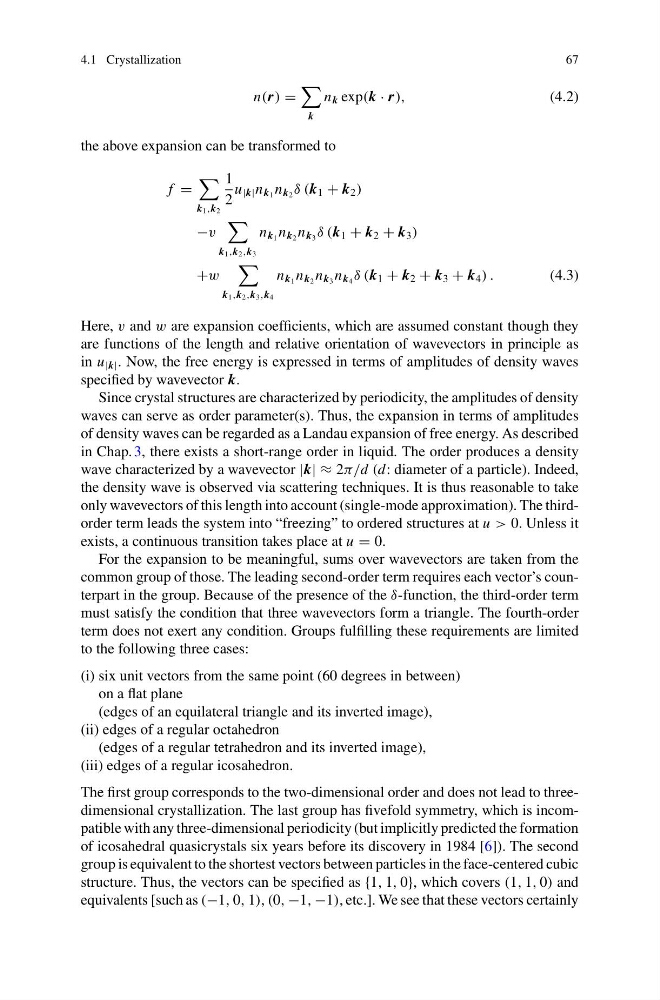
n(r) =
k
n k exp(k · r),
(4.2)
the above expansion can be transformed to
f =
k 1 ,k 2
1
2
u |k| n k 1 n k 2 δ (k 1 + k 2 )
−v
k 1 ,k 2 ,k 3
n k 1 n k 2 n k 3 δ (k 1 + k 2 + k 3 )
+w
k 1 ,k 2 ,k 3 ,k 4
n k 1 n k 2 n k 3 n k 4 δ (k 1 + k 2 + k 3 + k 4 ) .
(4.3)
Here, v and w are expansion coefficients, which are assumed constant though they
are functions of the length and relative orientation of wavevectors in principle as
in u |k| . Now, the free energy is expressed in terms of amplitudes of density waves
specified by wavevector k.
Since crystal structures are characterized by periodicity, the amplitudes of density
waves can serve as order parameter(s). Thus, the expansion in terms of amplitudes
of density waves can be regarded as a Landau expansion of free energy. As described
in Chap. 3, there exists a short-range order in liquid. The order produces a density
wave characterized by a wavevector |k| ≈ 2π/d (d: diameter of a particle). Indeed,
the density wave is observed via scattering techniques. It is thus reasonable to take
only wavevectors of this length into account (single-mode approximation). The thirdorder term leads the system into “freezing” to ordered structures at u > 0. Unless it
exists, a continuous transition takes place at u = 0.
For the expansion to be meaningful, sums over wavevectors are taken from the
common group of those. The leading second-order term requires each vector’s counterpart in the group. Because of the presence of the δ-function, the third-order term
must satisfy the condition that three wavevectors form a triangle. The fourth-order
term does not exert any condition. Groups fulfilling these requirements are limited
to the following three cases:
(i) six unit vectors from the same point (60 degrees in between)
on a flat plane
(edges of an equilateral triangle and its inverted image),
(ii) edges of a regular octahedron
(edges of a regular tetrahedron and its inverted image),
(iii) edges of a regular icosahedron.
The first group corresponds to the two-dimensional order and does not lead to threedimensional crystallization. The last group has fivefold symmetry, which is incompatible with any three-dimensional periodicity (but implicitly predicted the formation
of icosahedral quasicrystals six years before its discovery in 1984 [6]). The second
group is equivalent to the shortest vectors between particles in the face-centered cubic
structure. Thus, the vectors can be specified as {1, 1, 0}, which covers (1, 1, 0) and
equivalents [such as (−1, 0, 1), (0, −1, −1), etc.]. We see that these vectors certainly
67
n(r) =
k
n k exp(k · r),
(4.2)
the above expansion can be transformed to
f =
k 1 ,k 2
1
2
u |k| n k 1 n k 2 δ (k 1 + k 2 )
−v
k 1 ,k 2 ,k 3
n k 1 n k 2 n k 3 δ (k 1 + k 2 + k 3 )
+w
k 1 ,k 2 ,k 3 ,k 4
n k 1 n k 2 n k 3 n k 4 δ (k 1 + k 2 + k 3 + k 4 ) .
(4.3)
Here, v and w are expansion coefficients, which are assumed constant though they
are functions of the length and relative orientation of wavevectors in principle as
in u |k| . Now, the free energy is expressed in terms of amplitudes of density waves
specified by wavevector k.
Since crystal structures are characterized by periodicity, the amplitudes of density
waves can serve as order parameter(s). Thus, the expansion in terms of amplitudes
of density waves can be regarded as a Landau expansion of free energy. As described
in Chap. 3, there exists a short-range order in liquid. The order produces a density
wave characterized by a wavevector |k| ≈ 2π/d (d: diameter of a particle). Indeed,
the density wave is observed via scattering techniques. It is thus reasonable to take
only wavevectors of this length into account (single-mode approximation). The thirdorder term leads the system into “freezing” to ordered structures at u > 0. Unless it
exists, a continuous transition takes place at u = 0.
For the expansion to be meaningful, sums over wavevectors are taken from the
common group of those. The leading second-order term requires each vector’s counterpart in the group. Because of the presence of the δ-function, the third-order term
must satisfy the condition that three wavevectors form a triangle. The fourth-order
term does not exert any condition. Groups fulfilling these requirements are limited
to the following three cases:
(i) six unit vectors from the same point (60 degrees in between)
on a flat plane
(edges of an equilateral triangle and its inverted image),
(ii) edges of a regular octahedron
(edges of a regular tetrahedron and its inverted image),
(iii) edges of a regular icosahedron.
The first group corresponds to the two-dimensional order and does not lead to threedimensional crystallization. The last group has fivefold symmetry, which is incompatible with any three-dimensional periodicity (but implicitly predicted the formation
of icosahedral quasicrystals six years before its discovery in 1984 [6]). The second
group is equivalent to the shortest vectors between particles in the face-centered cubic
structure. Thus, the vectors can be specified as {1, 1, 0}, which covers (1, 1, 0) and
equivalents [such as (−1, 0, 1), (0, −1, −1), etc.]. We see that these vectors certainly