

66
4 Molecular Crystals
Getting mobility implies that the inflated crystal has more microscopic states than
the jammed random packing. Assuming the continuity between the jammed random
packing and random arrangements in the fluid, we may expect that the crystal is more
stable, at least, for ρ ρ jam . Indeed, Alder and Wainwright [4] demonstrated that the
hard spheres certainly crystallize above some density through molecular dynamics
simulation. The crystallization by the entropic mechanism is nowadays called the
Alder transition. Their work is recognized as one of the pioneering ones in computational physics, which relies on modern computers to tackle physical problems.
The Alder transition presents two issues, which may be controversial in comparison with real materials. The first is that the repulsive interaction is a driving force
of crystallization. Although this is the case for the Alder transition, it does not deny
another possibility. For example, if attractive interaction is directional with saturating
property as in the hydrogen bond, just enough formation of the bonds will produce
a highly regular order. Thus, the Alder transition is to be recognized as indicating
that the molecular shape is essential for crystallization. The second issue related to
the Alder transition is that the transition predicts the entropy decreases upon fusion.
The crucial difference between the ensemble of hard spheres and real molecules is
the presence of attractive interaction. There always exists an attractive interaction
between molecules. Concerning the fusion of crystals under constant pressure, the
entropy of the high-temperature phase is larger than that of the low-temperature
phase.
4.1.2 Landau Theory of Weak Crystallization
To get an idea concerning the crystal structure, we begin with consideration in a
framework of Landau theory of phase transition. The validity of the treatment is left
for a while.
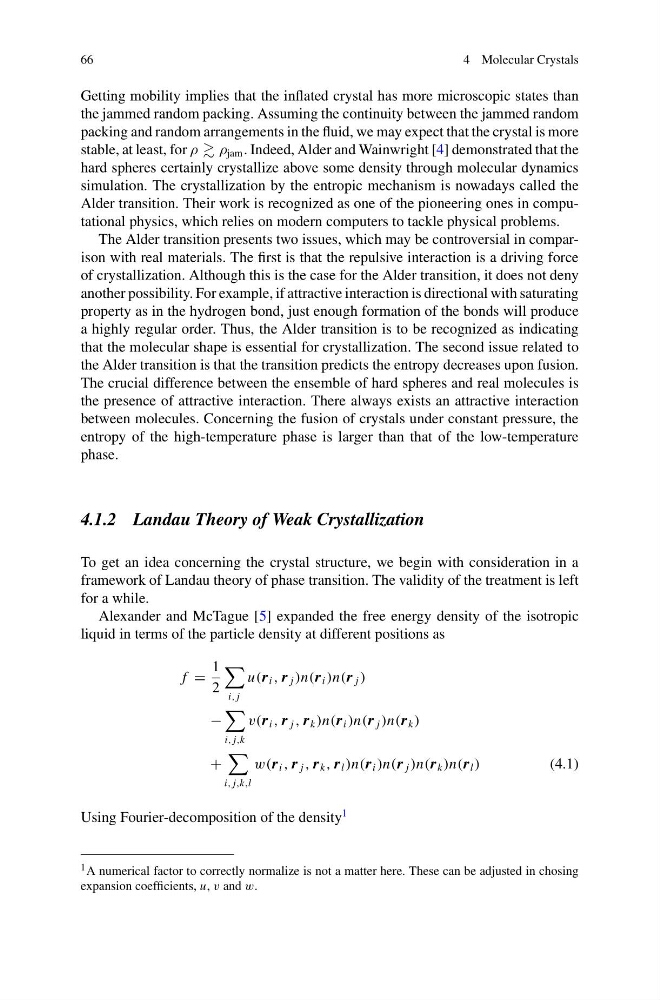
Alexander and McTague [5] expanded the free energy density of the isotropic
liquid in terms of the particle density at different positions as
f =
1
2
i, j
u(r i , r j )n(r i )n(r j )
−
i, j,k
v(r i , r j , r k )n(r i )n(r j )n(r k )
+
i, j,k,l
w(r i , r j , r k , r l )n(r i )n(r j )n(r k )n(r l )
(4.1)
Using Fourier-decomposition of the density
1
1 A numerical factor to correctly normalize is not a matter here. These can be adjusted in chosing
expansion coefficients, u, v and w.
4 Molecular Crystals
Getting mobility implies that the inflated crystal has more microscopic states than
the jammed random packing. Assuming the continuity between the jammed random
packing and random arrangements in the fluid, we may expect that the crystal is more
stable, at least, for ρ ρ jam . Indeed, Alder and Wainwright [4] demonstrated that the
hard spheres certainly crystallize above some density through molecular dynamics
simulation. The crystallization by the entropic mechanism is nowadays called the
Alder transition. Their work is recognized as one of the pioneering ones in computational physics, which relies on modern computers to tackle physical problems.
The Alder transition presents two issues, which may be controversial in comparison with real materials. The first is that the repulsive interaction is a driving force
of crystallization. Although this is the case for the Alder transition, it does not deny
another possibility. For example, if attractive interaction is directional with saturating
property as in the hydrogen bond, just enough formation of the bonds will produce
a highly regular order. Thus, the Alder transition is to be recognized as indicating
that the molecular shape is essential for crystallization. The second issue related to
the Alder transition is that the transition predicts the entropy decreases upon fusion.
The crucial difference between the ensemble of hard spheres and real molecules is
the presence of attractive interaction. There always exists an attractive interaction
between molecules. Concerning the fusion of crystals under constant pressure, the
entropy of the high-temperature phase is larger than that of the low-temperature
phase.
4.1.2 Landau Theory of Weak Crystallization
To get an idea concerning the crystal structure, we begin with consideration in a
framework of Landau theory of phase transition. The validity of the treatment is left
for a while.
Alexander and McTague [5] expanded the free energy density of the isotropic
liquid in terms of the particle density at different positions as
f =
1
2
i, j
u(r i , r j )n(r i )n(r j )
−
i, j,k
v(r i , r j , r k )n(r i )n(r j )n(r k )
+
i, j,k,l
w(r i , r j , r k , r l )n(r i )n(r j )n(r k )n(r l )
(4.1)
Using Fourier-decomposition of the density
1
1 A numerical factor to correctly normalize is not a matter here. These can be adjusted in chosing
expansion coefficients, u, v and w.