

3.1 Liquid Structure
55
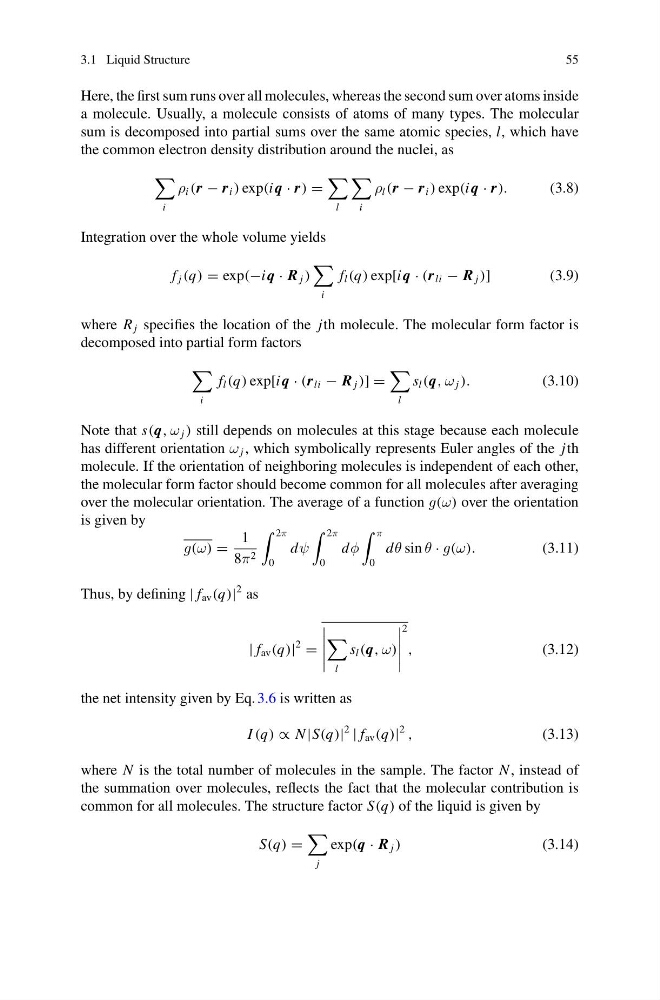
Here, the first sum runs over all molecules, whereas the second sum over atoms inside
a molecule. Usually, a molecule consists of atoms of many types. The molecular
sum is decomposed into partial sums over the same atomic species, l, which have
the common electron density distribution around the nuclei, as
i
ρ i (r − r i ) exp(i q · r) =
l
i
ρ l (r − r i ) exp(i q · r).
(3.8)
Integration over the whole volume yields
f j (q) = exp(−i q · R j )
i
f l (q) exp[i q · (r li − R j )]
(3.9)
where R j specifies the location of the jth molecule. The molecular form factor is
decomposed into partial form factors
i
f l (q) exp[i q · (r li − R j )] =
l
s l (q, ω j ).
(3.10)
Note that s(q, ω j ) still depends on molecules at this stage because each molecule
has different orientation ω j , which symbolically represents Euler angles of the jth
molecule. If the orientation of neighboring molecules is independent of each other,
the molecular form factor should become common for all molecules after averaging
over the molecular orientation. The average of a function g(ω) over the orientation
is given by
g(ω) =
1
8π 2
2π
0
dψ
2π
0
dφ
π
0
dθ sin θ · g(ω).
(3.11)
Thus, by defining | f av (q)|
2 as
| f av (q)|
2
=
l
s l (q, ω)
2
,
(3.12)
the net intensity given by Eq. 3.6 is written as
I (q) ∝ N |S(q)|
2
| f av (q)|
2
,
(3.13)
where N is the total number of molecules in the sample. The factor N , instead of
the summation over molecules, reflects the fact that the molecular contribution is
common for all molecules. The structure factor S(q) of the liquid is given by
S(q) =
j
exp(q · R j )
(3.14)
55
Here, the first sum runs over all molecules, whereas the second sum over atoms inside
a molecule. Usually, a molecule consists of atoms of many types. The molecular
sum is decomposed into partial sums over the same atomic species, l, which have
the common electron density distribution around the nuclei, as
i
ρ i (r − r i ) exp(i q · r) =
l
i
ρ l (r − r i ) exp(i q · r).
(3.8)
Integration over the whole volume yields
f j (q) = exp(−i q · R j )
i
f l (q) exp[i q · (r li − R j )]
(3.9)
where R j specifies the location of the jth molecule. The molecular form factor is
decomposed into partial form factors
i
f l (q) exp[i q · (r li − R j )] =
l
s l (q, ω j ).
(3.10)
Note that s(q, ω j ) still depends on molecules at this stage because each molecule
has different orientation ω j , which symbolically represents Euler angles of the jth
molecule. If the orientation of neighboring molecules is independent of each other,
the molecular form factor should become common for all molecules after averaging
over the molecular orientation. The average of a function g(ω) over the orientation
is given by
g(ω) =
1
8π 2
2π
0
dψ
2π
0
dφ
π
0
dθ sin θ · g(ω).
(3.11)
Thus, by defining | f av (q)|
2 as
| f av (q)|
2
=
l
s l (q, ω)
2
,
(3.12)
the net intensity given by Eq. 3.6 is written as
I (q) ∝ N |S(q)|
2
| f av (q)|
2
,
(3.13)
where N is the total number of molecules in the sample. The factor N , instead of
the summation over molecules, reflects the fact that the molecular contribution is
common for all molecules. The structure factor S(q) of the liquid is given by
S(q) =
j
exp(q · R j )
(3.14)