

54
3 Molecular Liquids
This structure factor is related [1] to the radial distribution function,
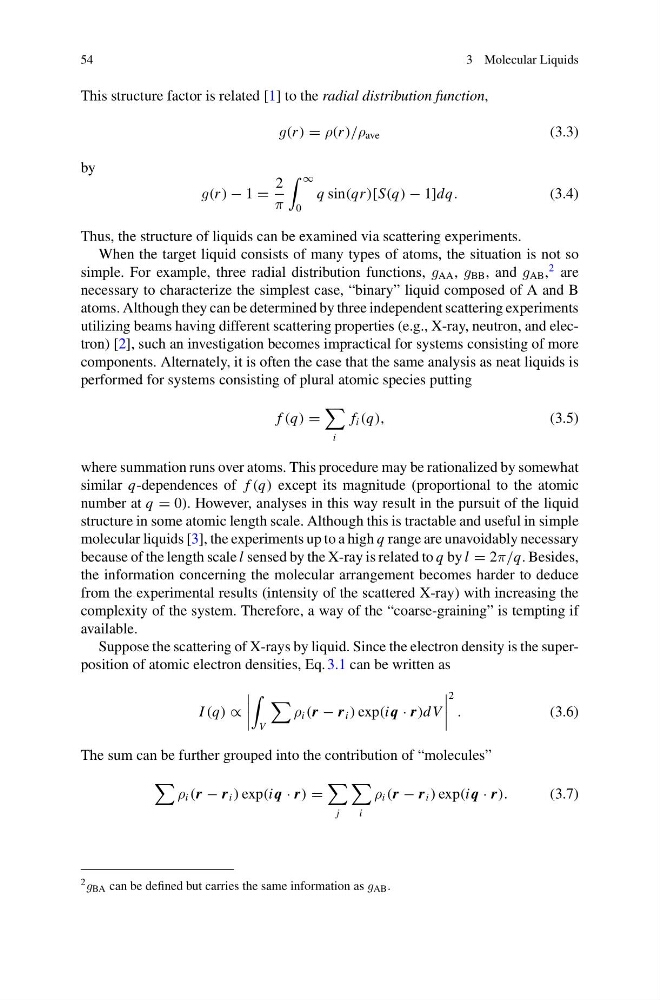
g(r ) = ρ(r )/ρ ave
(3.3)
by
g(r ) − 1 =
2
π
∞
0
q sin(qr)[S(q) − 1]dq.
(3.4)
Thus, the structure of liquids can be examined via scattering experiments.
When the target liquid consists of many types of atoms, the situation is not so
simple. For example, three radial distribution functions, g AA , g BB , and g AB ,
2 are
necessary to characterize the simplest case, “binary” liquid composed of A and B
atoms. Although they can be determined by three independent scattering experiments
utilizing beams having different scattering properties (e.g., X-ray, neutron, and electron) [2], such an investigation becomes impractical for systems consisting of more
components. Alternately, it is often the case that the same analysis as neat liquids is
performed for systems consisting of plural atomic species putting
f (q) =
i
f i (q),
(3.5)
where summation runs over atoms. This procedure may be rationalized by somewhat
similar q-dependences of f (q) except its magnitude (proportional to the atomic
number at q = 0). However, analyses in this way result in the pursuit of the liquid
structure in some atomic length scale. Although this is tractable and useful in simple
molecular liquids [3], the experiments up to a high q range are unavoidably necessary
because of the length scale l sensed by the X-ray is related to q by l = 2π/q. Besides,
the information concerning the molecular arrangement becomes harder to deduce
from the experimental results (intensity of the scattered X-ray) with increasing the
complexity of the system. Therefore, a way of the “coarse-graining” is tempting if
available.
Suppose the scattering of X-rays by liquid. Since the electron density is the superposition of atomic electron densities, Eq. 3.1 can be written as
I (q) ∝
V
ρ i (r − r i ) exp(i q · r)dV
2
.
(3.6)
The sum can be further grouped into the contribution of “molecules”
ρ i (r − r i ) exp(i q · r) =
j
i
ρ i (r − r i ) exp(i q · r).
(3.7)
2 g BA can be defined but carries the same information as g AB .
3 Molecular Liquids
This structure factor is related [1] to the radial distribution function,
g(r ) = ρ(r )/ρ ave
(3.3)
by
g(r ) − 1 =
2
π
∞
0
q sin(qr)[S(q) − 1]dq.
(3.4)
Thus, the structure of liquids can be examined via scattering experiments.
When the target liquid consists of many types of atoms, the situation is not so
simple. For example, three radial distribution functions, g AA , g BB , and g AB ,
2 are
necessary to characterize the simplest case, “binary” liquid composed of A and B
atoms. Although they can be determined by three independent scattering experiments
utilizing beams having different scattering properties (e.g., X-ray, neutron, and electron) [2], such an investigation becomes impractical for systems consisting of more
components. Alternately, it is often the case that the same analysis as neat liquids is
performed for systems consisting of plural atomic species putting
f (q) =
i
f i (q),
(3.5)
where summation runs over atoms. This procedure may be rationalized by somewhat
similar q-dependences of f (q) except its magnitude (proportional to the atomic
number at q = 0). However, analyses in this way result in the pursuit of the liquid
structure in some atomic length scale. Although this is tractable and useful in simple
molecular liquids [3], the experiments up to a high q range are unavoidably necessary
because of the length scale l sensed by the X-ray is related to q by l = 2π/q. Besides,
the information concerning the molecular arrangement becomes harder to deduce
from the experimental results (intensity of the scattered X-ray) with increasing the
complexity of the system. Therefore, a way of the “coarse-graining” is tempting if
available.
Suppose the scattering of X-rays by liquid. Since the electron density is the superposition of atomic electron densities, Eq. 3.1 can be written as
I (q) ∝
V
ρ i (r − r i ) exp(i q · r)dV
2
.
(3.6)
The sum can be further grouped into the contribution of “molecules”
ρ i (r − r i ) exp(i q · r) =
j
i
ρ i (r − r i ) exp(i q · r).
(3.7)
2 g BA can be defined but carries the same information as g AB .