

44
2 Phase Transitions
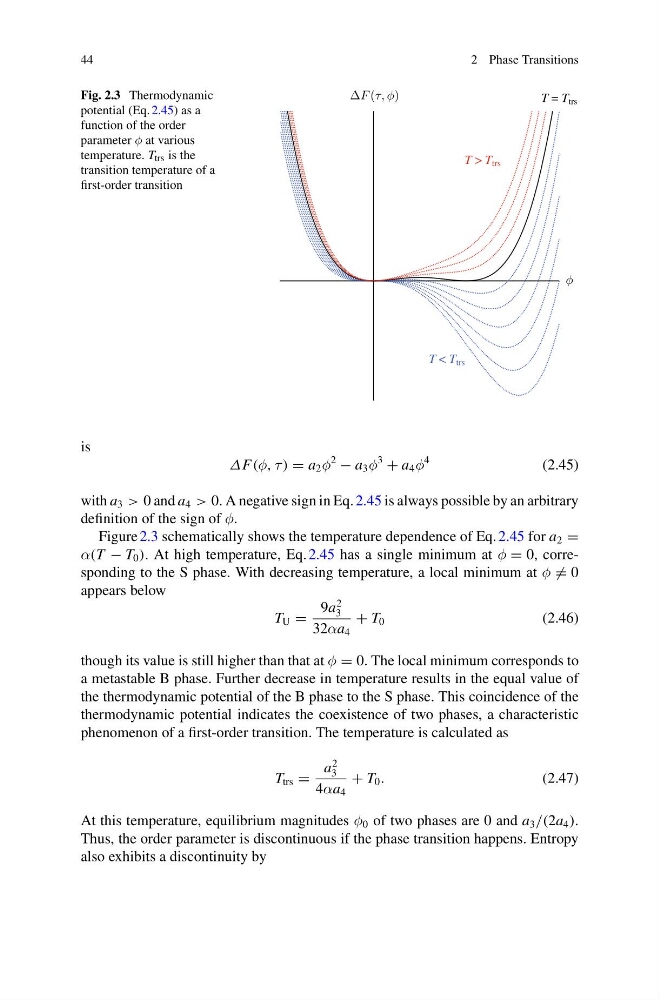
Fig. 2.3 Thermodynamic
potential (Eq. 2.45) as a
function of the order
parameter φ at various
temperature. T trs is the
transition temperature of a
first-order transition
T > T trs
T < T trs
T = T trs
is
ΔF(φ, τ ) = a 2 φ
2
− a 3 φ
3
+ a 4 φ
4
(2.45)
with a 3 > 0 and a 4 > 0. A negative sign in Eq. 2.45 is always possible by an arbitrary
definition of the sign of φ.
Figure 2.3 schematically shows the temperature dependence of Eq. 2.45 for a 2 =
α(T − T 0 ). At high temperature, Eq. 2.45 has a single minimum at φ = 0, corresponding to the S phase. With decreasing temperature, a local minimum at φ = 0
appears below
T U =
9a
2
3
32αa 4
+ T 0
(2.46)
though its value is still higher than that at φ = 0. The local minimum corresponds to
a metastable B phase. Further decrease in temperature results in the equal value of
the thermodynamic potential of the B phase to the S phase. This coincidence of the
thermodynamic potential indicates the coexistence of two phases, a characteristic
phenomenon of a first-order transition. The temperature is calculated as
T trs =
a
2
3
4αa 4
+ T 0 .
(2.47)
At this temperature, equilibrium magnitudes φ 0 of two phases are 0 and a 3 /(2a 4 ).
Thus, the order parameter is discontinuous if the phase transition happens. Entropy
also exhibits a discontinuity by
2 Phase Transitions
Fig. 2.3 Thermodynamic
potential (Eq. 2.45) as a
function of the order
parameter φ at various
temperature. T trs is the
transition temperature of a
first-order transition
T > T trs
T < T trs
T = T trs
is
ΔF(φ, τ ) = a 2 φ
2
− a 3 φ
3
+ a 4 φ
4
(2.45)
with a 3 > 0 and a 4 > 0. A negative sign in Eq. 2.45 is always possible by an arbitrary
definition of the sign of φ.
Figure 2.3 schematically shows the temperature dependence of Eq. 2.45 for a 2 =
α(T − T 0 ). At high temperature, Eq. 2.45 has a single minimum at φ = 0, corresponding to the S phase. With decreasing temperature, a local minimum at φ = 0
appears below
T U =
9a
2
3
32αa 4
+ T 0
(2.46)
though its value is still higher than that at φ = 0. The local minimum corresponds to
a metastable B phase. Further decrease in temperature results in the equal value of
the thermodynamic potential of the B phase to the S phase. This coincidence of the
thermodynamic potential indicates the coexistence of two phases, a characteristic
phenomenon of a first-order transition. The temperature is calculated as
T trs =
a
2
3
4αa 4
+ T 0 .
(2.47)
At this temperature, equilibrium magnitudes φ 0 of two phases are 0 and a 3 /(2a 4 ).
Thus, the order parameter is discontinuous if the phase transition happens. Entropy
also exhibits a discontinuity by