

2.2 Landau’s Phenomenology
43
φ 0 (h) =
h
2a 2
(T > T 0 ).
(2.38)
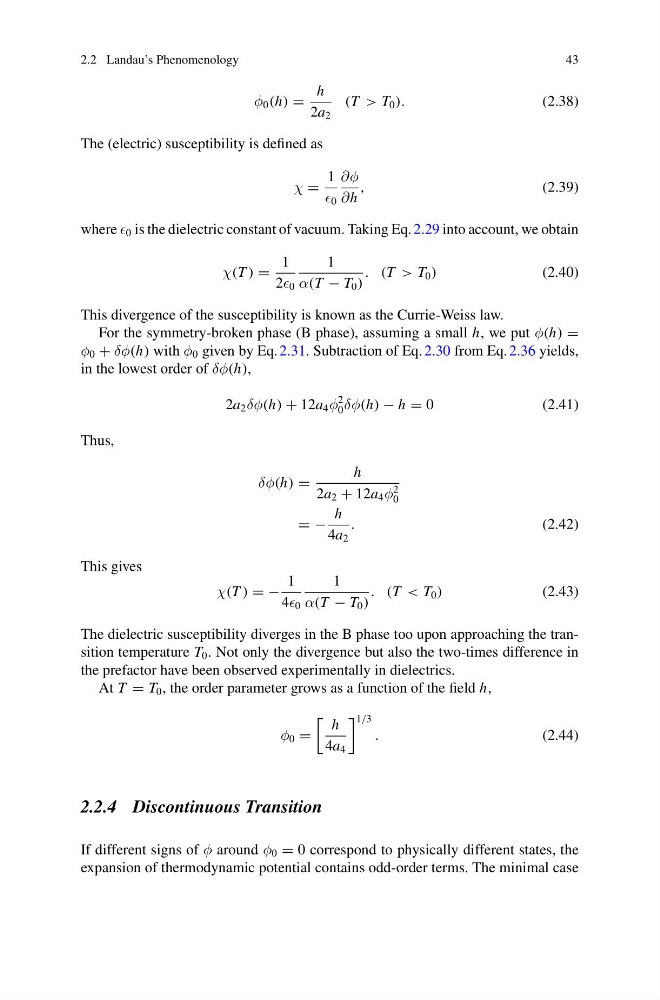
The (electric) susceptibility is defined as
χ =
1
0
∂φ
∂h
,
(2.39)
where 0 is the dielectric constant of vacuum. Taking Eq. 2.29 into account, we obtain
χ(T ) =
1
2 0
1
α(T − T 0 )
. (T > T 0 )
(2.40)
This divergence of the susceptibility is known as the Currie-Weiss law.
For the symmetry-broken phase (B phase), assuming a small h, we put φ(h) =
φ 0 + δφ(h) with φ 0 given by Eq. 2.31. Subtraction of Eq. 2.30 from Eq. 2.36 yields,
in the lowest order of δφ(h),
2a 2 δφ(h) + 12a 4 φ
2
0 δφ(h) − h = 0
(2.41)
Thus,
δφ(h) =
h
2a 2 + 12a 4 φ
2
0
= −
h
4a 2
.
(2.42)
This gives
χ(T ) = −
1
4 0
1
α(T − T 0 )
. (T < T 0 )
(2.43)
The dielectric susceptibility diverges in the B phase too upon approaching the transition temperature T 0 . Not only the divergence but also the two-times difference in
the prefactor have been observed experimentally in dielectrics.
At T = T 0 , the order parameter grows as a function of the field h,
φ 0 =
h
4a 4
1/3
.
(2.44)
2.2.4 Discontinuous Transition
If different signs of φ around φ 0 = 0 correspond to physically different states, the
expansion of thermodynamic potential contains odd-order terms. The minimal case
43
φ 0 (h) =
h
2a 2
(T > T 0 ).
(2.38)
The (electric) susceptibility is defined as
χ =
1
0
∂φ
∂h
,
(2.39)
where 0 is the dielectric constant of vacuum. Taking Eq. 2.29 into account, we obtain
χ(T ) =
1
2 0
1
α(T − T 0 )
. (T > T 0 )
(2.40)
This divergence of the susceptibility is known as the Currie-Weiss law.
For the symmetry-broken phase (B phase), assuming a small h, we put φ(h) =
φ 0 + δφ(h) with φ 0 given by Eq. 2.31. Subtraction of Eq. 2.30 from Eq. 2.36 yields,
in the lowest order of δφ(h),
2a 2 δφ(h) + 12a 4 φ
2
0 δφ(h) − h = 0
(2.41)
Thus,
δφ(h) =
h
2a 2 + 12a 4 φ
2
0
= −
h
4a 2
.
(2.42)
This gives
χ(T ) = −
1
4 0
1
α(T − T 0 )
. (T < T 0 )
(2.43)
The dielectric susceptibility diverges in the B phase too upon approaching the transition temperature T 0 . Not only the divergence but also the two-times difference in
the prefactor have been observed experimentally in dielectrics.
At T = T 0 , the order parameter grows as a function of the field h,
φ 0 =
h
4a 4
1/3
.
(2.44)
2.2.4 Discontinuous Transition
If different signs of φ around φ 0 = 0 correspond to physically different states, the
expansion of thermodynamic potential contains odd-order terms. The minimal case