

2.1 Background
33
Here, Δ trs s and Δ trs v are molar entropy and volume of transition, respectively.
Although Eq. 2.3 is not affected by virtue of its form, the selection of their signs
have a tradition: Δ trs s > 0 for the phase transition driven by a temperature change,
i.e., phase H is a high-temperature phase, and Δ trs v < 0 for the phase transition
driven by a pressure change, i.e., phase H is a high-pressure phase. Note that the
correspondence of the signs and relative stabilities of two phases is related to the
self-consistency of thermodynamics, which requests the absolute stability of thermodynamic systems.
2
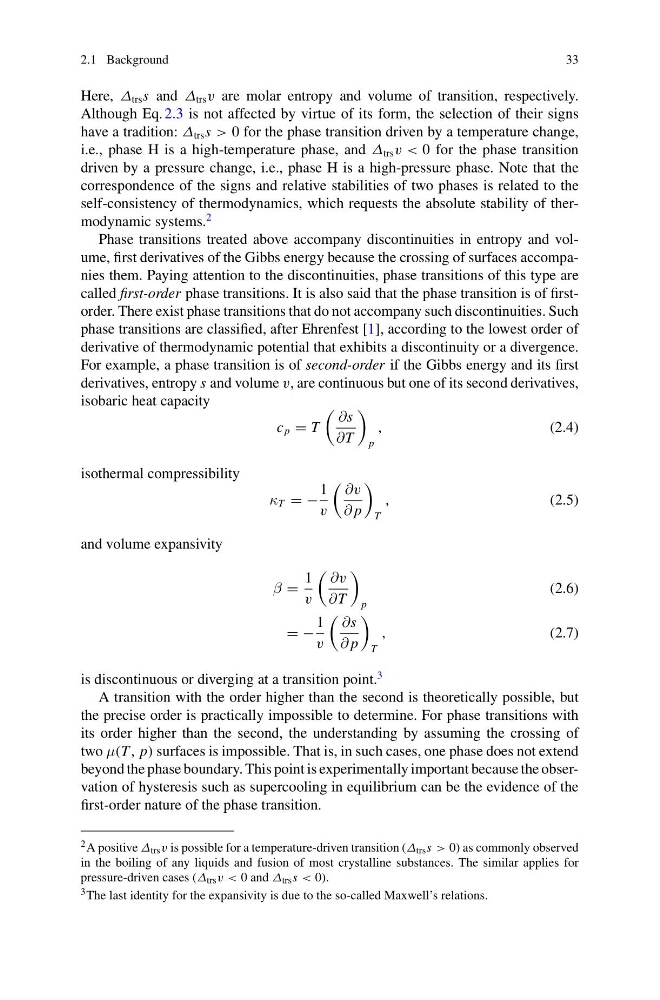
Phase transitions treated above accompany discontinuities in entropy and volume, first derivatives of the Gibbs energy because the crossing of surfaces accompanies them. Paying attention to the discontinuities, phase transitions of this type are
called first-order phase transitions. It is also said that the phase transition is of firstorder. There exist phase transitions that do not accompany such discontinuities. Such
phase transitions are classified, after Ehrenfest [1], according to the lowest order of
derivative of thermodynamic potential that exhibits a discontinuity or a divergence.
For example, a phase transition is of second-order if the Gibbs energy and its first
derivatives, entropy s and volume v, are continuous but one of its second derivatives,
isobaric heat capacity
c p = T
∂s
∂T
p
,
(2.4)
isothermal compressibility
κ T = −
1
v
∂v
∂ p
T
,
(2.5)
and volume expansivity
β =
1
v
∂v
∂T
p
(2.6)
= −
1
v
∂s
∂ p
T
,
(2.7)
is discontinuous or diverging at a transition point.
3
A transition with the order higher than the second is theoretically possible, but
the precise order is practically impossible to determine. For phase transitions with
its order higher than the second, the understanding by assuming the crossing of
two μ(T, p) surfaces is impossible. That is, in such cases, one phase does not extend
beyond the phase boundary. This point is experimentally important because the observation of hysteresis such as supercooling in equilibrium can be the evidence of the
first-order nature of the phase transition.
2 A positive Δ trs v is possible for a temperature-driven transition (Δ trs s > 0) as commonly observed
in the boiling of any liquids and fusion of most crystalline substances. The similar applies for
pressure-driven cases (Δ trs v < 0 and Δ trs s < 0).
3 The last identity for the expansivity is due to the so-called Maxwell’s relations.
33
Here, Δ trs s and Δ trs v are molar entropy and volume of transition, respectively.
Although Eq. 2.3 is not affected by virtue of its form, the selection of their signs
have a tradition: Δ trs s > 0 for the phase transition driven by a temperature change,
i.e., phase H is a high-temperature phase, and Δ trs v < 0 for the phase transition
driven by a pressure change, i.e., phase H is a high-pressure phase. Note that the
correspondence of the signs and relative stabilities of two phases is related to the
self-consistency of thermodynamics, which requests the absolute stability of thermodynamic systems.
2
Phase transitions treated above accompany discontinuities in entropy and volume, first derivatives of the Gibbs energy because the crossing of surfaces accompanies them. Paying attention to the discontinuities, phase transitions of this type are
called first-order phase transitions. It is also said that the phase transition is of firstorder. There exist phase transitions that do not accompany such discontinuities. Such
phase transitions are classified, after Ehrenfest [1], according to the lowest order of
derivative of thermodynamic potential that exhibits a discontinuity or a divergence.
For example, a phase transition is of second-order if the Gibbs energy and its first
derivatives, entropy s and volume v, are continuous but one of its second derivatives,
isobaric heat capacity
c p = T
∂s
∂T
p
,
(2.4)
isothermal compressibility
κ T = −
1
v
∂v
∂ p
T
,
(2.5)
and volume expansivity
β =
1
v
∂v
∂T
p
(2.6)
= −
1
v
∂s
∂ p
T
,
(2.7)
is discontinuous or diverging at a transition point.
3
A transition with the order higher than the second is theoretically possible, but
the precise order is practically impossible to determine. For phase transitions with
its order higher than the second, the understanding by assuming the crossing of
two μ(T, p) surfaces is impossible. That is, in such cases, one phase does not extend
beyond the phase boundary. This point is experimentally important because the observation of hysteresis such as supercooling in equilibrium can be the evidence of the
first-order nature of the phase transition.
2 A positive Δ trs v is possible for a temperature-driven transition (Δ trs s > 0) as commonly observed
in the boiling of any liquids and fusion of most crystalline substances. The similar applies for
pressure-driven cases (Δ trs v < 0 and Δ trs s < 0).
3 The last identity for the expansivity is due to the so-called Maxwell’s relations.