

32
2 Phase Transitions
µ
T
p
H
L
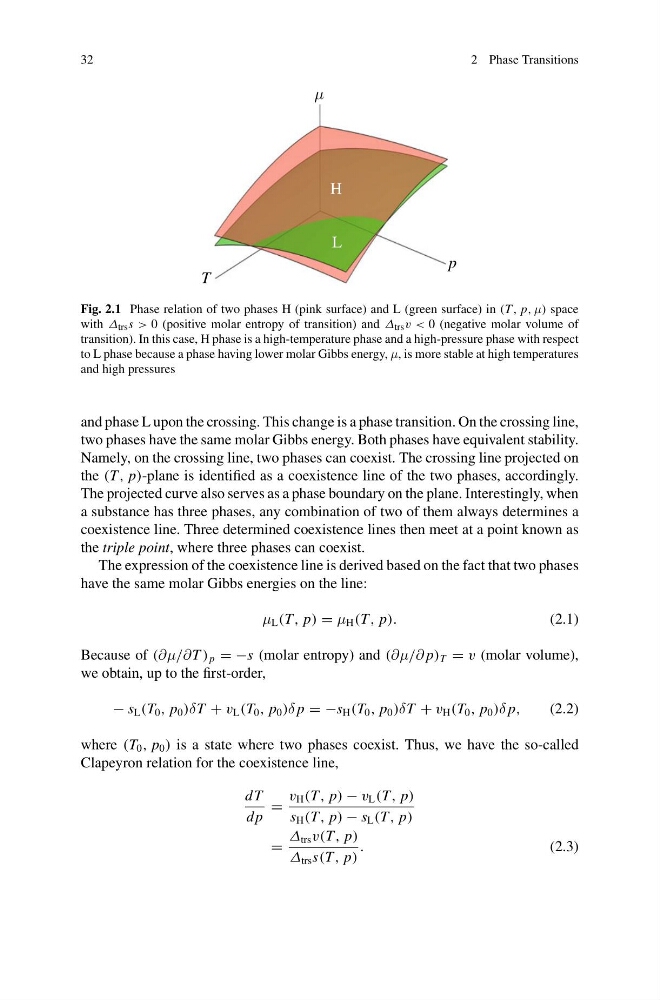
Fig. 2.1 Phase relation of two phases H (pink surface) and L (green surface) in (T, p, μ) space
with Δ trs s > 0 (positive molar entropy of transition) and Δ trs v < 0 (negative molar volume of
transition). In this case, H phase is a high-temperature phase and a high-pressure phase with respect
to L phase because a phase having lower molar Gibbs energy, μ, is more stable at high temperatures
and high pressures
and phase L upon the crossing. This change is a phase transition. On the crossing line,
two phases have the same molar Gibbs energy. Both phases have equivalent stability.
Namely, on the crossing line, two phases can coexist. The crossing line projected on
the (T, p)-plane is identified as a coexistence line of the two phases, accordingly.
The projected curve also serves as a phase boundary on the plane. Interestingly, when
a substance has three phases, any combination of two of them always determines a
coexistence line. Three determined coexistence lines then meet at a point known as
the triple point, where three phases can coexist.
The expression of the coexistence line is derived based on the fact that two phases
have the same molar Gibbs energies on the line:
μ L (T, p) = μ H (T, p).
(2.1)
Because of (∂μ/∂T ) p = −s (molar entropy) and (∂μ/∂ p) T = v (molar volume),
we obtain, up to the first-order,
− s L (T 0 , p 0 )δT + v L (T 0 , p 0 )δ p = −s H (T 0 , p 0 )δT + v H (T 0 , p 0 )δ p,
(2.2)
where (T 0 , p 0 ) is a state where two phases coexist. Thus, we have the so-called
Clapeyron relation for the coexistence line,
dT
dp
=
v H (T, p) − v L (T, p)
s H (T, p) − s L (T, p)
=
Δ trs v(T, p)
Δ trs s(T, p)
.
(2.3)
2 Phase Transitions
µ
T
p
H
L
Fig. 2.1 Phase relation of two phases H (pink surface) and L (green surface) in (T, p, μ) space
with Δ trs s > 0 (positive molar entropy of transition) and Δ trs v < 0 (negative molar volume of
transition). In this case, H phase is a high-temperature phase and a high-pressure phase with respect
to L phase because a phase having lower molar Gibbs energy, μ, is more stable at high temperatures
and high pressures
and phase L upon the crossing. This change is a phase transition. On the crossing line,
two phases have the same molar Gibbs energy. Both phases have equivalent stability.
Namely, on the crossing line, two phases can coexist. The crossing line projected on
the (T, p)-plane is identified as a coexistence line of the two phases, accordingly.
The projected curve also serves as a phase boundary on the plane. Interestingly, when
a substance has three phases, any combination of two of them always determines a
coexistence line. Three determined coexistence lines then meet at a point known as
the triple point, where three phases can coexist.
The expression of the coexistence line is derived based on the fact that two phases
have the same molar Gibbs energies on the line:
μ L (T, p) = μ H (T, p).
(2.1)
Because of (∂μ/∂T ) p = −s (molar entropy) and (∂μ/∂ p) T = v (molar volume),
we obtain, up to the first-order,
− s L (T 0 , p 0 )δT + v L (T 0 , p 0 )δ p = −s H (T 0 , p 0 )δT + v H (T 0 , p 0 )δ p,
(2.2)
where (T 0 , p 0 ) is a state where two phases coexist. Thus, we have the so-called
Clapeyron relation for the coexistence line,
dT
dp
=
v H (T, p) − v L (T, p)
s H (T, p) − s L (T, p)
=
Δ trs v(T, p)
Δ trs s(T, p)
.
(2.3)