

1.2 Intermolecular Interaction
17
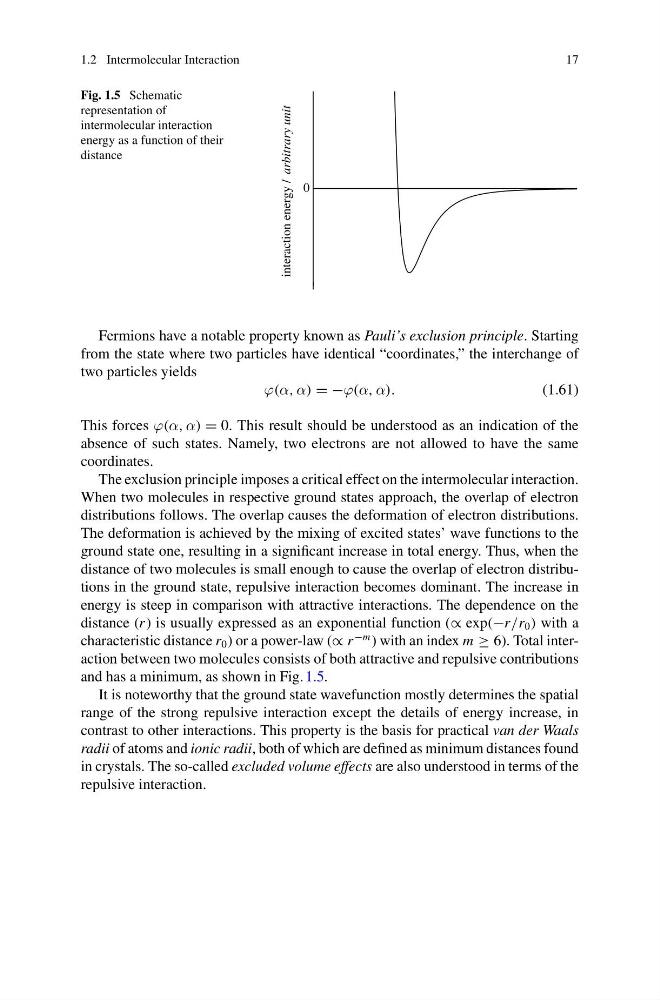
Fig. 1.5 Schematic
representation of
intermolecular interaction
energy as a function of their
distance
0
interaction energy / arbitrary unit
Fermions have a notable property known as Pauli’s exclusion principle. Starting
from the state where two particles have identical “coordinates,” the interchange of
two particles yields
ϕ(α, α) = −ϕ(α, α).
(1.61)
This forces ϕ(α, α) = 0. This result should be understood as an indication of the
absence of such states. Namely, two electrons are not allowed to have the same
coordinates.
The exclusion principle imposes a critical effect on the intermolecular interaction.
When two molecules in respective ground states approach, the overlap of electron
distributions follows. The overlap causes the deformation of electron distributions.
The deformation is achieved by the mixing of excited states’ wave functions to the
ground state one, resulting in a significant increase in total energy. Thus, when the
distance of two molecules is small enough to cause the overlap of electron distributions in the ground state, repulsive interaction becomes dominant. The increase in
energy is steep in comparison with attractive interactions. The dependence on the
distance (r ) is usually expressed as an exponential function (∝ exp(−r/r 0 ) with a
characteristic distance r 0 ) or a power-law (∝ r
−m ) with an index m ≥ 6). Total interaction between two molecules consists of both attractive and repulsive contributions
and has a minimum, as shown in Fig. 1.5.
It is noteworthy that the ground state wavefunction mostly determines the spatial
range of the strong repulsive interaction except the details of energy increase, in
contrast to other interactions. This property is the basis for practical van der Waals
radii of atoms and ionic radii, both of which are defined as minimum distances found
in crystals. The so-called excluded volume effects are also understood in terms of the
repulsive interaction.
17
Fig. 1.5 Schematic
representation of
intermolecular interaction
energy as a function of their
distance
0
interaction energy / arbitrary unit
Fermions have a notable property known as Pauli’s exclusion principle. Starting
from the state where two particles have identical “coordinates,” the interchange of
two particles yields
ϕ(α, α) = −ϕ(α, α).
(1.61)
This forces ϕ(α, α) = 0. This result should be understood as an indication of the
absence of such states. Namely, two electrons are not allowed to have the same
coordinates.
The exclusion principle imposes a critical effect on the intermolecular interaction.
When two molecules in respective ground states approach, the overlap of electron
distributions follows. The overlap causes the deformation of electron distributions.
The deformation is achieved by the mixing of excited states’ wave functions to the
ground state one, resulting in a significant increase in total energy. Thus, when the
distance of two molecules is small enough to cause the overlap of electron distributions in the ground state, repulsive interaction becomes dominant. The increase in
energy is steep in comparison with attractive interactions. The dependence on the
distance (r ) is usually expressed as an exponential function (∝ exp(−r/r 0 ) with a
characteristic distance r 0 ) or a power-law (∝ r
−m ) with an index m ≥ 6). Total interaction between two molecules consists of both attractive and repulsive contributions
and has a minimum, as shown in Fig. 1.5.
It is noteworthy that the ground state wavefunction mostly determines the spatial
range of the strong repulsive interaction except the details of energy increase, in
contrast to other interactions. This property is the basis for practical van der Waals
radii of atoms and ionic radii, both of which are defined as minimum distances found
in crystals. The so-called excluded volume effects are also understood in terms of the
repulsive interaction.