

16
1 Molecules and Intermolecular Interactions
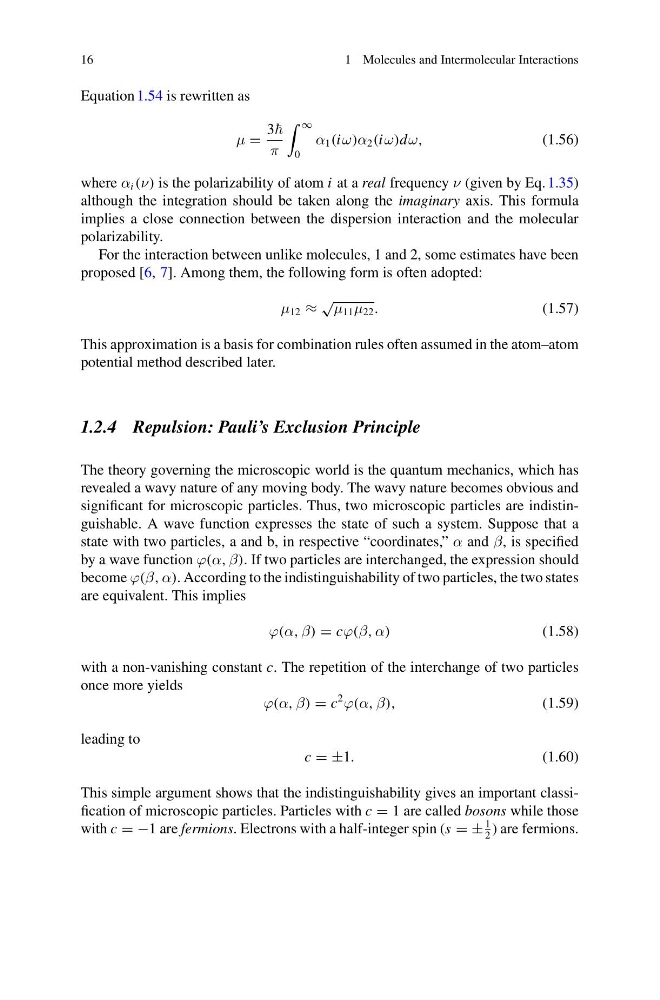
Equation 1.54 is rewritten as
μ =
3
π
∞
0
α 1 (iω)α 2 (iω)dω,
(1.56)
where α i (ν) is the polarizability of atom i at a real frequency ν (given by Eq. 1.35)
although the integration should be taken along the imaginary axis. This formula
implies a close connection between the dispersion interaction and the molecular
polarizability.
For the interaction between unlike molecules, 1 and 2, some estimates have been
proposed [6, 7]. Among them, the following form is often adopted:
μ 12 ≈
√ μ 11 μ 22 .
(1.57)
This approximation is a basis for combination rules often assumed in the atom–atom
potential method described later.
1.2.4 Repulsion: Pauli’s Exclusion Principle
The theory governing the microscopic world is the quantum mechanics, which has
revealed a wavy nature of any moving body. The wavy nature becomes obvious and
significant for microscopic particles. Thus, two microscopic particles are indistinguishable. A wave function expresses the state of such a system. Suppose that a
state with two particles, a and b, in respective “coordinates,” α and β, is specified
by a wave function ϕ(α, β). If two particles are interchanged, the expression should
become ϕ(β, α). According to the indistinguishability of two particles, the two states
are equivalent. This implies
ϕ(α, β) = cϕ(β, α)
(1.58)
with a non-vanishing constant c. The repetition of the interchange of two particles
once more yields
ϕ(α, β) = c
2
ϕ(α, β),
(1.59)
leading to
c = ±1.
(1.60)
This simple argument shows that the indistinguishability gives an important classification of microscopic particles. Particles with c = 1 are called bosons while those
with c = −1 are fermions. Electrons with a half-integer spin (s = ±
1
2
) are fermions.
1 Molecules and Intermolecular Interactions
Equation 1.54 is rewritten as
μ =
3
π
∞
0
α 1 (iω)α 2 (iω)dω,
(1.56)
where α i (ν) is the polarizability of atom i at a real frequency ν (given by Eq. 1.35)
although the integration should be taken along the imaginary axis. This formula
implies a close connection between the dispersion interaction and the molecular
polarizability.
For the interaction between unlike molecules, 1 and 2, some estimates have been
proposed [6, 7]. Among them, the following form is often adopted:
μ 12 ≈
√ μ 11 μ 22 .
(1.57)
This approximation is a basis for combination rules often assumed in the atom–atom
potential method described later.
1.2.4 Repulsion: Pauli’s Exclusion Principle
The theory governing the microscopic world is the quantum mechanics, which has
revealed a wavy nature of any moving body. The wavy nature becomes obvious and
significant for microscopic particles. Thus, two microscopic particles are indistinguishable. A wave function expresses the state of such a system. Suppose that a
state with two particles, a and b, in respective “coordinates,” α and β, is specified
by a wave function ϕ(α, β). If two particles are interchanged, the expression should
become ϕ(β, α). According to the indistinguishability of two particles, the two states
are equivalent. This implies
ϕ(α, β) = cϕ(β, α)
(1.58)
with a non-vanishing constant c. The repetition of the interchange of two particles
once more yields
ϕ(α, β) = c
2
ϕ(α, β),
(1.59)
leading to
c = ±1.
(1.60)
This simple argument shows that the indistinguishability gives an important classification of microscopic particles. Particles with c = 1 are called bosons while those
with c = −1 are fermions. Electrons with a half-integer spin (s = ±
1
2
) are fermions.