

14
1 Molecules and Intermolecular Interactions
H H = −
2
2M
∇
2
I −
2
2m
∇
2
1 −
q
2
4πε 0
1
|r 1 − R I |
.
(1.38)
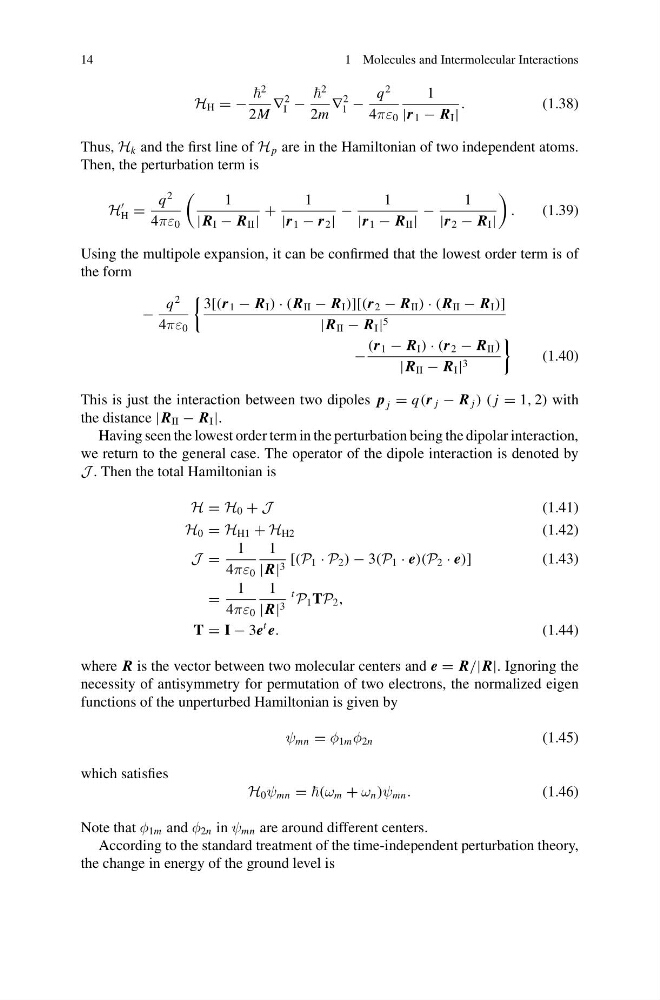
Thus, H k and the first line of H p are in the Hamiltonian of two independent atoms.
Then, the perturbation term is
H
H =
q
2
4πε 0
1
|R I − R II |
+
1
|r 1 − r 2 |
−
1
|r 1 − R II |
−
1
|r 2 − R I |
.
(1.39)
Using the multipole expansion, it can be confirmed that the lowest order term is of
the form
−
q
2
4πε 0
3[(r 1 − R I ) · (R II − R I )][(r 2 − R II ) · (R II − R I )]
|R II − R I | 5
−
(r 1 − R I ) · (r 2 − R II )
|R II − R I | 3
(1.40)
This is just the interaction between two dipoles p j = q(r j − R j ) ( j = 1, 2) with
the distance |R II − R I |.
Having seen the lowest order term in the perturbation being the dipolar interaction,
we return to the general case. The operator of the dipole interaction is denoted by
J . Then the total Hamiltonian is
H = H 0 + J
(1.41)
H 0 = H H1 + H H2
(1.42)
J =
1
4πε 0
1
|R| 3 [(P 1 · P 2 ) − 3(P 1 · e)(P 2 · e)]
(1.43)
=
1
4πε 0
1
|R| 3
t
P 1 TP 2 ,
T = I − 3e
t e.
(1.44)
where R is the vector between two molecular centers and e = R/|R|. Ignoring the
necessity of antisymmetry for permutation of two electrons, the normalized eigen
functions of the unperturbed Hamiltonian is given by
ψ mn = φ 1m φ 2n
(1.45)
which satisfies
H 0 ψ mn = (ω m + ω n )ψ mn .
(1.46)
Note that φ 1m and φ 2n in ψ mn are around different centers.
According to the standard treatment of the time-independent perturbation theory,
the change in energy of the ground level is
1 Molecules and Intermolecular Interactions
H H = −
2
2M
∇
2
I −
2
2m
∇
2
1 −
q
2
4πε 0
1
|r 1 − R I |
.
(1.38)
Thus, H k and the first line of H p are in the Hamiltonian of two independent atoms.
Then, the perturbation term is
H
H =
q
2
4πε 0
1
|R I − R II |
+
1
|r 1 − r 2 |
−
1
|r 1 − R II |
−
1
|r 2 − R I |
.
(1.39)
Using the multipole expansion, it can be confirmed that the lowest order term is of
the form
−
q
2
4πε 0
3[(r 1 − R I ) · (R II − R I )][(r 2 − R II ) · (R II − R I )]
|R II − R I | 5
−
(r 1 − R I ) · (r 2 − R II )
|R II − R I | 3
(1.40)
This is just the interaction between two dipoles p j = q(r j − R j ) ( j = 1, 2) with
the distance |R II − R I |.
Having seen the lowest order term in the perturbation being the dipolar interaction,
we return to the general case. The operator of the dipole interaction is denoted by
J . Then the total Hamiltonian is
H = H 0 + J
(1.41)
H 0 = H H1 + H H2
(1.42)
J =
1
4πε 0
1
|R| 3 [(P 1 · P 2 ) − 3(P 1 · e)(P 2 · e)]
(1.43)
=
1
4πε 0
1
|R| 3
t
P 1 TP 2 ,
T = I − 3e
t e.
(1.44)
where R is the vector between two molecular centers and e = R/|R|. Ignoring the
necessity of antisymmetry for permutation of two electrons, the normalized eigen
functions of the unperturbed Hamiltonian is given by
ψ mn = φ 1m φ 2n
(1.45)
which satisfies
H 0 ψ mn = (ω m + ω n )ψ mn .
(1.46)
Note that φ 1m and φ 2n in ψ mn are around different centers.
According to the standard treatment of the time-independent perturbation theory,
the change in energy of the ground level is