

1.2 Intermolecular Interaction
13
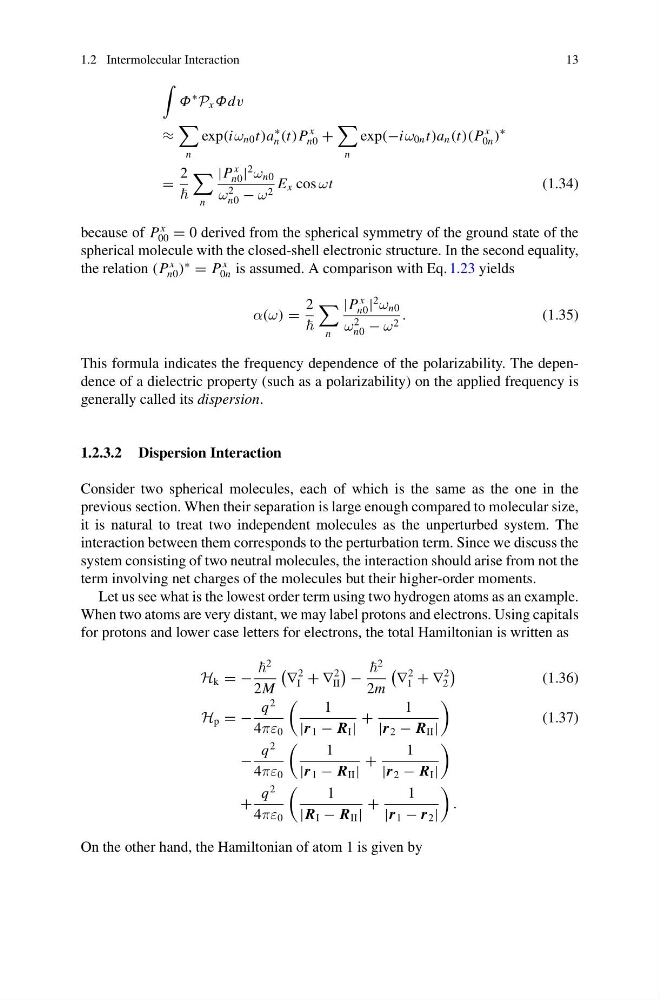
Φ
∗
P x Φdv
≈
n
exp(iω n0 t)a
∗
n (t)P
x
n0 +
n
exp(−iω 0n t)a n (t)(P
x
0n )
∗
=
2
n
|P
x
n0 |
2
ω n0
ω
2
n0 − ω 2 E x cos ωt
(1.34)
because of P
x
00 = 0 derived from the spherical symmetry of the ground state of the
spherical molecule with the closed-shell electronic structure. In the second equality,
the relation (P
x
n0 )
∗
= P
x
0n is assumed. A comparison with Eq. 1.23 yields
α(ω) =
2
n
|P
x
n0 |
2
ω n0
ω
2
n0 − ω 2 .
(1.35)
This formula indicates the frequency dependence of the polarizability. The dependence of a dielectric property (such as a polarizability) on the applied frequency is
generally called its dispersion.
1.2.3.2 Dispersion Interaction
Consider two spherical molecules, each of which is the same as the one in the
previous section. When their separation is large enough compared to molecular size,
it is natural to treat two independent molecules as the unperturbed system. The
interaction between them corresponds to the perturbation term. Since we discuss the
system consisting of two neutral molecules, the interaction should arise from not the
term involving net charges of the molecules but their higher-order moments.
Let us see what is the lowest order term using two hydrogen atoms as an example.
When two atoms are very distant, we may label protons and electrons. Using capitals
for protons and lower case letters for electrons, the total Hamiltonian is written as
H k = −
2
2M
∇
2
I + ∇
2
II
−
2
2m
∇
2
1 + ∇
2
2
(1.36)
H p = −
q
2
4πε 0
1
|r 1 − R I |
+
1
|r 2 − R II |
(1.37)
−
q
2
4πε 0
1
|r 1 − R II |
+
1
|r 2 − R I |
+
q
2
4πε 0
1
|R I − R II |
+
1
|r 1 − r 2 |
.
On the other hand, the Hamiltonian of atom 1 is given by
13
Φ
∗
P x Φdv
≈
n
exp(iω n0 t)a
∗
n (t)P
x
n0 +
n
exp(−iω 0n t)a n (t)(P
x
0n )
∗
=
2
n
|P
x
n0 |
2
ω n0
ω
2
n0 − ω 2 E x cos ωt
(1.34)
because of P
x
00 = 0 derived from the spherical symmetry of the ground state of the
spherical molecule with the closed-shell electronic structure. In the second equality,
the relation (P
x
n0 )
∗
= P
x
0n is assumed. A comparison with Eq. 1.23 yields
α(ω) =
2
n
|P
x
n0 |
2
ω n0
ω
2
n0 − ω 2 .
(1.35)
This formula indicates the frequency dependence of the polarizability. The dependence of a dielectric property (such as a polarizability) on the applied frequency is
generally called its dispersion.
1.2.3.2 Dispersion Interaction
Consider two spherical molecules, each of which is the same as the one in the
previous section. When their separation is large enough compared to molecular size,
it is natural to treat two independent molecules as the unperturbed system. The
interaction between them corresponds to the perturbation term. Since we discuss the
system consisting of two neutral molecules, the interaction should arise from not the
term involving net charges of the molecules but their higher-order moments.
Let us see what is the lowest order term using two hydrogen atoms as an example.
When two atoms are very distant, we may label protons and electrons. Using capitals
for protons and lower case letters for electrons, the total Hamiltonian is written as
H k = −
2
2M
∇
2
I + ∇
2
II
−
2
2m
∇
2
1 + ∇
2
2
(1.36)
H p = −
q
2
4πε 0
1
|r 1 − R I |
+
1
|r 2 − R II |
(1.37)
−
q
2
4πε 0
1
|r 1 − R II |
+
1
|r 2 − R I |
+
q
2
4πε 0
1
|R I − R II |
+
1
|r 1 − r 2 |
.
On the other hand, the Hamiltonian of atom 1 is given by