

10.2 Molecular Crystals as Tunable Model System
207
300
200
100
0
T
trs / K
7
6
5
4
3
2
1
number of rings
BP
DFQP
TP
QP
QQP
SP
DFTP
DFBP
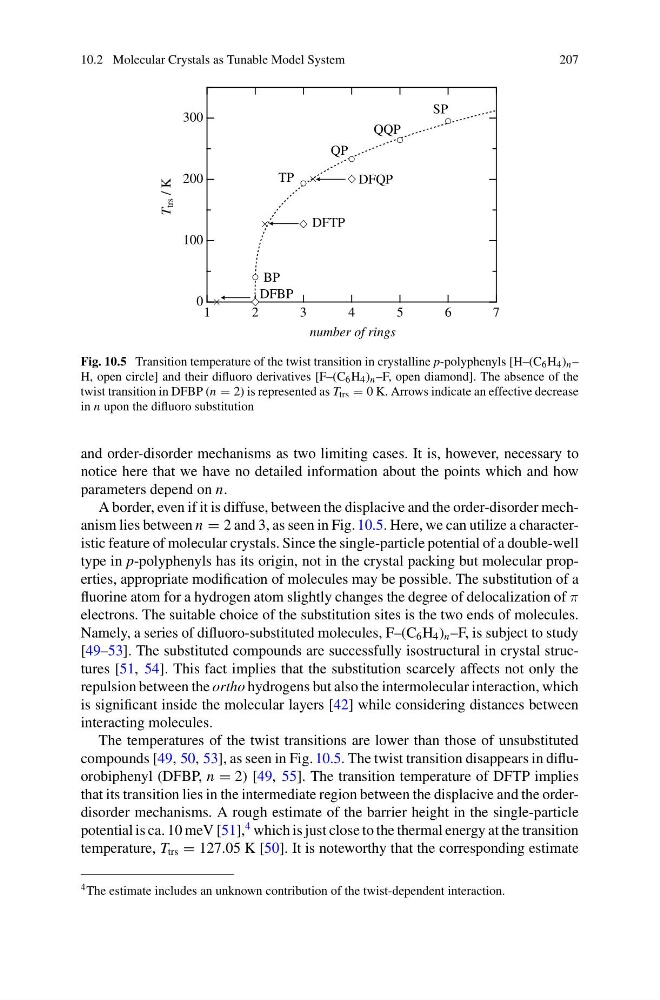
Fig. 10.5 Transition temperature of the twist transition in crystalline p-polyphenyls [H–(C 6 H 4 ) n –
H, open circle] and their difluoro derivatives [F–(C 6 H 4 ) n –F, open diamond]. The absence of the
twist transition in DFBP (n = 2) is represented as T trs = 0 K. Arrows indicate an effective decrease
in n upon the difluoro substitution
and order-disorder mechanisms as two limiting cases. It is, however, necessary to
notice here that we have no detailed information about the points which and how
parameters depend on n.
A border, even if it is diffuse, between the displacive and the order-disorder mechanism lies between n = 2 and 3, as seen in Fig. 10.5. Here, we can utilize a characteristic feature of molecular crystals. Since the single-particle potential of a double-well
type in p-polyphenyls has its origin, not in the crystal packing but molecular properties, appropriate modification of molecules may be possible. The substitution of a
fluorine atom for a hydrogen atom slightly changes the degree of delocalization of π
electrons. The suitable choice of the substitution sites is the two ends of molecules.
Namely, a series of difluoro-substituted molecules, F–(C 6 H 4 ) n –F, is subject to study
[49–53]. The substituted compounds are successfully isostructural in crystal structures [51, 54]. This fact implies that the substitution scarcely affects not only the
repulsion between the ortho hydrogens but also the intermolecular interaction, which
is significant inside the molecular layers [42] while considering distances between
interacting molecules.
The temperatures of the twist transitions are lower than those of unsubstituted
compounds [49, 50, 53], as seen in Fig. 10.5. The twist transition disappears in difluorobiphenyl (DFBP, n = 2) [49, 55]. The transition temperature of DFTP implies
that its transition lies in the intermediate region between the displacive and the orderdisorder mechanisms. A rough estimate of the barrier height in the single-particle
potential is ca. 10 meV [51],
4 which is just close to the thermal energy at the transition
temperature, T trs = 127.05 K [50]. It is noteworthy that the corresponding estimate
4 The estimate includes an unknown contribution of the twist-dependent interaction.
207
300
200
100
0
T
trs / K
7
6
5
4
3
2
1
number of rings
BP
DFQP
TP
QP
QQP
SP
DFTP
DFBP
Fig. 10.5 Transition temperature of the twist transition in crystalline p-polyphenyls [H–(C 6 H 4 ) n –
H, open circle] and their difluoro derivatives [F–(C 6 H 4 ) n –F, open diamond]. The absence of the
twist transition in DFBP (n = 2) is represented as T trs = 0 K. Arrows indicate an effective decrease
in n upon the difluoro substitution
and order-disorder mechanisms as two limiting cases. It is, however, necessary to
notice here that we have no detailed information about the points which and how
parameters depend on n.
A border, even if it is diffuse, between the displacive and the order-disorder mechanism lies between n = 2 and 3, as seen in Fig. 10.5. Here, we can utilize a characteristic feature of molecular crystals. Since the single-particle potential of a double-well
type in p-polyphenyls has its origin, not in the crystal packing but molecular properties, appropriate modification of molecules may be possible. The substitution of a
fluorine atom for a hydrogen atom slightly changes the degree of delocalization of π
electrons. The suitable choice of the substitution sites is the two ends of molecules.
Namely, a series of difluoro-substituted molecules, F–(C 6 H 4 ) n –F, is subject to study
[49–53]. The substituted compounds are successfully isostructural in crystal structures [51, 54]. This fact implies that the substitution scarcely affects not only the
repulsion between the ortho hydrogens but also the intermolecular interaction, which
is significant inside the molecular layers [42] while considering distances between
interacting molecules.
The temperatures of the twist transitions are lower than those of unsubstituted
compounds [49, 50, 53], as seen in Fig. 10.5. The twist transition disappears in difluorobiphenyl (DFBP, n = 2) [49, 55]. The transition temperature of DFTP implies
that its transition lies in the intermediate region between the displacive and the orderdisorder mechanisms. A rough estimate of the barrier height in the single-particle
potential is ca. 10 meV [51],
4 which is just close to the thermal energy at the transition
temperature, T trs = 127.05 K [50]. It is noteworthy that the corresponding estimate
4 The estimate includes an unknown contribution of the twist-dependent interaction.