

206
10 Importance of Molecular Crystals
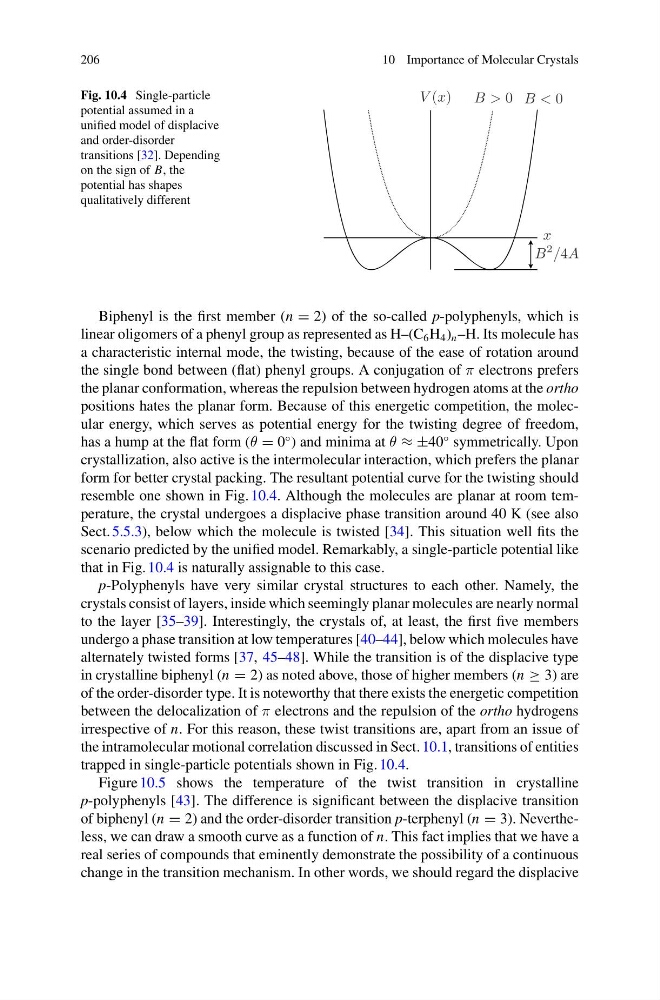
Fig. 10.4 Single-particle
potential assumed in a
unified model of displacive
and order-disorder
transitions [32]. Depending
on the sign of B, the
potential has shapes
qualitatively different
Biphenyl is the first member (n = 2) of the so-called p-polyphenyls, which is
linear oligomers of a phenyl group as represented as H–(C 6 H 4 ) n –H. Its molecule has
a characteristic internal mode, the twisting, because of the ease of rotation around
the single bond between (flat) phenyl groups. A conjugation of π electrons prefers
the planar conformation, whereas the repulsion between hydrogen atoms at the ortho
positions hates the planar form. Because of this energetic competition, the molecular energy, which serves as potential energy for the twisting degree of freedom,
has a hump at the flat form (θ = 0
◦ ) and minima at θ ≈ ±40
◦ symmetrically. Upon
crystallization, also active is the intermolecular interaction, which prefers the planar
form for better crystal packing. The resultant potential curve for the twisting should
resemble one shown in Fig. 10.4. Although the molecules are planar at room temperature, the crystal undergoes a displacive phase transition around 40 K (see also
Sect. 5.5.3), below which the molecule is twisted [34]. This situation well fits the
scenario predicted by the unified model. Remarkably, a single-particle potential like
that in Fig. 10.4 is naturally assignable to this case.
p-Polyphenyls have very similar crystal structures to each other. Namely, the
crystals consist of layers, inside which seemingly planar molecules are nearly normal
to the layer [35–39]. Interestingly, the crystals of, at least, the first five members
undergo a phase transition at low temperatures [40–44], below which molecules have
alternately twisted forms [37, 45–48]. While the transition is of the displacive type
in crystalline biphenyl (n = 2) as noted above, those of higher members (n ≥ 3) are
of the order-disorder type. It is noteworthy that there exists the energetic competition
between the delocalization of π electrons and the repulsion of the ortho hydrogens
irrespective of n. For this reason, these twist transitions are, apart from an issue of
the intramolecular motional correlation discussed in Sect. 10.1, transitions of entities
trapped in single-particle potentials shown in Fig. 10.4.
Figure 10.5 shows the temperature of the twist transition in crystalline
p-polyphenyls [43]. The difference is significant between the displacive transition
of biphenyl (n = 2) and the order-disorder transition p-terphenyl (n = 3). Nevertheless, we can draw a smooth curve as a function of n. This fact implies that we have a
real series of compounds that eminently demonstrate the possibility of a continuous
change in the transition mechanism. In other words, we should regard the displacive
10 Importance of Molecular Crystals
Fig. 10.4 Single-particle
potential assumed in a
unified model of displacive
and order-disorder
transitions [32]. Depending
on the sign of B, the
potential has shapes
qualitatively different
Biphenyl is the first member (n = 2) of the so-called p-polyphenyls, which is
linear oligomers of a phenyl group as represented as H–(C 6 H 4 ) n –H. Its molecule has
a characteristic internal mode, the twisting, because of the ease of rotation around
the single bond between (flat) phenyl groups. A conjugation of π electrons prefers
the planar conformation, whereas the repulsion between hydrogen atoms at the ortho
positions hates the planar form. Because of this energetic competition, the molecular energy, which serves as potential energy for the twisting degree of freedom,
has a hump at the flat form (θ = 0
◦ ) and minima at θ ≈ ±40
◦ symmetrically. Upon
crystallization, also active is the intermolecular interaction, which prefers the planar
form for better crystal packing. The resultant potential curve for the twisting should
resemble one shown in Fig. 10.4. Although the molecules are planar at room temperature, the crystal undergoes a displacive phase transition around 40 K (see also
Sect. 5.5.3), below which the molecule is twisted [34]. This situation well fits the
scenario predicted by the unified model. Remarkably, a single-particle potential like
that in Fig. 10.4 is naturally assignable to this case.
p-Polyphenyls have very similar crystal structures to each other. Namely, the
crystals consist of layers, inside which seemingly planar molecules are nearly normal
to the layer [35–39]. Interestingly, the crystals of, at least, the first five members
undergo a phase transition at low temperatures [40–44], below which molecules have
alternately twisted forms [37, 45–48]. While the transition is of the displacive type
in crystalline biphenyl (n = 2) as noted above, those of higher members (n ≥ 3) are
of the order-disorder type. It is noteworthy that there exists the energetic competition
between the delocalization of π electrons and the repulsion of the ortho hydrogens
irrespective of n. For this reason, these twist transitions are, apart from an issue of
the intramolecular motional correlation discussed in Sect. 10.1, transitions of entities
trapped in single-particle potentials shown in Fig. 10.4.
Figure 10.5 shows the temperature of the twist transition in crystalline
p-polyphenyls [43]. The difference is significant between the displacive transition
of biphenyl (n = 2) and the order-disorder transition p-terphenyl (n = 3). Nevertheless, we can draw a smooth curve as a function of n. This fact implies that we have a
real series of compounds that eminently demonstrate the possibility of a continuous
change in the transition mechanism. In other words, we should regard the displacive