

9.4 Conformational Disordering of Alkyl Groups
195
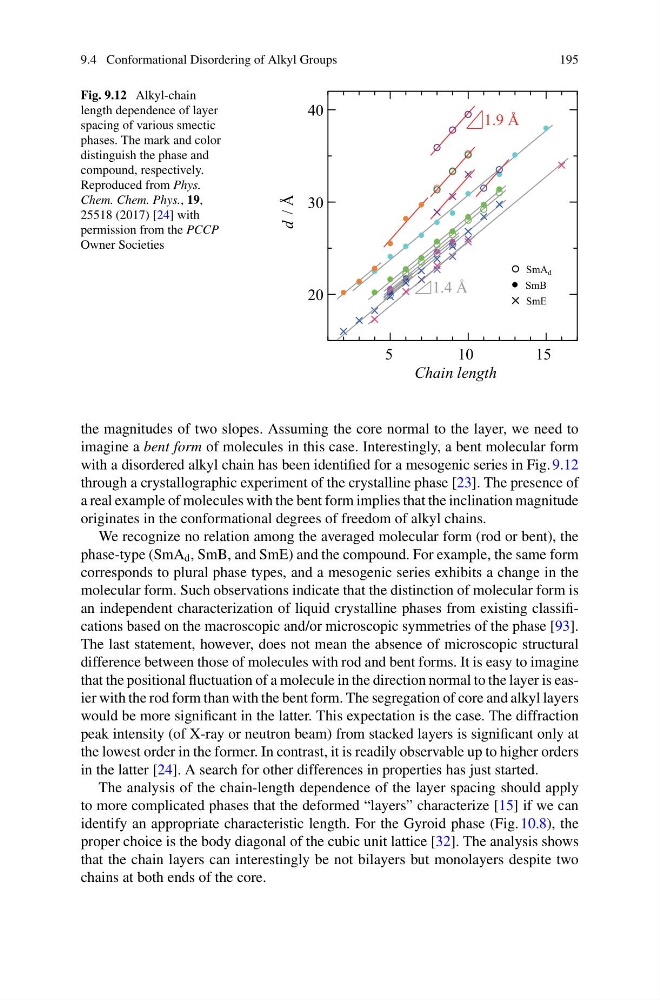
Fig. 9.12 Alkyl-chain
length dependence of layer
spacing of various smectic
phases. The mark and color
distinguish the phase and
compound, respectively.
Reproduced from Phys.
Chem. Chem. Phys., 19,
25518 (2017) [24] with
permission from the PCCP
Owner Societies
5
10
15
20
30
40
Chain length
d / Å
1.4 Å
1.9 Å
SmA d
SmB
SmE
the magnitudes of two slopes. Assuming the core normal to the layer, we need to
imagine a bent form of molecules in this case. Interestingly, a bent molecular form
with a disordered alkyl chain has been identified for a mesogenic series in Fig. 9.12
through a crystallographic experiment of the crystalline phase [23]. The presence of
a real example of molecules with the bent form implies that the inclination magnitude
originates in the conformational degrees of freedom of alkyl chains.
We recognize no relation among the averaged molecular form (rod or bent), the
phase-type (SmA d , SmB, and SmE) and the compound. For example, the same form
corresponds to plural phase types, and a mesogenic series exhibits a change in the
molecular form. Such observations indicate that the distinction of molecular form is
an independent characterization of liquid crystalline phases from existing classifications based on the macroscopic and/or microscopic symmetries of the phase [93].
The last statement, however, does not mean the absence of microscopic structural
difference between those of molecules with rod and bent forms. It is easy to imagine
that the positional fluctuation of a molecule in the direction normal to the layer is easier with the rod form than with the bent form. The segregation of core and alkyl layers
would be more significant in the latter. This expectation is the case. The diffraction
peak intensity (of X-ray or neutron beam) from stacked layers is significant only at
the lowest order in the former. In contrast, it is readily observable up to higher orders
in the latter [24]. A search for other differences in properties has just started.
The analysis of the chain-length dependence of the layer spacing should apply
to more complicated phases that the deformed “layers” characterize [15] if we can
identify an appropriate characteristic length. For the Gyroid phase (Fig. 10.8), the
proper choice is the body diagonal of the cubic unit lattice [32]. The analysis shows
that the chain layers can interestingly be not bilayers but monolayers despite two
chains at both ends of the core.
195
Fig. 9.12 Alkyl-chain
length dependence of layer
spacing of various smectic
phases. The mark and color
distinguish the phase and
compound, respectively.
Reproduced from Phys.
Chem. Chem. Phys., 19,
25518 (2017) [24] with
permission from the PCCP
Owner Societies
5
10
15
20
30
40
Chain length
d / Å
1.4 Å
1.9 Å
SmA d
SmB
SmE
the magnitudes of two slopes. Assuming the core normal to the layer, we need to
imagine a bent form of molecules in this case. Interestingly, a bent molecular form
with a disordered alkyl chain has been identified for a mesogenic series in Fig. 9.12
through a crystallographic experiment of the crystalline phase [23]. The presence of
a real example of molecules with the bent form implies that the inclination magnitude
originates in the conformational degrees of freedom of alkyl chains.
We recognize no relation among the averaged molecular form (rod or bent), the
phase-type (SmA d , SmB, and SmE) and the compound. For example, the same form
corresponds to plural phase types, and a mesogenic series exhibits a change in the
molecular form. Such observations indicate that the distinction of molecular form is
an independent characterization of liquid crystalline phases from existing classifications based on the macroscopic and/or microscopic symmetries of the phase [93].
The last statement, however, does not mean the absence of microscopic structural
difference between those of molecules with rod and bent forms. It is easy to imagine
that the positional fluctuation of a molecule in the direction normal to the layer is easier with the rod form than with the bent form. The segregation of core and alkyl layers
would be more significant in the latter. This expectation is the case. The diffraction
peak intensity (of X-ray or neutron beam) from stacked layers is significant only at
the lowest order in the former. In contrast, it is readily observable up to higher orders
in the latter [24]. A search for other differences in properties has just started.
The analysis of the chain-length dependence of the layer spacing should apply
to more complicated phases that the deformed “layers” characterize [15] if we can
identify an appropriate characteristic length. For the Gyroid phase (Fig. 10.8), the
proper choice is the body diagonal of the cubic unit lattice [32]. The analysis shows
that the chain layers can interestingly be not bilayers but monolayers despite two
chains at both ends of the core.