

194
9 Molecular Flexibility and Material Properties
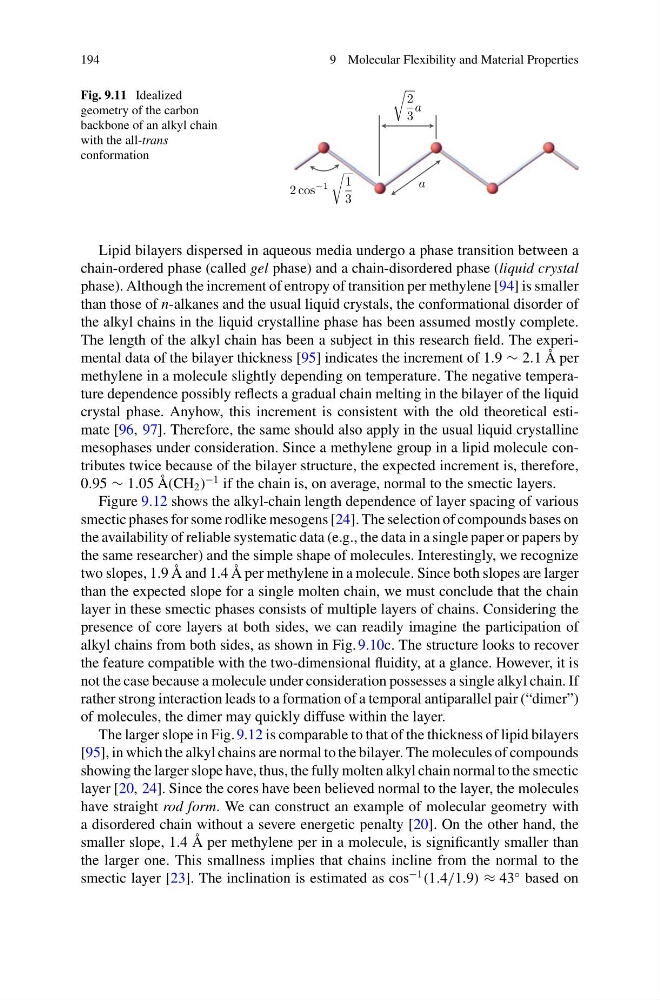
Fig. 9.11 Idealized
geometry of the carbon
backbone of an alkyl chain
with the all-trans
conformation
Lipid bilayers dispersed in aqueous media undergo a phase transition between a
chain-ordered phase (called gel phase) and a chain-disordered phase (liquid crystal
phase). Although the increment of entropy of transition per methylene [94] is smaller
than those of n-alkanes and the usual liquid crystals, the conformational disorder of
the alkyl chains in the liquid crystalline phase has been assumed mostly complete.
The length of the alkyl chain has been a subject in this research field. The experimental data of the bilayer thickness [95] indicates the increment of 1.9 ∼ 2.1 Å per
methylene in a molecule slightly depending on temperature. The negative temperature dependence possibly reflects a gradual chain melting in the bilayer of the liquid
crystal phase. Anyhow, this increment is consistent with the old theoretical estimate [96, 97]. Therefore, the same should also apply in the usual liquid crystalline
mesophases under consideration. Since a methylene group in a lipid molecule contributes twice because of the bilayer structure, the expected increment is, therefore,
0.95 ∼ 1.05 Å(CH 2 )
−1 if the chain is, on average, normal to the smectic layers.
Figure 9.12 shows the alkyl-chain length dependence of layer spacing of various
smectic phases for some rodlike mesogens [24]. The selection of compounds bases on
the availability of reliable systematic data (e.g., the data in a single paper or papers by
the same researcher) and the simple shape of molecules. Interestingly, we recognize
two slopes, 1.9 Å and 1.4 Å per methylene in a molecule. Since both slopes are larger
than the expected slope for a single molten chain, we must conclude that the chain
layer in these smectic phases consists of multiple layers of chains. Considering the
presence of core layers at both sides, we can readily imagine the participation of
alkyl chains from both sides, as shown in Fig. 9.10c. The structure looks to recover
the feature compatible with the two-dimensional fluidity, at a glance. However, it is
not the case because a molecule under consideration possesses a single alkyl chain. If
rather strong interaction leads to a formation of a temporal antiparallel pair (“dimer”)
of molecules, the dimer may quickly diffuse within the layer.
The larger slope in Fig. 9.12 is comparable to that of the thickness of lipid bilayers
[95], in which the alkyl chains are normal to the bilayer. The molecules of compounds
showing the larger slope have, thus, the fully molten alkyl chain normal to the smectic
layer [20, 24]. Since the cores have been believed normal to the layer, the molecules
have straight rod form. We can construct an example of molecular geometry with
a disordered chain without a severe energetic penalty [20]. On the other hand, the
smaller slope, 1.4 Å per methylene per in a molecule, is significantly smaller than
the larger one. This smallness implies that chains incline from the normal to the
smectic layer [23]. The inclination is estimated as cos
−1
(1.4/1.9) ≈ 43
◦ based on
9 Molecular Flexibility and Material Properties
Fig. 9.11 Idealized
geometry of the carbon
backbone of an alkyl chain
with the all-trans
conformation
Lipid bilayers dispersed in aqueous media undergo a phase transition between a
chain-ordered phase (called gel phase) and a chain-disordered phase (liquid crystal
phase). Although the increment of entropy of transition per methylene [94] is smaller
than those of n-alkanes and the usual liquid crystals, the conformational disorder of
the alkyl chains in the liquid crystalline phase has been assumed mostly complete.
The length of the alkyl chain has been a subject in this research field. The experimental data of the bilayer thickness [95] indicates the increment of 1.9 ∼ 2.1 Å per
methylene in a molecule slightly depending on temperature. The negative temperature dependence possibly reflects a gradual chain melting in the bilayer of the liquid
crystal phase. Anyhow, this increment is consistent with the old theoretical estimate [96, 97]. Therefore, the same should also apply in the usual liquid crystalline
mesophases under consideration. Since a methylene group in a lipid molecule contributes twice because of the bilayer structure, the expected increment is, therefore,
0.95 ∼ 1.05 Å(CH 2 )
−1 if the chain is, on average, normal to the smectic layers.
Figure 9.12 shows the alkyl-chain length dependence of layer spacing of various
smectic phases for some rodlike mesogens [24]. The selection of compounds bases on
the availability of reliable systematic data (e.g., the data in a single paper or papers by
the same researcher) and the simple shape of molecules. Interestingly, we recognize
two slopes, 1.9 Å and 1.4 Å per methylene in a molecule. Since both slopes are larger
than the expected slope for a single molten chain, we must conclude that the chain
layer in these smectic phases consists of multiple layers of chains. Considering the
presence of core layers at both sides, we can readily imagine the participation of
alkyl chains from both sides, as shown in Fig. 9.10c. The structure looks to recover
the feature compatible with the two-dimensional fluidity, at a glance. However, it is
not the case because a molecule under consideration possesses a single alkyl chain. If
rather strong interaction leads to a formation of a temporal antiparallel pair (“dimer”)
of molecules, the dimer may quickly diffuse within the layer.
The larger slope in Fig. 9.12 is comparable to that of the thickness of lipid bilayers
[95], in which the alkyl chains are normal to the bilayer. The molecules of compounds
showing the larger slope have, thus, the fully molten alkyl chain normal to the smectic
layer [20, 24]. Since the cores have been believed normal to the layer, the molecules
have straight rod form. We can construct an example of molecular geometry with
a disordered chain without a severe energetic penalty [20]. On the other hand, the
smaller slope, 1.4 Å per methylene per in a molecule, is significantly smaller than
the larger one. This smallness implies that chains incline from the normal to the
smectic layer [23]. The inclination is estimated as cos
−1
(1.4/1.9) ≈ 43
◦ based on