

8.1 Glass as Frozen-in State
169
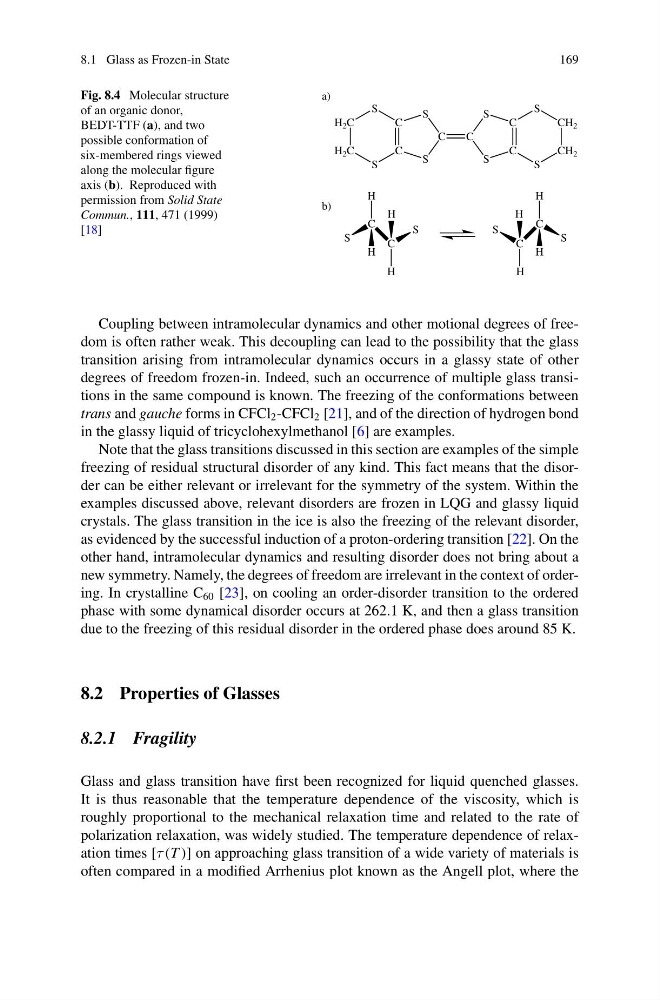
Fig. 8.4 Molecular structure
of an organic donor,
BEDT-TTF (a), and two
possible conformation of
six-membered rings viewed
along the molecular figure
axis (b). Reproduced with
permission from Solid State
Commun., 111, 471 (1999)
[18]
H 2 C
H 2 C
S
C
C
S
S
C
S
CH 2
CH 2
S
C
C
S
S
C
S
S
C
C
S
S
C
C
S
H
H
H
H
H
H
H
H
a)
b)
Coupling between intramolecular dynamics and other motional degrees of freedom is often rather weak. This decoupling can lead to the possibility that the glass
transition arising from intramolecular dynamics occurs in a glassy state of other
degrees of freedom frozen-in. Indeed, such an occurrence of multiple glass transitions in the same compound is known. The freezing of the conformations between
trans and gauche forms in CFCl 2 -CFCl 2 [21], and of the direction of hydrogen bond
in the glassy liquid of tricyclohexylmethanol [6] are examples.
Note that the glass transitions discussed in this section are examples of the simple
freezing of residual structural disorder of any kind. This fact means that the disorder can be either relevant or irrelevant for the symmetry of the system. Within the
examples discussed above, relevant disorders are frozen in LQG and glassy liquid
crystals. The glass transition in the ice is also the freezing of the relevant disorder,
as evidenced by the successful induction of a proton-ordering transition [22]. On the
other hand, intramolecular dynamics and resulting disorder does not bring about a
new symmetry. Namely, the degrees of freedom are irrelevant in the context of ordering. In crystalline C 60 [23], on cooling an order-disorder transition to the ordered
phase with some dynamical disorder occurs at 262.1 K, and then a glass transition
due to the freezing of this residual disorder in the ordered phase does around 85 K.
8.2 Properties of Glasses
8.2.1 Fragility
Glass and glass transition have first been recognized for liquid quenched glasses.
It is thus reasonable that the temperature dependence of the viscosity, which is
roughly proportional to the mechanical relaxation time and related to the rate of
polarization relaxation, was widely studied. The temperature dependence of relaxation times [τ (T )] on approaching glass transition of a wide variety of materials is
often compared in a modified Arrhenius plot known as the Angell plot, where the
169
Fig. 8.4 Molecular structure
of an organic donor,
BEDT-TTF (a), and two
possible conformation of
six-membered rings viewed
along the molecular figure
axis (b). Reproduced with
permission from Solid State
Commun., 111, 471 (1999)
[18]
H 2 C
H 2 C
S
C
C
S
S
C
S
CH 2
CH 2
S
C
C
S
S
C
S
S
C
C
S
S
C
C
S
H
H
H
H
H
H
H
H
a)
b)
Coupling between intramolecular dynamics and other motional degrees of freedom is often rather weak. This decoupling can lead to the possibility that the glass
transition arising from intramolecular dynamics occurs in a glassy state of other
degrees of freedom frozen-in. Indeed, such an occurrence of multiple glass transitions in the same compound is known. The freezing of the conformations between
trans and gauche forms in CFCl 2 -CFCl 2 [21], and of the direction of hydrogen bond
in the glassy liquid of tricyclohexylmethanol [6] are examples.
Note that the glass transitions discussed in this section are examples of the simple
freezing of residual structural disorder of any kind. This fact means that the disorder can be either relevant or irrelevant for the symmetry of the system. Within the
examples discussed above, relevant disorders are frozen in LQG and glassy liquid
crystals. The glass transition in the ice is also the freezing of the relevant disorder,
as evidenced by the successful induction of a proton-ordering transition [22]. On the
other hand, intramolecular dynamics and resulting disorder does not bring about a
new symmetry. Namely, the degrees of freedom are irrelevant in the context of ordering. In crystalline C 60 [23], on cooling an order-disorder transition to the ordered
phase with some dynamical disorder occurs at 262.1 K, and then a glass transition
due to the freezing of this residual disorder in the ordered phase does around 85 K.
8.2 Properties of Glasses
8.2.1 Fragility
Glass and glass transition have first been recognized for liquid quenched glasses.
It is thus reasonable that the temperature dependence of the viscosity, which is
roughly proportional to the mechanical relaxation time and related to the rate of
polarization relaxation, was widely studied. The temperature dependence of relaxation times [τ (T )] on approaching glass transition of a wide variety of materials is
often compared in a modified Arrhenius plot known as the Angell plot, where the