

7.3 Effects of Molecular Shape
155
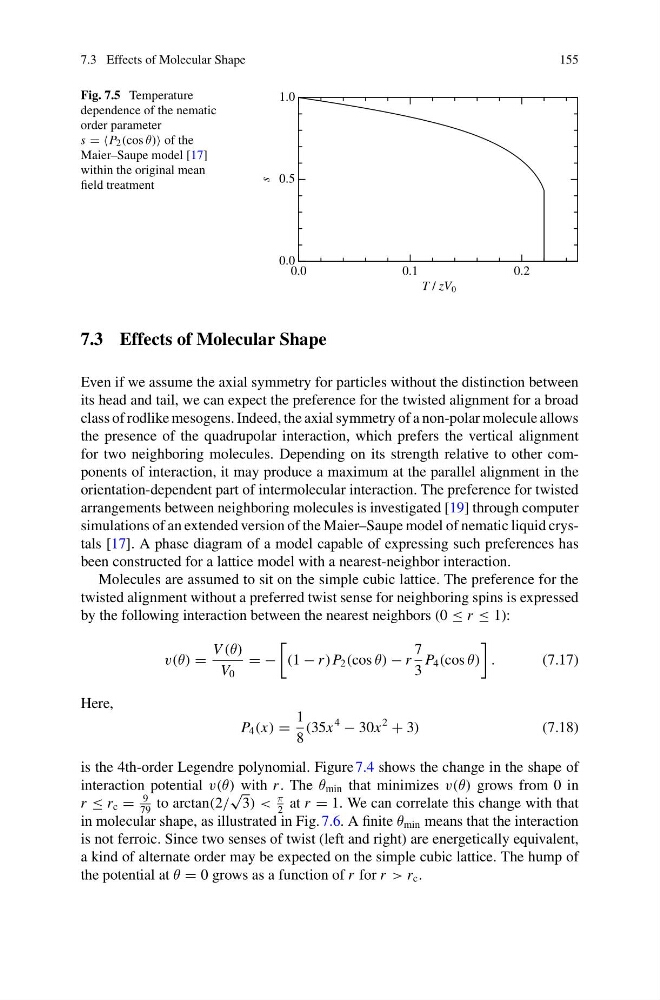
Fig. 7.5 Temperature
dependence of the nematic
order parameter
s = =P 2 (cos θ) of the
Maier–Saupe model [17]
within the original mean
field treatment
1.0
0.5
0.0
s
0.2
0.1
0.0
T / zV 0
7.3 Effects of Molecular Shape
Even if we assume the axial symmetry for particles without the distinction between
its head and tail, we can expect the preference for the twisted alignment for a broad
class of rodlike mesogens. Indeed, the axial symmetry of a non-polar molecule allows
the presence of the quadrupolar interaction, which prefers the vertical alignment
for two neighboring molecules. Depending on its strength relative to other components of interaction, it may produce a maximum at the parallel alignment in the
orientation-dependent part of intermolecular interaction. The preference for twisted
arrangements between neighboring molecules is investigated [19] through computer
simulations of an extended version of the Maier–Saupe model of nematic liquid crystals [17]. A phase diagram of a model capable of expressing such preferences has
been constructed for a lattice model with a nearest-neighbor interaction.
Molecules are assumed to sit on the simple cubic lattice. The preference for the
twisted alignment without a preferred twist sense for neighboring spins is expressed
by the following interaction between the nearest neighbors (0 ≤ r ≤ 1):
v(θ) =
V (θ)
V 0
= −
(1 − r )P 2 (cos θ) − r
7
3
P 4 (cos θ)
.
(7.17)
Here,
P 4 (x) =
1
8
(35x
4
− 30x
2
+ 3)
(7.18)
is the 4th-order Legendre polynomial. Figure 7.4 shows the change in the shape of
interaction potential v(θ) with r . The θ min that minimizes v(θ) grows from 0 in
r ≤ r c =
9
79
to arctan(2/
√
3) <
π
2
at r = 1. We can correlate this change with that
in molecular shape, as illustrated in Fig. 7.6. A finite θ min means that the interaction
is not ferroic. Since two senses of twist (left and right) are energetically equivalent,
a kind of alternate order may be expected on the simple cubic lattice. The hump of
the potential at θ = 0 grows as a function of r for r > r c .
155
Fig. 7.5 Temperature
dependence of the nematic
order parameter
s = =P 2 (cos θ) of the
Maier–Saupe model [17]
within the original mean
field treatment
1.0
0.5
0.0
s
0.2
0.1
0.0
T / zV 0
7.3 Effects of Molecular Shape
Even if we assume the axial symmetry for particles without the distinction between
its head and tail, we can expect the preference for the twisted alignment for a broad
class of rodlike mesogens. Indeed, the axial symmetry of a non-polar molecule allows
the presence of the quadrupolar interaction, which prefers the vertical alignment
for two neighboring molecules. Depending on its strength relative to other components of interaction, it may produce a maximum at the parallel alignment in the
orientation-dependent part of intermolecular interaction. The preference for twisted
arrangements between neighboring molecules is investigated [19] through computer
simulations of an extended version of the Maier–Saupe model of nematic liquid crystals [17]. A phase diagram of a model capable of expressing such preferences has
been constructed for a lattice model with a nearest-neighbor interaction.
Molecules are assumed to sit on the simple cubic lattice. The preference for the
twisted alignment without a preferred twist sense for neighboring spins is expressed
by the following interaction between the nearest neighbors (0 ≤ r ≤ 1):
v(θ) =
V (θ)
V 0
= −
(1 − r )P 2 (cos θ) − r
7
3
P 4 (cos θ)
.
(7.17)
Here,
P 4 (x) =
1
8
(35x
4
− 30x
2
+ 3)
(7.18)
is the 4th-order Legendre polynomial. Figure 7.4 shows the change in the shape of
interaction potential v(θ) with r . The θ min that minimizes v(θ) grows from 0 in
r ≤ r c =
9
79
to arctan(2/
√
3) <
π
2
at r = 1. We can correlate this change with that
in molecular shape, as illustrated in Fig. 7.6. A finite θ min means that the interaction
is not ferroic. Since two senses of twist (left and right) are energetically equivalent,
a kind of alternate order may be expected on the simple cubic lattice. The hump of
the potential at θ = 0 grows as a function of r for r > r c .