

138
6 Melting of Molecular Crystals
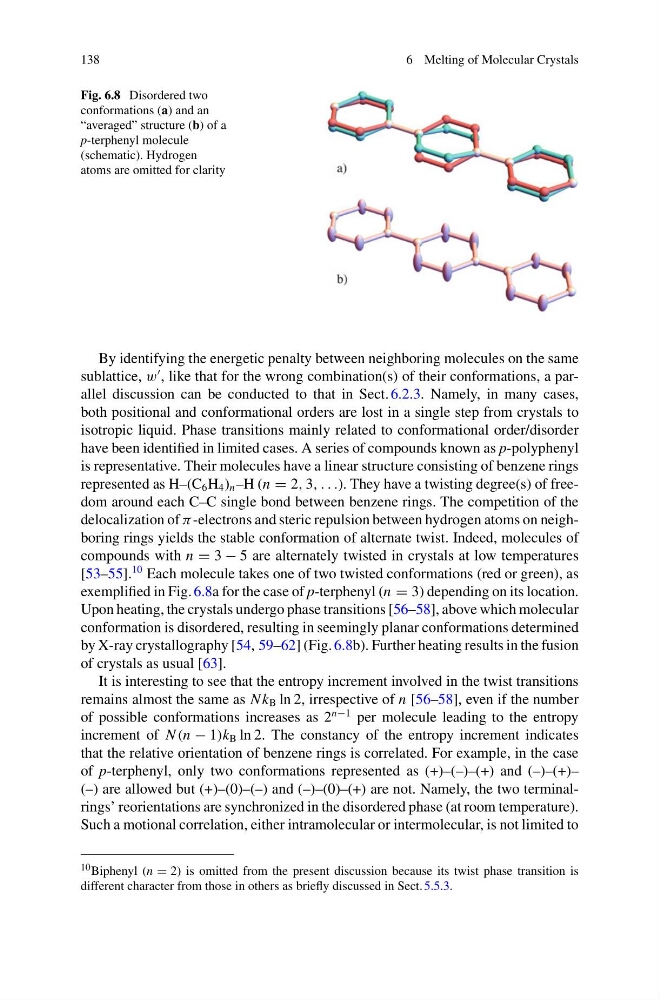
Fig. 6.8 Disordered two
conformations (a) and an
“averaged” structure (b) of a
p-terphenyl molecule
(schematic). Hydrogen
atoms are omitted for clarity
By identifying the energetic penalty between neighboring molecules on the same
sublattice, w
, like that for the wrong combination(s) of their conformations, a parallel discussion can be conducted to that in Sect. 6.2.3. Namely, in many cases,
both positional and conformational orders are lost in a single step from crystals to
isotropic liquid. Phase transitions mainly related to conformational order/disorder
have been identified in limited cases. A series of compounds known as p-polyphenyl
is representative. Their molecules have a linear structure consisting of benzene rings
represented as H–(C 6 H 4 ) n –H (n = 2, 3, . . .). They have a twisting degree(s) of freedom around each C–C single bond between benzene rings. The competition of the
delocalization of π -electrons and steric repulsion between hydrogen atoms on neighboring rings yields the stable conformation of alternate twist. Indeed, molecules of
compounds with n = 3 − 5 are alternately twisted in crystals at low temperatures
[53–55].
10 Each molecule takes one of two twisted conformations (red or green), as
exemplified in Fig. 6.8a for the case of p-terphenyl (n = 3) depending on its location.
Upon heating, the crystals undergo phase transitions [56–58], above which molecular
conformation is disordered, resulting in seemingly planar conformations determined
by X-ray crystallography [54, 59–62] (Fig. 6.8b). Further heating results in the fusion
of crystals as usual [63].
It is interesting to see that the entropy increment involved in the twist transitions
remains almost the same as N k B ln 2, irrespective of n [56–58], even if the number
of possible conformations increases as 2
n−1 per molecule leading to the entropy
increment of N (n − 1)k B ln 2. The constancy of the entropy increment indicates
that the relative orientation of benzene rings is correlated. For example, in the case
of p-terphenyl, only two conformations represented as (+)–(–)–(+) and (–)–(+)–
(–) are allowed but (+)–(0)–(–) and (–)–(0)–(+) are not. Namely, the two terminalrings’ reorientations are synchronized in the disordered phase (at room temperature).
Such a motional correlation, either intramolecular or intermolecular, is not limited to
10 Biphenyl (n = 2) is omitted from the present discussion because its twist phase transition is
different character from those in others as briefly discussed in Sect. 5.5.3.
6 Melting of Molecular Crystals
Fig. 6.8 Disordered two
conformations (a) and an
“averaged” structure (b) of a
p-terphenyl molecule
(schematic). Hydrogen
atoms are omitted for clarity
By identifying the energetic penalty between neighboring molecules on the same
sublattice, w
, like that for the wrong combination(s) of their conformations, a parallel discussion can be conducted to that in Sect. 6.2.3. Namely, in many cases,
both positional and conformational orders are lost in a single step from crystals to
isotropic liquid. Phase transitions mainly related to conformational order/disorder
have been identified in limited cases. A series of compounds known as p-polyphenyl
is representative. Their molecules have a linear structure consisting of benzene rings
represented as H–(C 6 H 4 ) n –H (n = 2, 3, . . .). They have a twisting degree(s) of freedom around each C–C single bond between benzene rings. The competition of the
delocalization of π -electrons and steric repulsion between hydrogen atoms on neighboring rings yields the stable conformation of alternate twist. Indeed, molecules of
compounds with n = 3 − 5 are alternately twisted in crystals at low temperatures
[53–55].
10 Each molecule takes one of two twisted conformations (red or green), as
exemplified in Fig. 6.8a for the case of p-terphenyl (n = 3) depending on its location.
Upon heating, the crystals undergo phase transitions [56–58], above which molecular
conformation is disordered, resulting in seemingly planar conformations determined
by X-ray crystallography [54, 59–62] (Fig. 6.8b). Further heating results in the fusion
of crystals as usual [63].
It is interesting to see that the entropy increment involved in the twist transitions
remains almost the same as N k B ln 2, irrespective of n [56–58], even if the number
of possible conformations increases as 2
n−1 per molecule leading to the entropy
increment of N (n − 1)k B ln 2. The constancy of the entropy increment indicates
that the relative orientation of benzene rings is correlated. For example, in the case
of p-terphenyl, only two conformations represented as (+)–(–)–(+) and (–)–(+)–
(–) are allowed but (+)–(0)–(–) and (–)–(0)–(+) are not. Namely, the two terminalrings’ reorientations are synchronized in the disordered phase (at room temperature).
Such a motional correlation, either intramolecular or intermolecular, is not limited to
10 Biphenyl (n = 2) is omitted from the present discussion because its twist phase transition is
different character from those in others as briefly discussed in Sect. 5.5.3.