

6.3 Molecular Deformation
137
300
200
100
0
30
20
10
0
n in H-(CH 2 ) n -H
S
/ J K
-1
mol
-1
trs S
fus S + trs S
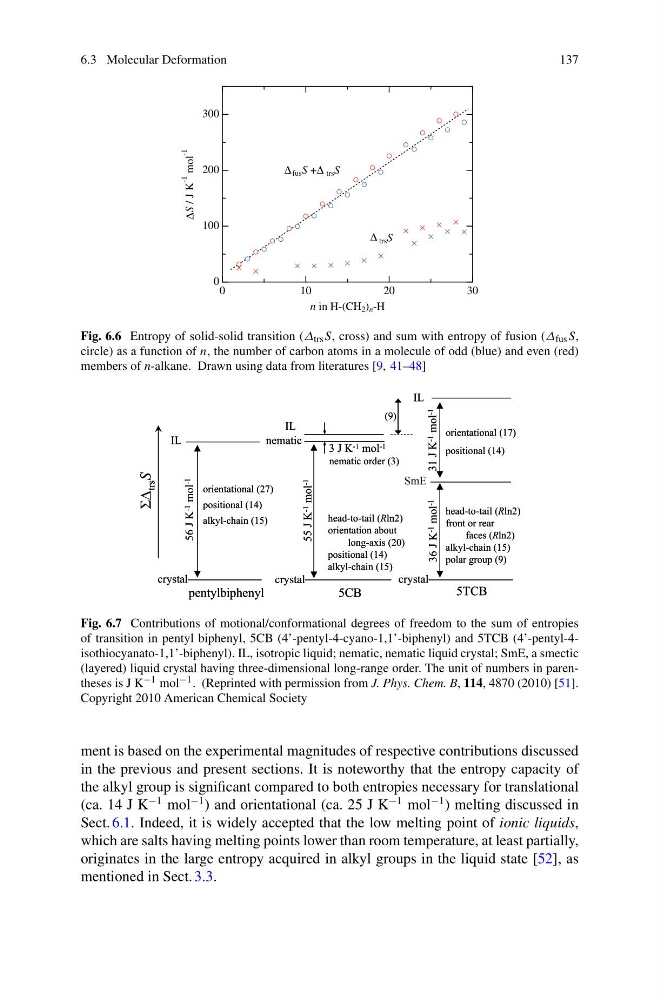
Fig. 6.6 Entropy of solid-solid transition (Δ trs S, cross) and sum with entropy of fusion (Δ fus S,
circle) as a function of n, the number of carbon atoms in a molecule of odd (blue) and even (red)
members of n-alkane. Drawn using data from literatures [9, 41–48]
56 J K -1
mol -1
55 J K -1
mol -1
31 J K -1
mol -1
36 J K -1
mol -1
crystal
SmE
IL
IL
IL
nematic
trs S
pentylbiphenyl
5CB
5TCB
3 J K -1 mol -1
orientational (27)
positional (14)
alkyl-chain (15)
nematic order (3)
head-to-tail (Rln2)
orientation about
long-axis (20)
positional (14)
alkyl-chain (15)
head-to-tail (Rln2)
front or rear
faces (Rln2)
alkyl-chain (15)
polar group (9)
orientational (17)
positional (14)
(9)
crystal
crystal
56 J K -1
mol -1
55 J K -1
mol -1
31 J K -1
mol -1
36 J K -1
mol -1
crystal
IL
IL
IL
nematic
ΣΔ
trs S
pentylbiphenyl
5CB
5TCB
3 J K -1 mol -1
orientational (27)
positional (14)
alkyl-chain (15)
nematic order (3)
head-to-tail (Rln2)
orientation about
long-axis (20)
positional (14)
alkyl-chain (15)
head-to-tail (Rln2)
front or rear
faces (Rln2)
alkyl-chain (15)
polar group (9)
orientational (17)
positional (14)
(9)
crystal
crystal
Fig. 6.7 Contributions of motional/conformational degrees of freedom to the sum of entropies
of transition in pentyl biphenyl, 5CB (4’-pentyl-4-cyano-1,1’-biphenyl) and 5TCB (4’-pentyl-4isothiocyanato-1,1’-biphenyl). IL, isotropic liquid; nematic, nematic liquid crystal; SmE, a smectic
(layered) liquid crystal having three-dimensional long-range order. The unit of numbers in parentheses is J K −1 mol −1 . (Reprinted with permission from J. Phys. Chem. B, 114, 4870 (2010) [51].
Copyright 2010 American Chemical Society
ment is based on the experimental magnitudes of respective contributions discussed
in the previous and present sections. It is noteworthy that the entropy capacity of
the alkyl group is significant compared to both entropies necessary for translational
(ca. 14 J K
−1 mol
−1 ) and orientational (ca. 25 J K
−1 mol
−1 ) melting discussed in
Sect. 6.1. Indeed, it is widely accepted that the low melting point of ionic liquids,
which are salts having melting points lower than room temperature, at least partially,
originates in the large entropy acquired in alkyl groups in the liquid state [52], as
mentioned in Sect. 3.3.
137
300
200
100
0
30
20
10
0
n in H-(CH 2 ) n -H
S
/ J K
-1
mol
-1
trs S
fus S + trs S
Fig. 6.6 Entropy of solid-solid transition (Δ trs S, cross) and sum with entropy of fusion (Δ fus S,
circle) as a function of n, the number of carbon atoms in a molecule of odd (blue) and even (red)
members of n-alkane. Drawn using data from literatures [9, 41–48]
56 J K -1
mol -1
55 J K -1
mol -1
31 J K -1
mol -1
36 J K -1
mol -1
crystal
SmE
IL
IL
IL
nematic
trs S
pentylbiphenyl
5CB
5TCB
3 J K -1 mol -1
orientational (27)
positional (14)
alkyl-chain (15)
nematic order (3)
head-to-tail (Rln2)
orientation about
long-axis (20)
positional (14)
alkyl-chain (15)
head-to-tail (Rln2)
front or rear
faces (Rln2)
alkyl-chain (15)
polar group (9)
orientational (17)
positional (14)
(9)
crystal
crystal
56 J K -1
mol -1
55 J K -1
mol -1
31 J K -1
mol -1
36 J K -1
mol -1
crystal
IL
IL
IL
nematic
ΣΔ
trs S
pentylbiphenyl
5CB
5TCB
3 J K -1 mol -1
orientational (27)
positional (14)
alkyl-chain (15)
nematic order (3)
head-to-tail (Rln2)
orientation about
long-axis (20)
positional (14)
alkyl-chain (15)
head-to-tail (Rln2)
front or rear
faces (Rln2)
alkyl-chain (15)
polar group (9)
orientational (17)
positional (14)
(9)
crystal
crystal
Fig. 6.7 Contributions of motional/conformational degrees of freedom to the sum of entropies
of transition in pentyl biphenyl, 5CB (4’-pentyl-4-cyano-1,1’-biphenyl) and 5TCB (4’-pentyl-4isothiocyanato-1,1’-biphenyl). IL, isotropic liquid; nematic, nematic liquid crystal; SmE, a smectic
(layered) liquid crystal having three-dimensional long-range order. The unit of numbers in parentheses is J K −1 mol −1 . (Reprinted with permission from J. Phys. Chem. B, 114, 4870 (2010) [51].
Copyright 2010 American Chemical Society
ment is based on the experimental magnitudes of respective contributions discussed
in the previous and present sections. It is noteworthy that the entropy capacity of
the alkyl group is significant compared to both entropies necessary for translational
(ca. 14 J K
−1 mol
−1 ) and orientational (ca. 25 J K
−1 mol
−1 ) melting discussed in
Sect. 6.1. Indeed, it is widely accepted that the low melting point of ionic liquids,
which are salts having melting points lower than room temperature, at least partially,
originates in the large entropy acquired in alkyl groups in the liquid state [52], as
mentioned in Sect. 3.3.