

134
6 Melting of Molecular Crystals
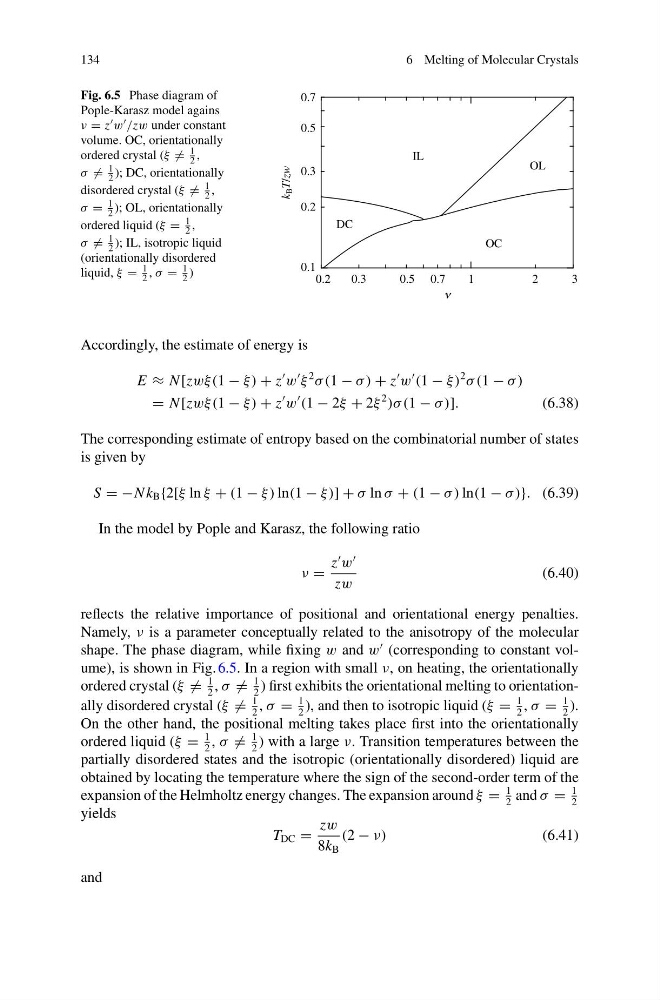
Fig. 6.5 Phase diagram of
Pople-Karasz model agains
ν = z w /zw under constant
volume. OC, orientationally
ordered crystal (ξ =
1
2 ,
σ =
1
2 ); DC, orientationally
disordered crystal (ξ =
1
2 ,
σ =
1
2 ); OL, orientationally
ordered liquid (ξ =
1
2 ,
σ =
1
2 ); IL, isotropic liquid
(orientationally disordered
liquid, ξ =
1
2 , σ =
1
2 )
0.1
k
B T/zw
IL
OL
DC
OC
0.2
0.3
0.5 0.7
1
2
3
0.2
0.3
0.5
0.7
Accordingly, the estimate of energy is
E ≈ N [zwξ(1 − ξ) + z
w
ξ
2
σ (1 − σ ) + z
w
(1 − ξ)
2
σ (1 − σ )
= N [zwξ(1 − ξ) + z
w
(1 − 2ξ + 2ξ
2
)σ (1 − σ )].
(6.38)
The corresponding estimate of entropy based on the combinatorial number of states
is given by
S = −N k B {2[ξ ln ξ + (1 − ξ) ln(1 − ξ)] + σ ln σ + (1 − σ ) ln(1 − σ )}. (6.39)
In the model by Pople and Karasz, the following ratio
ν =
z
w
zw
(6.40)
reflects the relative importance of positional and orientational energy penalties.
Namely, ν is a parameter conceptually related to the anisotropy of the molecular
shape. The phase diagram, while fixing w and w
(corresponding to constant volume), is shown in Fig. 6.5. In a region with small ν, on heating, the orientationally
ordered crystal (ξ =
1
2
, σ =
1
2
) first exhibits the orientational melting to orientationally disordered crystal (ξ =
1
2
, σ =
1
2
), and then to isotropic liquid (ξ =
1
2
, σ =
1
2
).
On the other hand, the positional melting takes place first into the orientationally
ordered liquid (ξ =
1
2
, σ =
1
2
) with a large ν. Transition temperatures between the
partially disordered states and the isotropic (orientationally disordered) liquid are
obtained by locating the temperature where the sign of the second-order term of the
expansion of the Helmholtz energy changes. The expansion around ξ =
1
2
and σ =
1
2
yields
T DC =
zw
8k B
(2 − ν)
(6.41)
and
6 Melting of Molecular Crystals
Fig. 6.5 Phase diagram of
Pople-Karasz model agains
ν = z w /zw under constant
volume. OC, orientationally
ordered crystal (ξ =
1
2 ,
σ =
1
2 ); DC, orientationally
disordered crystal (ξ =
1
2 ,
σ =
1
2 ); OL, orientationally
ordered liquid (ξ =
1
2 ,
σ =
1
2 ); IL, isotropic liquid
(orientationally disordered
liquid, ξ =
1
2 , σ =
1
2 )
0.1
k
B T/zw
IL
OL
DC
OC
0.2
0.3
0.5 0.7
1
2
3
0.2
0.3
0.5
0.7
Accordingly, the estimate of energy is
E ≈ N [zwξ(1 − ξ) + z
w
ξ
2
σ (1 − σ ) + z
w
(1 − ξ)
2
σ (1 − σ )
= N [zwξ(1 − ξ) + z
w
(1 − 2ξ + 2ξ
2
)σ (1 − σ )].
(6.38)
The corresponding estimate of entropy based on the combinatorial number of states
is given by
S = −N k B {2[ξ ln ξ + (1 − ξ) ln(1 − ξ)] + σ ln σ + (1 − σ ) ln(1 − σ )}. (6.39)
In the model by Pople and Karasz, the following ratio
ν =
z
w
zw
(6.40)
reflects the relative importance of positional and orientational energy penalties.
Namely, ν is a parameter conceptually related to the anisotropy of the molecular
shape. The phase diagram, while fixing w and w
(corresponding to constant volume), is shown in Fig. 6.5. In a region with small ν, on heating, the orientationally
ordered crystal (ξ =
1
2
, σ =
1
2
) first exhibits the orientational melting to orientationally disordered crystal (ξ =
1
2
, σ =
1
2
), and then to isotropic liquid (ξ =
1
2
, σ =
1
2
).
On the other hand, the positional melting takes place first into the orientationally
ordered liquid (ξ =
1
2
, σ =
1
2
) with a large ν. Transition temperatures between the
partially disordered states and the isotropic (orientationally disordered) liquid are
obtained by locating the temperature where the sign of the second-order term of the
expansion of the Helmholtz energy changes. The expansion around ξ =
1
2
and σ =
1
2
yields
T DC =
zw
8k B
(2 − ν)
(6.41)
and