

6.2 Plastic Crystals and Liquid Crystals
133
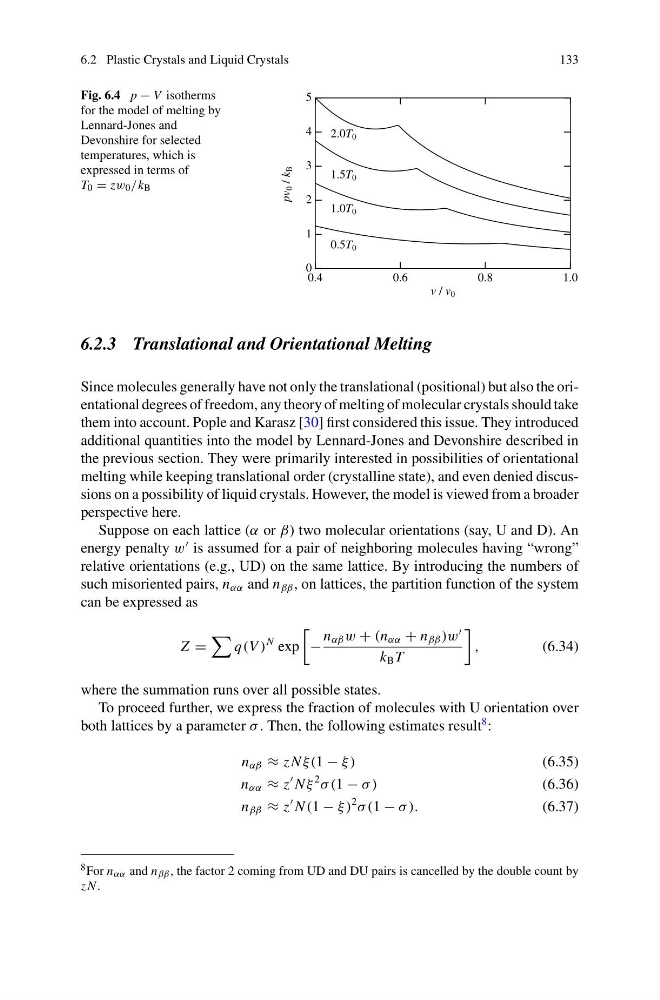
Fig. 6.4 p − V isotherms
for the model of melting by
Lennard-Jones and
Devonshire for selected
temperatures, which is
expressed in terms of
T 0 = zw 0 /k B
5
4
3
2
1
0
pv
0 / k
B
1.0
0.8
0.6
0.4
v / v 0
0.5T 0
1.0T 0
1.5T 0
2.0T 0
6.2.3 Translational and Orientational Melting
Since molecules generally have not only the translational (positional) but also the orientational degrees of freedom, any theory of melting of molecular crystals should take
them into account. Pople and Karasz [30] first considered this issue. They introduced
additional quantities into the model by Lennard-Jones and Devonshire described in
the previous section. They were primarily interested in possibilities of orientational
melting while keeping translational order (crystalline state), and even denied discussions on a possibility of liquid crystals. However, the model is viewed from a broader
perspective here.
Suppose on each lattice (α or β) two molecular orientations (say, U and D). An
energy penalty w
is assumed for a pair of neighboring molecules having “wrong”
relative orientations (e.g., UD) on the same lattice. By introducing the numbers of
such misoriented pairs, n αα and n ββ , on lattices, the partition function of the system
can be expressed as
Z =
q(V )
N exp
−
n αβ w + (n αα + n ββ )w
k B T
,
(6.34)
where the summation runs over all possible states.
To proceed further, we express the fraction of molecules with U orientation over
both lattices by a parameter σ . Then, the following estimates result
8 :
n αβ ≈ z N ξ(1 − ξ)
(6.35)
n αα ≈ z
N ξ
2
σ (1 − σ )
(6.36)
n ββ ≈ z
N (1 − ξ)
2
σ (1 − σ ).
(6.37)
8 For n αα and n ββ , the factor 2 coming from UD and DU pairs is cancelled by the double count by
z N .
133
Fig. 6.4 p − V isotherms
for the model of melting by
Lennard-Jones and
Devonshire for selected
temperatures, which is
expressed in terms of
T 0 = zw 0 /k B
5
4
3
2
1
0
pv
0 / k
B
1.0
0.8
0.6
0.4
v / v 0
0.5T 0
1.0T 0
1.5T 0
2.0T 0
6.2.3 Translational and Orientational Melting
Since molecules generally have not only the translational (positional) but also the orientational degrees of freedom, any theory of melting of molecular crystals should take
them into account. Pople and Karasz [30] first considered this issue. They introduced
additional quantities into the model by Lennard-Jones and Devonshire described in
the previous section. They were primarily interested in possibilities of orientational
melting while keeping translational order (crystalline state), and even denied discussions on a possibility of liquid crystals. However, the model is viewed from a broader
perspective here.
Suppose on each lattice (α or β) two molecular orientations (say, U and D). An
energy penalty w
is assumed for a pair of neighboring molecules having “wrong”
relative orientations (e.g., UD) on the same lattice. By introducing the numbers of
such misoriented pairs, n αα and n ββ , on lattices, the partition function of the system
can be expressed as
Z =
q(V )
N exp
−
n αβ w + (n αα + n ββ )w
k B T
,
(6.34)
where the summation runs over all possible states.
To proceed further, we express the fraction of molecules with U orientation over
both lattices by a parameter σ . Then, the following estimates result
8 :
n αβ ≈ z N ξ(1 − ξ)
(6.35)
n αα ≈ z
N ξ
2
σ (1 − σ )
(6.36)
n ββ ≈ z
N (1 − ξ)
2
σ (1 − σ ).
(6.37)
8 For n αα and n ββ , the factor 2 coming from UD and DU pairs is cancelled by the double count by
z N .