

6.1 Melting in Reality
121
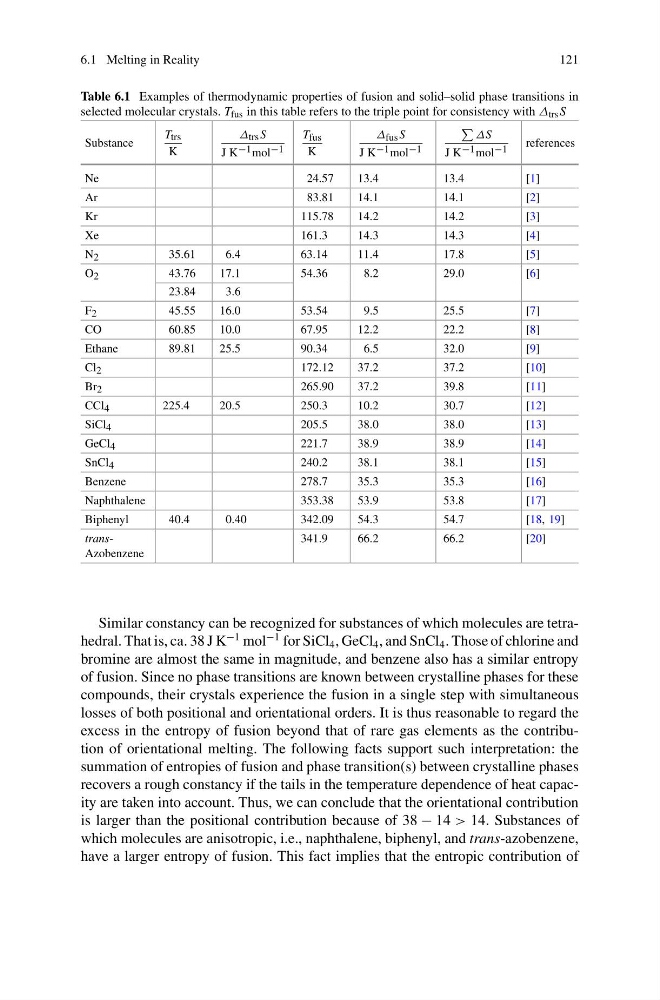
Table 6.1 Examples of thermodynamic properties of fusion and solid–solid phase transitions in
selected molecular crystals. T fus in this table refers to the triple point for consistency with Δ trs S
Substance
T trs
K
Δ trs S
J K −1 mol −1
T fus
K
Δ fus S
J K −1 mol −1
ΔS
J K −1 mol −1
references
Ne
24.57
13.4
13.4
[1]
Ar
83.81
14.1
14.1
[2]
Kr
115.78
14.2
14.2
[3]
Xe
161.3
14.3
14.3
[4]
N 2
35.61
6.4
63.14
11.4
17.8
[5]
O 2
43.76
17.1
54.36
8.2
29.0
[6]
23.84
3.6
F 2
45.55
16.0
53.54
9.5
25.5
[7]
CO
60.85
10.0
67.95
12.2
22.2
[8]
Ethane
89.81
25.5
90.34
6.5
32.0
[9]
Cl 2
172.12
37.2
37.2
[10]
Br 2
265.90
37.2
39.8
[11]
CCl 4
225.4
20.5
250.3
10.2
30.7
[12]
SiCl 4
205.5
38.0
38.0
[13]
GeCl 4
221.7
38.9
38.9
[14]
SnCl 4
240.2
38.1
38.1
[15]
Benzene
278.7
35.3
35.3
[16]
Naphthalene
353.38
53.9
53.8
[17]
Biphenyl
40.4
0.40
342.09
54.3
54.7
[18, 19]
transAzobenzene
341.9
66.2
66.2
[20]
Similar constancy can be recognized for substances of which molecules are tetrahedral. That is, ca. 38 J K
−1 mol
−1 for SiCl 4 , GeCl 4 , and SnCl 4 . Those of chlorine and
bromine are almost the same in magnitude, and benzene also has a similar entropy
of fusion. Since no phase transitions are known between crystalline phases for these
compounds, their crystals experience the fusion in a single step with simultaneous
losses of both positional and orientational orders. It is thus reasonable to regard the
excess in the entropy of fusion beyond that of rare gas elements as the contribution of orientational melting. The following facts support such interpretation: the
summation of entropies of fusion and phase transition(s) between crystalline phases
recovers a rough constancy if the tails in the temperature dependence of heat capacity are taken into account. Thus, we can conclude that the orientational contribution
is larger than the positional contribution because of 38 − 14 > 14. Substances of
which molecules are anisotropic, i.e., naphthalene, biphenyl, and trans-azobenzene,
have a larger entropy of fusion. This fact implies that the entropic contribution of
121
Table 6.1 Examples of thermodynamic properties of fusion and solid–solid phase transitions in
selected molecular crystals. T fus in this table refers to the triple point for consistency with Δ trs S
Substance
T trs
K
Δ trs S
J K −1 mol −1
T fus
K
Δ fus S
J K −1 mol −1
ΔS
J K −1 mol −1
references
Ne
24.57
13.4
13.4
[1]
Ar
83.81
14.1
14.1
[2]
Kr
115.78
14.2
14.2
[3]
Xe
161.3
14.3
14.3
[4]
N 2
35.61
6.4
63.14
11.4
17.8
[5]
O 2
43.76
17.1
54.36
8.2
29.0
[6]
23.84
3.6
F 2
45.55
16.0
53.54
9.5
25.5
[7]
CO
60.85
10.0
67.95
12.2
22.2
[8]
Ethane
89.81
25.5
90.34
6.5
32.0
[9]
Cl 2
172.12
37.2
37.2
[10]
Br 2
265.90
37.2
39.8
[11]
CCl 4
225.4
20.5
250.3
10.2
30.7
[12]
SiCl 4
205.5
38.0
38.0
[13]
GeCl 4
221.7
38.9
38.9
[14]
SnCl 4
240.2
38.1
38.1
[15]
Benzene
278.7
35.3
35.3
[16]
Naphthalene
353.38
53.9
53.8
[17]
Biphenyl
40.4
0.40
342.09
54.3
54.7
[18, 19]
transAzobenzene
341.9
66.2
66.2
[20]
Similar constancy can be recognized for substances of which molecules are tetrahedral. That is, ca. 38 J K
−1 mol
−1 for SiCl 4 , GeCl 4 , and SnCl 4 . Those of chlorine and
bromine are almost the same in magnitude, and benzene also has a similar entropy
of fusion. Since no phase transitions are known between crystalline phases for these
compounds, their crystals experience the fusion in a single step with simultaneous
losses of both positional and orientational orders. It is thus reasonable to regard the
excess in the entropy of fusion beyond that of rare gas elements as the contribution of orientational melting. The following facts support such interpretation: the
summation of entropies of fusion and phase transition(s) between crystalline phases
recovers a rough constancy if the tails in the temperature dependence of heat capacity are taken into account. Thus, we can conclude that the orientational contribution
is larger than the positional contribution because of 38 − 14 > 14. Substances of
which molecules are anisotropic, i.e., naphthalene, biphenyl, and trans-azobenzene,
have a larger entropy of fusion. This fact implies that the entropic contribution of