

120
6 Melting of Molecular Crystals
melting
orientational
melting
orientational
melting
positional
melting
positional
melting
Ordered
Crystal
Plastic
Crystal
Liquid
Crystal
(Nematic)
Isotropic
Liquid
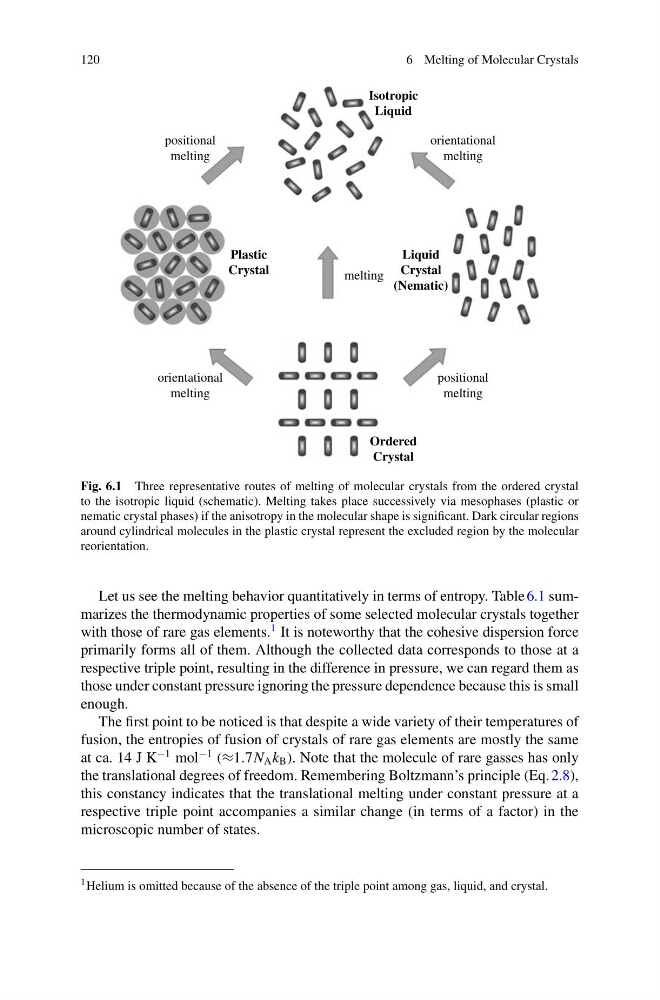
Fig. 6.1 Three representative routes of melting of molecular crystals from the ordered crystal
to the isotropic liquid (schematic). Melting takes place successively via mesophases (plastic or
nematic crystal phases) if the anisotropy in the molecular shape is significant. Dark circular regions
around cylindrical molecules in the plastic crystal represent the excluded region by the molecular
reorientation.
Let us see the melting behavior quantitatively in terms of entropy. Table 6.1 summarizes the thermodynamic properties of some selected molecular crystals together
with those of rare gas elements.
1 It is noteworthy that the cohesive dispersion force
primarily forms all of them. Although the collected data corresponds to those at a
respective triple point, resulting in the difference in pressure, we can regard them as
those under constant pressure ignoring the pressure dependence because this is small
enough.
The first point to be noticed is that despite a wide variety of their temperatures of
fusion, the entropies of fusion of crystals of rare gas elements are mostly the same
at ca. 14 J K
−1 mol
−1 (≈1.7N A k B ). Note that the molecule of rare gasses has only
the translational degrees of freedom. Remembering Boltzmann’s principle (Eq. 2.8),
this constancy indicates that the translational melting under constant pressure at a
respective triple point accompanies a similar change (in terms of a factor) in the
microscopic number of states.
1 Helium is omitted because of the absence of the triple point among gas, liquid, and crystal.
6 Melting of Molecular Crystals
melting
orientational
melting
orientational
melting
positional
melting
positional
melting
Ordered
Crystal
Plastic
Crystal
Liquid
Crystal
(Nematic)
Isotropic
Liquid
Fig. 6.1 Three representative routes of melting of molecular crystals from the ordered crystal
to the isotropic liquid (schematic). Melting takes place successively via mesophases (plastic or
nematic crystal phases) if the anisotropy in the molecular shape is significant. Dark circular regions
around cylindrical molecules in the plastic crystal represent the excluded region by the molecular
reorientation.
Let us see the melting behavior quantitatively in terms of entropy. Table 6.1 summarizes the thermodynamic properties of some selected molecular crystals together
with those of rare gas elements.
1 It is noteworthy that the cohesive dispersion force
primarily forms all of them. Although the collected data corresponds to those at a
respective triple point, resulting in the difference in pressure, we can regard them as
those under constant pressure ignoring the pressure dependence because this is small
enough.
The first point to be noticed is that despite a wide variety of their temperatures of
fusion, the entropies of fusion of crystals of rare gas elements are mostly the same
at ca. 14 J K
−1 mol
−1 (≈1.7N A k B ). Note that the molecule of rare gasses has only
the translational degrees of freedom. Remembering Boltzmann’s principle (Eq. 2.8),
this constancy indicates that the translational melting under constant pressure at a
respective triple point accompanies a similar change (in terms of a factor) in the
microscopic number of states.
1 Helium is omitted because of the absence of the triple point among gas, liquid, and crystal.