

5.5 Related Issues and Examples
107
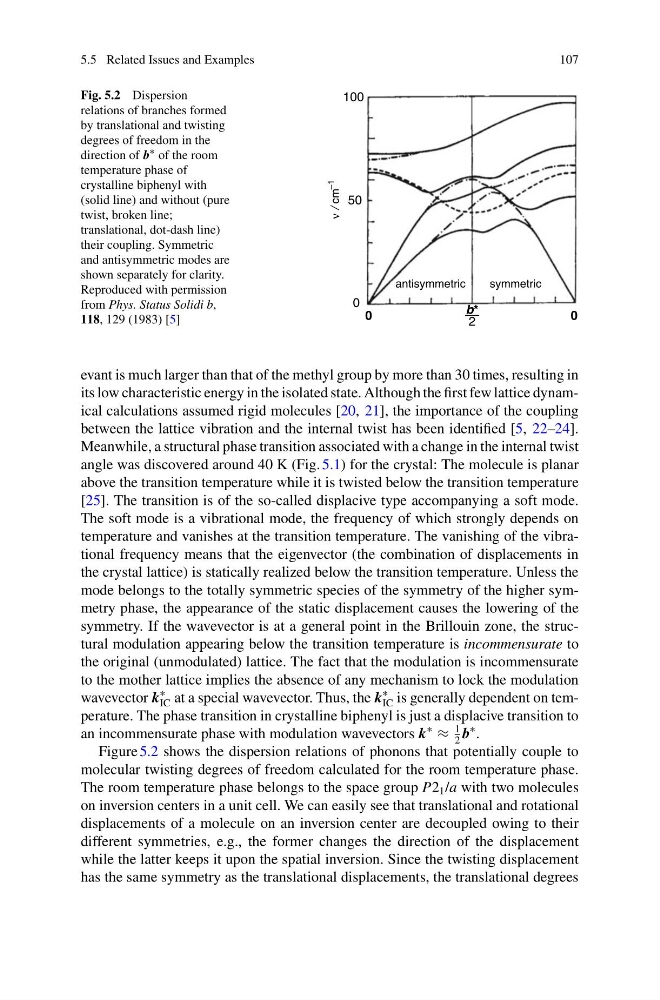
Fig. 5.2 Dispersion
relations of branches formed
by translational and twisting
degrees of freedom in the
direction of b
∗ of the room
temperature phase of
crystalline biphenyl with
(solid line) and without (pure
twist, broken line;
translational, dot-dash line)
their coupling. Symmetric
and antisymmetric modes are
shown separately for clarity.
Reproduced with permission
from Phys. Status Solidi b,
118, 129 (1983) [5]
0
50
100
ν /
cm
–1
0
0
b*
2
––
symmetric
antisymmetric
evant is much larger than that of the methyl group by more than 30 times, resulting in
its low characteristic energy in the isolated state. Although the first few lattice dynamical calculations assumed rigid molecules [20, 21], the importance of the coupling
between the lattice vibration and the internal twist has been identified [5, 22–24].
Meanwhile, a structural phase transition associated with a change in the internal twist
angle was discovered around 40 K (Fig. 5.1) for the crystal: The molecule is planar
above the transition temperature while it is twisted below the transition temperature
[25]. The transition is of the so-called displacive type accompanying a soft mode.
The soft mode is a vibrational mode, the frequency of which strongly depends on
temperature and vanishes at the transition temperature. The vanishing of the vibrational frequency means that the eigenvector (the combination of displacements in
the crystal lattice) is statically realized below the transition temperature. Unless the
mode belongs to the totally symmetric species of the symmetry of the higher symmetry phase, the appearance of the static displacement causes the lowering of the
symmetry. If the wavevector is at a general point in the Brillouin zone, the structural modulation appearing below the transition temperature is incommensurate to
the original (unmodulated) lattice. The fact that the modulation is incommensurate
to the mother lattice implies the absence of any mechanism to lock the modulation
wavevector k
∗
IC at a special wavevector. Thus, the k
∗
IC is generally dependent on temperature. The phase transition in crystalline biphenyl is just a displacive transition to
an incommensurate phase with modulation wavevectors k
∗
≈
1
2
b
∗ .
Figure 5.2 shows the dispersion relations of phonons that potentially couple to
molecular twisting degrees of freedom calculated for the room temperature phase.
The room temperature phase belongs to the space group P2 1 /a with two molecules
on inversion centers in a unit cell. We can easily see that translational and rotational
displacements of a molecule on an inversion center are decoupled owing to their
different symmetries, e.g., the former changes the direction of the displacement
while the latter keeps it upon the spatial inversion. Since the twisting displacement
has the same symmetry as the translational displacements, the translational degrees
107
Fig. 5.2 Dispersion
relations of branches formed
by translational and twisting
degrees of freedom in the
direction of b
∗ of the room
temperature phase of
crystalline biphenyl with
(solid line) and without (pure
twist, broken line;
translational, dot-dash line)
their coupling. Symmetric
and antisymmetric modes are
shown separately for clarity.
Reproduced with permission
from Phys. Status Solidi b,
118, 129 (1983) [5]
0
50
100
ν /
cm
–1
0
0
b*
2
––
symmetric
antisymmetric
evant is much larger than that of the methyl group by more than 30 times, resulting in
its low characteristic energy in the isolated state. Although the first few lattice dynamical calculations assumed rigid molecules [20, 21], the importance of the coupling
between the lattice vibration and the internal twist has been identified [5, 22–24].
Meanwhile, a structural phase transition associated with a change in the internal twist
angle was discovered around 40 K (Fig. 5.1) for the crystal: The molecule is planar
above the transition temperature while it is twisted below the transition temperature
[25]. The transition is of the so-called displacive type accompanying a soft mode.
The soft mode is a vibrational mode, the frequency of which strongly depends on
temperature and vanishes at the transition temperature. The vanishing of the vibrational frequency means that the eigenvector (the combination of displacements in
the crystal lattice) is statically realized below the transition temperature. Unless the
mode belongs to the totally symmetric species of the symmetry of the higher symmetry phase, the appearance of the static displacement causes the lowering of the
symmetry. If the wavevector is at a general point in the Brillouin zone, the structural modulation appearing below the transition temperature is incommensurate to
the original (unmodulated) lattice. The fact that the modulation is incommensurate
to the mother lattice implies the absence of any mechanism to lock the modulation
wavevector k
∗
IC at a special wavevector. Thus, the k
∗
IC is generally dependent on temperature. The phase transition in crystalline biphenyl is just a displacive transition to
an incommensurate phase with modulation wavevectors k
∗
≈
1
2
b
∗ .
Figure 5.2 shows the dispersion relations of phonons that potentially couple to
molecular twisting degrees of freedom calculated for the room temperature phase.
The room temperature phase belongs to the space group P2 1 /a with two molecules
on inversion centers in a unit cell. We can easily see that translational and rotational
displacements of a molecule on an inversion center are decoupled owing to their
different symmetries, e.g., the former changes the direction of the displacement
while the latter keeps it upon the spatial inversion. Since the twisting displacement
has the same symmetry as the translational displacements, the translational degrees