

106
5 Lattice Dynamics of Molecular Crystals
=
ω
k
1
2
+
exp
ω
k B T
− 1
−1
.
(5.109)
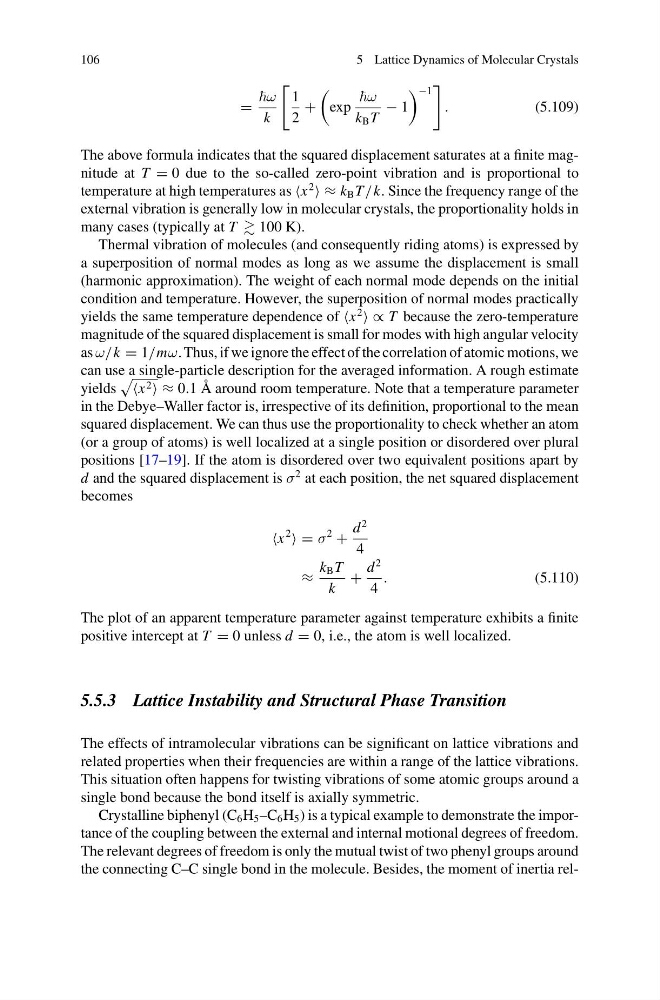
The above formula indicates that the squared displacement saturates at a finite magnitude at T = 0 due to the so-called zero-point vibration and is proportional to
temperature at high temperatures as x
2
≈ k B T /k. Since the frequency range of the
external vibration is generally low in molecular crystals, the proportionality holds in
many cases (typically at T 100 K).
Thermal vibration of molecules (and consequently riding atoms) is expressed by
a superposition of normal modes as long as we assume the displacement is small
(harmonic approximation). The weight of each normal mode depends on the initial
condition and temperature. However, the superposition of normal modes practically
yields the same temperature dependence of x
2
∝ T because the zero-temperature
magnitude of the squared displacement is small for modes with high angular velocity
as ω/k = 1/mω. Thus, if we ignore the effect of the correlation of atomic motions, we
can use a single-particle description for the averaged information. A rough estimate
yields
x 2 ≈ 0.1 Å around room temperature. Note that a temperature parameter
in the Debye–Waller factor is, irrespective of its definition, proportional to the mean
squared displacement. We can thus use the proportionality to check whether an atom
(or a group of atoms) is well localized at a single position or disordered over plural
positions [17–19]. If the atom is disordered over two equivalent positions apart by
d and the squared displacement is σ
2 at each position, the net squared displacement
becomes
x
2
= σ
2
+
d
2
4
≈
k B T
k
+
d
2
4
.
(5.110)
The plot of an apparent temperature parameter against temperature exhibits a finite
positive intercept at T = 0 unless d = 0, i.e., the atom is well localized.
5.5.3 Lattice Instability and Structural Phase Transition
The effects of intramolecular vibrations can be significant on lattice vibrations and
related properties when their frequencies are within a range of the lattice vibrations.
This situation often happens for twisting vibrations of some atomic groups around a
single bond because the bond itself is axially symmetric.
Crystalline biphenyl (C 6 H 5 –C 6 H 5 ) is a typical example to demonstrate the importance of the coupling between the external and internal motional degrees of freedom.
The relevant degrees of freedom is only the mutual twist of two phenyl groups around
the connecting C–C single bond in the molecule. Besides, the moment of inertia rel-
5 Lattice Dynamics of Molecular Crystals
=
ω
k
1
2
+
exp
ω
k B T
− 1
−1
.
(5.109)
The above formula indicates that the squared displacement saturates at a finite magnitude at T = 0 due to the so-called zero-point vibration and is proportional to
temperature at high temperatures as x
2
≈ k B T /k. Since the frequency range of the
external vibration is generally low in molecular crystals, the proportionality holds in
many cases (typically at T 100 K).
Thermal vibration of molecules (and consequently riding atoms) is expressed by
a superposition of normal modes as long as we assume the displacement is small
(harmonic approximation). The weight of each normal mode depends on the initial
condition and temperature. However, the superposition of normal modes practically
yields the same temperature dependence of x
2
∝ T because the zero-temperature
magnitude of the squared displacement is small for modes with high angular velocity
as ω/k = 1/mω. Thus, if we ignore the effect of the correlation of atomic motions, we
can use a single-particle description for the averaged information. A rough estimate
yields
x 2 ≈ 0.1 Å around room temperature. Note that a temperature parameter
in the Debye–Waller factor is, irrespective of its definition, proportional to the mean
squared displacement. We can thus use the proportionality to check whether an atom
(or a group of atoms) is well localized at a single position or disordered over plural
positions [17–19]. If the atom is disordered over two equivalent positions apart by
d and the squared displacement is σ
2 at each position, the net squared displacement
becomes
x
2
= σ
2
+
d
2
4
≈
k B T
k
+
d
2
4
.
(5.110)
The plot of an apparent temperature parameter against temperature exhibits a finite
positive intercept at T = 0 unless d = 0, i.e., the atom is well localized.
5.5.3 Lattice Instability and Structural Phase Transition
The effects of intramolecular vibrations can be significant on lattice vibrations and
related properties when their frequencies are within a range of the lattice vibrations.
This situation often happens for twisting vibrations of some atomic groups around a
single bond because the bond itself is axially symmetric.
Crystalline biphenyl (C 6 H 5 –C 6 H 5 ) is a typical example to demonstrate the importance of the coupling between the external and internal motional degrees of freedom.
The relevant degrees of freedom is only the mutual twist of two phenyl groups around
the connecting C–C single bond in the molecule. Besides, the moment of inertia rel-