

104
5 Lattice Dynamics of Molecular Crystals
should be different because there are acoustic and optical branches in the dispersion
relation. The sound velocity solely depends on the former, while the optical branch
is undoubtedly involved in the highest frequency of the lattice vibration. With the
increase in the number of atoms in a unit cell (n atom ), the number of the optical
branches increases while those of acoustic branches remain the same at 3 per unit
cell (or 3/n atom per atom). Although the highest frequency of the lattice vibration
can be significantly larger than that of the acoustic branch, it can serve as measures
for both purposes if taking the number of atoms correctly into account.
When the solid is a crystal consisting of rigid molecules, which have translational
and rotational degrees of freedom, the lattice vibration includes optical branches of
rotational degrees of freedom. There exist 6 (not 3) degrees of freedom per molecule,
accordingly. Only the three translational degrees of freedom can potentially contribute to the acoustic branches, which carry 3 degrees of freedom per unit cell. On
the other hand, all 6 degrees of freedom contributes to the lattice heat capacity. The
total degrees of freedom increase accordingly if we count internal vibrational modes.
In analyses of the temperature dependence of heat capacities of solids, an equivalent Debye temperature determined according to
C exp (T ) = C D
T
Θ D (T )
(5.106)
is often used. Here, the left-hand side is the experimental heat capacity, and
C D [T /Θ D ] is a universal function for the Debye heat capacity as a function of the
reduced temperature T /Θ D . This analysis is useful because Θ D is constant if the temperature dependence of heat capacity strictly follows the Debye model. Although the
real material does not follow precisely the model, the weak deviation is reflected in
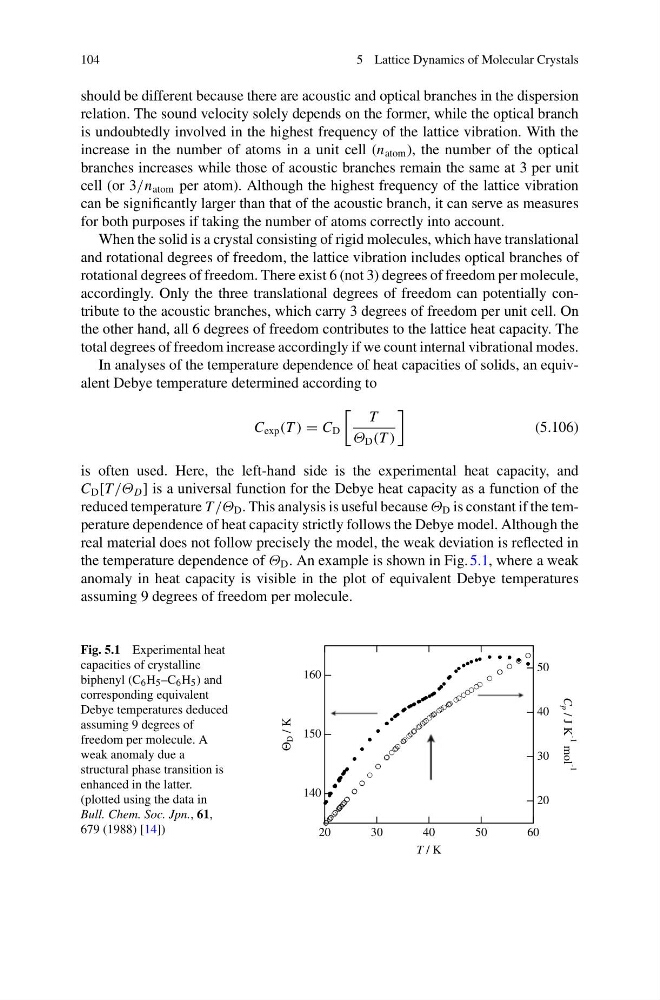
the temperature dependence of Θ D . An example is shown in Fig. 5.1, where a weak
anomaly in heat capacity is visible in the plot of equivalent Debye temperatures
assuming 9 degrees of freedom per molecule.
Fig. 5.1 Experimental heat
capacities of crystalline
biphenyl (C 6 H 5 –C 6 H 5 ) and
corresponding equivalent
Debye temperatures deduced
assuming 9 degrees of
freedom per molecule. A
weak anomaly due a
structural phase transition is
enhanced in the latter.
(plotted using the data in
Bull. Chem. Soc. Jpn., 61,
679 (1988) [14])
160
150
140
Θ D / K
60
50
40
30
20
T / K
50
40
30
20
C p / J K
-1
mol
-1
5 Lattice Dynamics of Molecular Crystals
should be different because there are acoustic and optical branches in the dispersion
relation. The sound velocity solely depends on the former, while the optical branch
is undoubtedly involved in the highest frequency of the lattice vibration. With the
increase in the number of atoms in a unit cell (n atom ), the number of the optical
branches increases while those of acoustic branches remain the same at 3 per unit
cell (or 3/n atom per atom). Although the highest frequency of the lattice vibration
can be significantly larger than that of the acoustic branch, it can serve as measures
for both purposes if taking the number of atoms correctly into account.
When the solid is a crystal consisting of rigid molecules, which have translational
and rotational degrees of freedom, the lattice vibration includes optical branches of
rotational degrees of freedom. There exist 6 (not 3) degrees of freedom per molecule,
accordingly. Only the three translational degrees of freedom can potentially contribute to the acoustic branches, which carry 3 degrees of freedom per unit cell. On
the other hand, all 6 degrees of freedom contributes to the lattice heat capacity. The
total degrees of freedom increase accordingly if we count internal vibrational modes.
In analyses of the temperature dependence of heat capacities of solids, an equivalent Debye temperature determined according to
C exp (T ) = C D
T
Θ D (T )
(5.106)
is often used. Here, the left-hand side is the experimental heat capacity, and
C D [T /Θ D ] is a universal function for the Debye heat capacity as a function of the
reduced temperature T /Θ D . This analysis is useful because Θ D is constant if the temperature dependence of heat capacity strictly follows the Debye model. Although the
real material does not follow precisely the model, the weak deviation is reflected in
the temperature dependence of Θ D . An example is shown in Fig. 5.1, where a weak
anomaly in heat capacity is visible in the plot of equivalent Debye temperatures
assuming 9 degrees of freedom per molecule.
Fig. 5.1 Experimental heat
capacities of crystalline
biphenyl (C 6 H 5 –C 6 H 5 ) and
corresponding equivalent
Debye temperatures deduced
assuming 9 degrees of
freedom per molecule. A
weak anomaly due a
structural phase transition is
enhanced in the latter.
(plotted using the data in
Bull. Chem. Soc. Jpn., 61,
679 (1988) [14])
160
150
140
Θ D / K
60
50
40
30
20
T / K
50
40
30
20
C p / J K
-1
mol
-1