

5.5 Related Issues and Examples
103
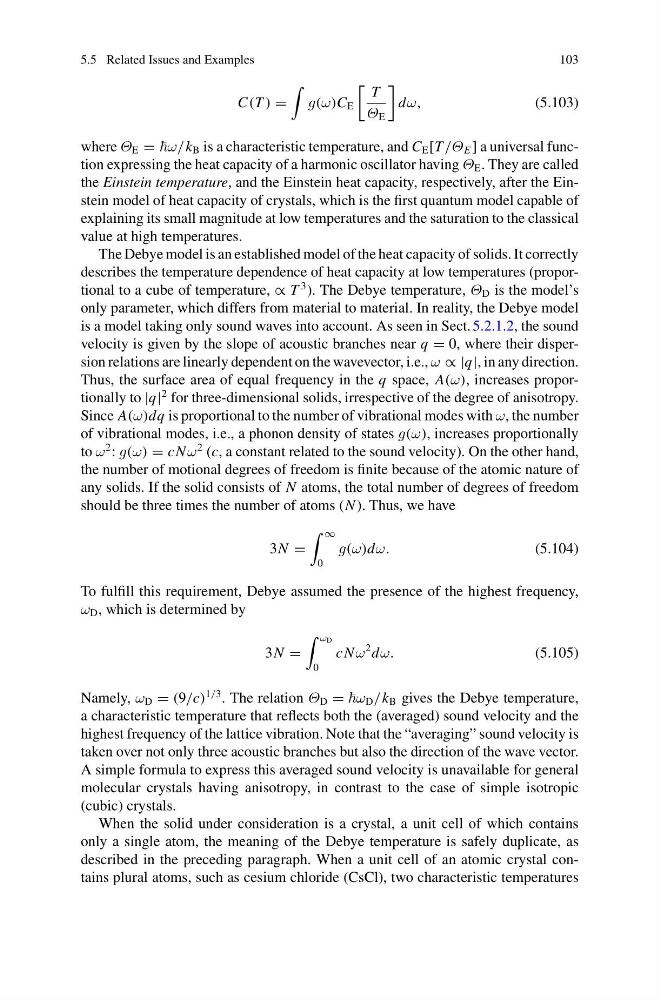
C(T ) =
g(ω)C E
T
Θ E
dω,
(5.103)
where Θ E = ω/k B is a characteristic temperature, and C E [T /Θ E ] a universal function expressing the heat capacity of a harmonic oscillator having Θ E . They are called
the Einstein temperature, and the Einstein heat capacity, respectively, after the Einstein model of heat capacity of crystals, which is the first quantum model capable of
explaining its small magnitude at low temperatures and the saturation to the classical
value at high temperatures.
The Debye model is an established model of the heat capacity of solids. It correctly
describes the temperature dependence of heat capacity at low temperatures (proportional to a cube of temperature, ∝ T
3 ). The Debye temperature, Θ D is the model’s
only parameter, which differs from material to material. In reality, the Debye model
is a model taking only sound waves into account. As seen in Sect. 5.2.1.2, the sound
velocity is given by the slope of acoustic branches near q = 0, where their dispersion relations are linearly dependent on the wavevector, i.e., ω ∝ |q|, in any direction.
Thus, the surface area of equal frequency in the q space, A(ω), increases proportionally to |q|
2 for three-dimensional solids, irrespective of the degree of anisotropy.
Since A(ω)dq is proportional to the number of vibrational modes with ω, the number
of vibrational modes, i.e., a phonon density of states g(ω), increases proportionally
to ω
2 : g(ω) = cN ω
2 (c, a constant related to the sound velocity). On the other hand,
the number of motional degrees of freedom is finite because of the atomic nature of
any solids. If the solid consists of N atoms, the total number of degrees of freedom
should be three times the number of atoms (N ). Thus, we have
3N =
∞
0
g(ω)dω.
(5.104)
To fulfill this requirement, Debye assumed the presence of the highest frequency,
ω D , which is determined by
3N =
ω D
0
cN ω
2 dω.
(5.105)
Namely, ω D = (9/c)
1/3 . The relation Θ D = ω D /k B gives the Debye temperature,
a characteristic temperature that reflects both the (averaged) sound velocity and the
highest frequency of the lattice vibration. Note that the “averaging” sound velocity is
taken over not only three acoustic branches but also the direction of the wave vector.
A simple formula to express this averaged sound velocity is unavailable for general
molecular crystals having anisotropy, in contrast to the case of simple isotropic
(cubic) crystals.
When the solid under consideration is a crystal, a unit cell of which contains
only a single atom, the meaning of the Debye temperature is safely duplicate, as
described in the preceding paragraph. When a unit cell of an atomic crystal contains plural atoms, such as cesium chloride (CsCl), two characteristic temperatures
103
C(T ) =
g(ω)C E
T
Θ E
dω,
(5.103)
where Θ E = ω/k B is a characteristic temperature, and C E [T /Θ E ] a universal function expressing the heat capacity of a harmonic oscillator having Θ E . They are called
the Einstein temperature, and the Einstein heat capacity, respectively, after the Einstein model of heat capacity of crystals, which is the first quantum model capable of
explaining its small magnitude at low temperatures and the saturation to the classical
value at high temperatures.
The Debye model is an established model of the heat capacity of solids. It correctly
describes the temperature dependence of heat capacity at low temperatures (proportional to a cube of temperature, ∝ T
3 ). The Debye temperature, Θ D is the model’s
only parameter, which differs from material to material. In reality, the Debye model
is a model taking only sound waves into account. As seen in Sect. 5.2.1.2, the sound
velocity is given by the slope of acoustic branches near q = 0, where their dispersion relations are linearly dependent on the wavevector, i.e., ω ∝ |q|, in any direction.
Thus, the surface area of equal frequency in the q space, A(ω), increases proportionally to |q|
2 for three-dimensional solids, irrespective of the degree of anisotropy.
Since A(ω)dq is proportional to the number of vibrational modes with ω, the number
of vibrational modes, i.e., a phonon density of states g(ω), increases proportionally
to ω
2 : g(ω) = cN ω
2 (c, a constant related to the sound velocity). On the other hand,
the number of motional degrees of freedom is finite because of the atomic nature of
any solids. If the solid consists of N atoms, the total number of degrees of freedom
should be three times the number of atoms (N ). Thus, we have
3N =
∞
0
g(ω)dω.
(5.104)
To fulfill this requirement, Debye assumed the presence of the highest frequency,
ω D , which is determined by
3N =
ω D
0
cN ω
2 dω.
(5.105)
Namely, ω D = (9/c)
1/3 . The relation Θ D = ω D /k B gives the Debye temperature,
a characteristic temperature that reflects both the (averaged) sound velocity and the
highest frequency of the lattice vibration. Note that the “averaging” sound velocity is
taken over not only three acoustic branches but also the direction of the wave vector.
A simple formula to express this averaged sound velocity is unavailable for general
molecular crystals having anisotropy, in contrast to the case of simple isotropic
(cubic) crystals.
When the solid under consideration is a crystal, a unit cell of which contains
only a single atom, the meaning of the Debye temperature is safely duplicate, as
described in the preceding paragraph. When a unit cell of an atomic crystal contains plural atoms, such as cesium chloride (CsCl), two characteristic temperatures