

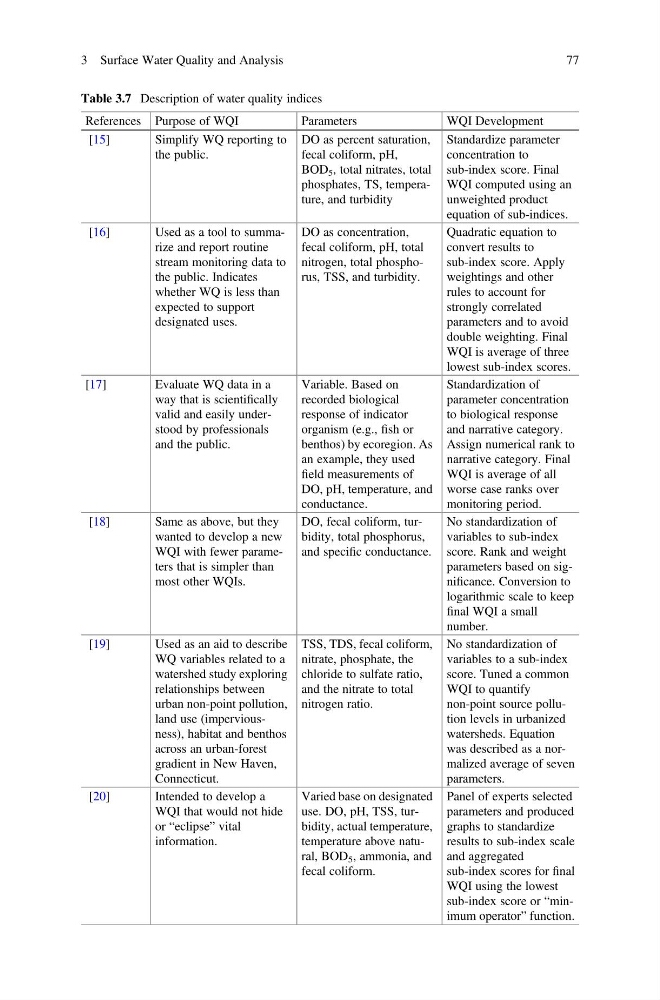
Table 3.7 Description of water quality indices
References Purpose of WQI
Parameters
WQI Development
[15]
Simplify WQ reporting to
the public.
DO as percent saturation,
fecal coliform, pH,
BOD 5 , total nitrates, total
phosphates, TS, temperature, and turbidity
Standardize parameter
concentration to
sub-index score. Final
WQI computed using an
unweighted product
equation of sub-indices.
[16]
Used as a tool to summarize and report routine
stream monitoring data to
the public. Indicates
whether WQ is less than
expected to support
designated uses.
DO as concentration,
fecal coliform, pH, total
nitrogen, total phosphorus, TSS, and turbidity.
Quadratic equation to
convert results to
sub-index score. Apply
weightings and other
rules to account for
strongly correlated
parameters and to avoid
double weighting. Final
WQI is average of three
lowest sub-index scores.
[17]
Evaluate WQ data in a
way that is scientifically
valid and easily understood by professionals
and the public.
Variable. Based on
recorded biological
response of indicator
organism (e.g., fish or
benthos) by ecoregion. As
an example, they used
field measurements of
DO, pH, temperature, and
conductance.
Standardization of
parameter concentration
to biological response
and narrative category.
Assign numerical rank to
narrative category. Final
WQI is average of all
worse case ranks over
monitoring period.
[18]
Same as above, but they
wanted to develop a new
WQI with fewer parameters that is simpler than
most other WQIs.
DO, fecal coliform, turbidity, total phosphorus,
and specific conductance.
No standardization of
variables to sub-index
score. Rank and weight
parameters based on significance. Conversion to
logarithmic scale to keep
final WQI a small
number.
[19]
Used as an aid to describe
WQ variables related to a
watershed study exploring
relationships between
urban non-point pollution,
land use (imperviousness), habitat and benthos
across an urban-forest
gradient in New Haven,
Connecticut.
TSS, TDS, fecal coliform,
nitrate, phosphate, the
chloride to sulfate ratio,
and the nitrate to total
nitrogen ratio.
No standardization of
variables to a sub-index
score. Tuned a common
WQI to quantify
non-point source pollution levels in urbanized
watersheds. Equation
was described as a normalized average of seven
parameters.
[20]
Intended to develop a
WQI that would not hide
or “eclipse” vital
information.
Varied base on designated
use. DO, pH, TSS, turbidity, actual temperature,
temperature above natural, BOD 5 , ammonia, and
fecal coliform.
Panel of experts selected
parameters and produced
graphs to standardize
results to sub-index scale
and aggregated
sub-index scores for final
WQI using the lowest
sub-index score or “minimum operator” function.
3 Surface Water Quality and Analysis
77
References Purpose of WQI
Parameters
WQI Development
[15]
Simplify WQ reporting to
the public.
DO as percent saturation,
fecal coliform, pH,
BOD 5 , total nitrates, total
phosphates, TS, temperature, and turbidity
Standardize parameter
concentration to
sub-index score. Final
WQI computed using an
unweighted product
equation of sub-indices.
[16]
Used as a tool to summarize and report routine
stream monitoring data to
the public. Indicates
whether WQ is less than
expected to support
designated uses.
DO as concentration,
fecal coliform, pH, total
nitrogen, total phosphorus, TSS, and turbidity.
Quadratic equation to
convert results to
sub-index score. Apply
weightings and other
rules to account for
strongly correlated
parameters and to avoid
double weighting. Final
WQI is average of three
lowest sub-index scores.
[17]
Evaluate WQ data in a
way that is scientifically
valid and easily understood by professionals
and the public.
Variable. Based on
recorded biological
response of indicator
organism (e.g., fish or
benthos) by ecoregion. As
an example, they used
field measurements of
DO, pH, temperature, and
conductance.
Standardization of
parameter concentration
to biological response
and narrative category.
Assign numerical rank to
narrative category. Final
WQI is average of all
worse case ranks over
monitoring period.
[18]
Same as above, but they
wanted to develop a new
WQI with fewer parameters that is simpler than
most other WQIs.
DO, fecal coliform, turbidity, total phosphorus,
and specific conductance.
No standardization of
variables to sub-index
score. Rank and weight
parameters based on significance. Conversion to
logarithmic scale to keep
final WQI a small
number.
[19]
Used as an aid to describe
WQ variables related to a
watershed study exploring
relationships between
urban non-point pollution,
land use (imperviousness), habitat and benthos
across an urban-forest
gradient in New Haven,
Connecticut.
TSS, TDS, fecal coliform,
nitrate, phosphate, the
chloride to sulfate ratio,
and the nitrate to total
nitrogen ratio.
No standardization of
variables to a sub-index
score. Tuned a common
WQI to quantify
non-point source pollution levels in urbanized
watersheds. Equation
was described as a normalized average of seven
parameters.
[20]
Intended to develop a
WQI that would not hide
or “eclipse” vital
information.
Varied base on designated
use. DO, pH, TSS, turbidity, actual temperature,
temperature above natural, BOD 5 , ammonia, and
fecal coliform.
Panel of experts selected
parameters and produced
graphs to standardize
results to sub-index scale
and aggregated
sub-index scores for final
WQI using the lowest
sub-index score or “minimum operator” function.
3 Surface Water Quality and Analysis
77