

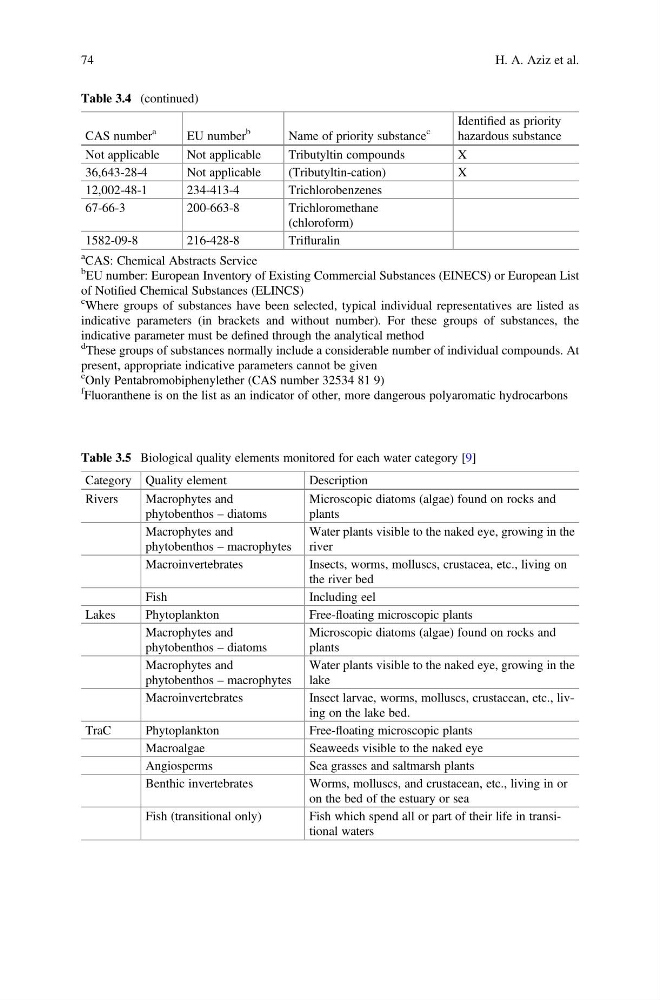
Table 3.4 (continued)
CAS number
a
EU number
b
Name of priority substance
c
Identified as priority
hazardous substance
Not applicable
Not applicable
Tributyltin compounds
X
36,643-28-4
Not applicable
(Tributyltin-cation)
X
12,002-48-1
234-413-4
Trichlorobenzenes
67-66-3
200-663-8
Trichloromethane
(chloroform)
1582-09-8
216-428-8
Trifluralin
a CAS: Chemical Abstracts Service
b
EU number: European Inventory of Existing Commercial Substances (EINECS) or European List
of Notified Chemical Substances (ELINCS)
c Where groups of substances have been selected, typical individual representatives are listed as
indicative parameters (in brackets and without number). For these groups of substances, the
indicative parameter must be defined through the analytical method
d
These groups of substances normally include a considerable number of individual compounds. At
present, appropriate indicative parameters cannot be given
e Only Pentabromobiphenylether (CAS number 32534 81 9)
f
Fluoranthene is on the list as an indicator of other, more dangerous polyaromatic hydrocarbons
Table 3.5 Biological quality elements monitored for each water category [9]
Category Quality element
Description
Rivers
Macrophytes and
phytobenthos – diatoms
Microscopic diatoms (algae) found on rocks and
plants
Macrophytes and
phytobenthos – macrophytes
Water plants visible to the naked eye, growing in the
river
Macroinvertebrates
Insects, worms, molluscs, crustacea, etc., living on
the river bed
Fish
Including eel
Lakes
Phytoplankton
Free-floating microscopic plants
Macrophytes and
phytobenthos – diatoms
Microscopic diatoms (algae) found on rocks and
plants
Macrophytes and
phytobenthos – macrophytes
Water plants visible to the naked eye, growing in the
lake
Macroinvertebrates
Insect larvae, worms, molluscs, crustacean, etc., living on the lake bed.
TraC
Phytoplankton
Free-floating microscopic plants
Macroalgae
Seaweeds visible to the naked eye
Angiosperms
Sea grasses and saltmarsh plants
Benthic invertebrates
Worms, molluscs, and crustacean, etc., living in or
on the bed of the estuary or sea
Fish (transitional only)
Fish which spend all or part of their life in transitional waters
74
H. A. Aziz et al.
CAS number
a
EU number
b
Name of priority substance
c
Identified as priority
hazardous substance
Not applicable
Not applicable
Tributyltin compounds
X
36,643-28-4
Not applicable
(Tributyltin-cation)
X
12,002-48-1
234-413-4
Trichlorobenzenes
67-66-3
200-663-8
Trichloromethane
(chloroform)
1582-09-8
216-428-8
Trifluralin
a CAS: Chemical Abstracts Service
b
EU number: European Inventory of Existing Commercial Substances (EINECS) or European List
of Notified Chemical Substances (ELINCS)
c Where groups of substances have been selected, typical individual representatives are listed as
indicative parameters (in brackets and without number). For these groups of substances, the
indicative parameter must be defined through the analytical method
d
These groups of substances normally include a considerable number of individual compounds. At
present, appropriate indicative parameters cannot be given
e Only Pentabromobiphenylether (CAS number 32534 81 9)
f
Fluoranthene is on the list as an indicator of other, more dangerous polyaromatic hydrocarbons
Table 3.5 Biological quality elements monitored for each water category [9]
Category Quality element
Description
Rivers
Macrophytes and
phytobenthos – diatoms
Microscopic diatoms (algae) found on rocks and
plants
Macrophytes and
phytobenthos – macrophytes
Water plants visible to the naked eye, growing in the
river
Macroinvertebrates
Insects, worms, molluscs, crustacea, etc., living on
the river bed
Fish
Including eel
Lakes
Phytoplankton
Free-floating microscopic plants
Macrophytes and
phytobenthos – diatoms
Microscopic diatoms (algae) found on rocks and
plants
Macrophytes and
phytobenthos – macrophytes
Water plants visible to the naked eye, growing in the
lake
Macroinvertebrates
Insect larvae, worms, molluscs, crustacean, etc., living on the lake bed.
TraC
Phytoplankton
Free-floating microscopic plants
Macroalgae
Seaweeds visible to the naked eye
Angiosperms
Sea grasses and saltmarsh plants
Benthic invertebrates
Worms, molluscs, and crustacean, etc., living in or
on the bed of the estuary or sea
Fish (transitional only)
Fish which spend all or part of their life in transitional waters
74
H. A. Aziz et al.