

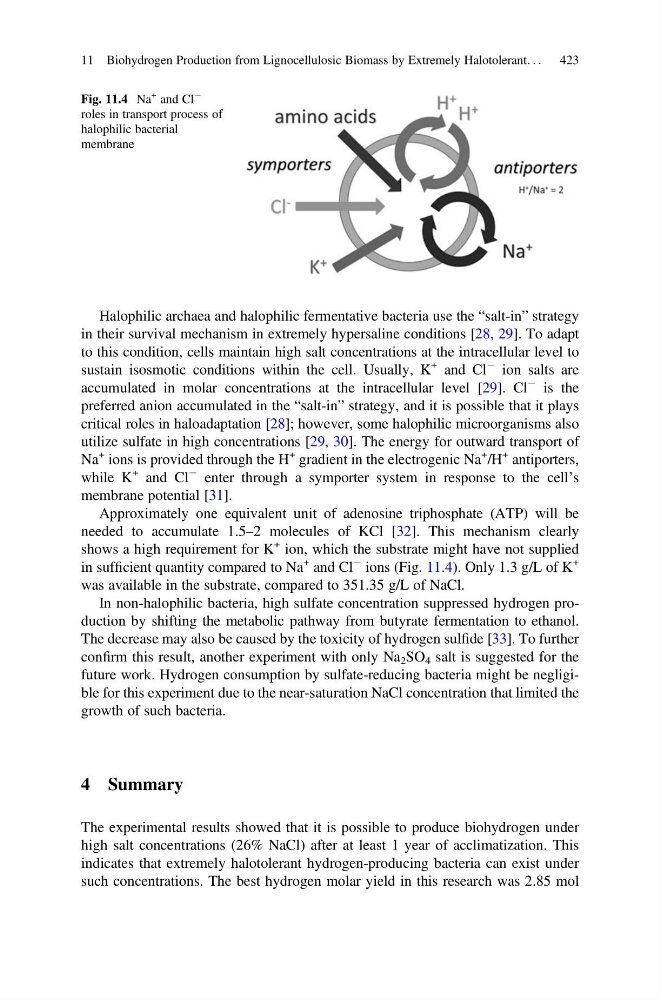
Halophilic archaea and halophilic fermentative bacteria use the “salt-in” strategy
in their survival mechanism in extremely hypersaline conditions [28, 29]. To adapt
to this condition, cells maintain high salt concentrations at the intracellular level to
sustain isosmotic conditions within the cell. Usually, K
+ and Cl
À ion salts are
accumulated in molar concentrations at the intracellular level [29]. Cl
À is the
preferred anion accumulated in the “salt-in” strategy, and it is possible that it plays
critical roles in haloadaptation [28]; however, some halophilic microorganisms also
utilize sulfate in high concentrations [29, 30]. The energy for outward transport of
Na
+ ions is provided through the H
+ gradient in the electrogenic Na
+
/H
+ antiporters,
while K
+ and Cl
À enter through a symporter system in response to the cell’s
membrane potential [31].
Approximately one equivalent unit of adenosine triphosphate (ATP) will be
needed to accumulate 1.5–2 molecules of KCl [32]. This mechanism clearly
shows a high requirement for K
+ ion, which the substrate might have not supplied
in sufficient quantity compared to Na
+ and Cl
À ions (Fig. 11.4). Only 1.3 g/L of K
+
was available in the substrate, compared to 351.35 g/L of NaCl.
In non-halophilic bacteria, high sulfate concentration suppressed hydrogen production by shifting the metabolic pathway from butyrate fermentation to ethanol.
The decrease may also be caused by the toxicity of hydrogen sulfide [33]. To further
confirm this result, another experiment with only Na 2 SO 4 salt is suggested for the
future work. Hydrogen consumption by sulfate-reducing bacteria might be negligible for this experiment due to the near-saturation NaCl concentration that limited the
growth of such bacteria.
4 Summary
The experimental results showed that it is possible to produce biohydrogen under
high salt concentrations (26% NaCl) after at least 1 year of acclimatization. This
indicates that extremely halotolerant hydrogen-producing bacteria can exist under
such concentrations. The best hydrogen molar yield in this research was 2.85 mol
Fig. 11.4 Na
+ and Cl
À
roles in transport process of
halophilic bacterial
membrane
11 Biohydrogen Production from Lignocellulosic Biomass by Extremely Halotolerant. . . 423
in their survival mechanism in extremely hypersaline conditions [28, 29]. To adapt
to this condition, cells maintain high salt concentrations at the intracellular level to
sustain isosmotic conditions within the cell. Usually, K
+ and Cl
À ion salts are
accumulated in molar concentrations at the intracellular level [29]. Cl
À is the
preferred anion accumulated in the “salt-in” strategy, and it is possible that it plays
critical roles in haloadaptation [28]; however, some halophilic microorganisms also
utilize sulfate in high concentrations [29, 30]. The energy for outward transport of
Na
+ ions is provided through the H
+ gradient in the electrogenic Na
+
/H
+ antiporters,
while K
+ and Cl
À enter through a symporter system in response to the cell’s
membrane potential [31].
Approximately one equivalent unit of adenosine triphosphate (ATP) will be
needed to accumulate 1.5–2 molecules of KCl [32]. This mechanism clearly
shows a high requirement for K
+ ion, which the substrate might have not supplied
in sufficient quantity compared to Na
+ and Cl
À ions (Fig. 11.4). Only 1.3 g/L of K
+
was available in the substrate, compared to 351.35 g/L of NaCl.
In non-halophilic bacteria, high sulfate concentration suppressed hydrogen production by shifting the metabolic pathway from butyrate fermentation to ethanol.
The decrease may also be caused by the toxicity of hydrogen sulfide [33]. To further
confirm this result, another experiment with only Na 2 SO 4 salt is suggested for the
future work. Hydrogen consumption by sulfate-reducing bacteria might be negligible for this experiment due to the near-saturation NaCl concentration that limited the
growth of such bacteria.
4 Summary
The experimental results showed that it is possible to produce biohydrogen under
high salt concentrations (26% NaCl) after at least 1 year of acclimatization. This
indicates that extremely halotolerant hydrogen-producing bacteria can exist under
such concentrations. The best hydrogen molar yield in this research was 2.85 mol
Fig. 11.4 Na
+ and Cl
À
roles in transport process of
halophilic bacterial
membrane
11 Biohydrogen Production from Lignocellulosic Biomass by Extremely Halotolerant. . . 423