

3.3 Evaluation of the Bacteria’s Requirement for Chloride
Ions in High Salinity Conditions
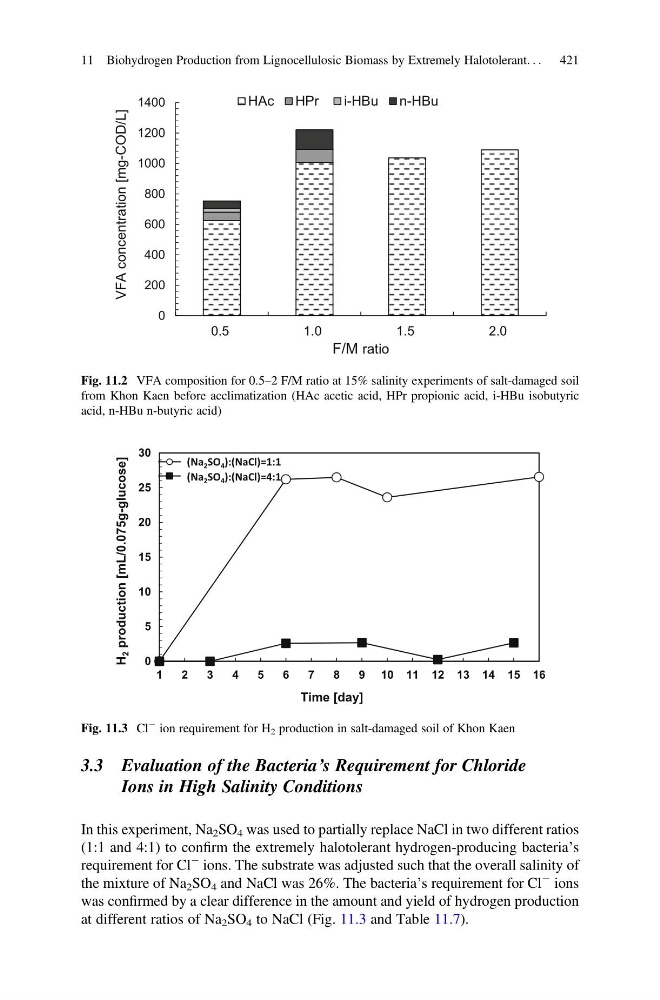
In this experiment, Na 2 SO 4 was used to partially replace NaCl in two different ratios
(1:1 and 4:1) to confirm the extremely halotolerant hydrogen-producing bacteria’s
requirement for Cl
À ions. The substrate was adjusted such that the overall salinity of
the mixture of Na 2 SO 4 and NaCl was 26%. The bacteria’s requirement for Cl
À ions
was confirmed by a clear difference in the amount and yield of hydrogen production
at different ratios of Na 2 SO 4 to NaCl (Fig. 11.3 and Table 11.7).
0
200
400
600
800
1000
1200
1400
0.5
1.0
1.5
2.0
VFA concentration [mg-COD/L]
F/M ratio
HAc
HPr
i-HBu
n-HBu
Fig. 11.2 VFA composition for 0.5–2 F/M ratio at 15% salinity experiments of salt-damaged soil
from Khon Kaen before acclimatization (HAc acetic acid, HPr propionic acid, i-HBu isobutyric
acid, n-HBu n-butyric acid)
0
5
10
15
20
25
30
1
2
3
4
5
6
7
8
9 10 11 12 13 14 15 16
H
2 production [mL/0.075g-glucose]
Time [day]
(Na 2 SO 4 ):(NaCl)=1:1
(Na 2 SO 4 ):(NaCl)=4:1
Fig. 11.3 Cl
À ion requirement for H 2 production in salt-damaged soil of Khon Kaen
11 Biohydrogen Production from Lignocellulosic Biomass by Extremely Halotolerant. . . 421
Ions in High Salinity Conditions
In this experiment, Na 2 SO 4 was used to partially replace NaCl in two different ratios
(1:1 and 4:1) to confirm the extremely halotolerant hydrogen-producing bacteria’s
requirement for Cl
À ions. The substrate was adjusted such that the overall salinity of
the mixture of Na 2 SO 4 and NaCl was 26%. The bacteria’s requirement for Cl
À ions
was confirmed by a clear difference in the amount and yield of hydrogen production
at different ratios of Na 2 SO 4 to NaCl (Fig. 11.3 and Table 11.7).
0
200
400
600
800
1000
1200
1400
0.5
1.0
1.5
2.0
VFA concentration [mg-COD/L]
F/M ratio
HAc
HPr
i-HBu
n-HBu
Fig. 11.2 VFA composition for 0.5–2 F/M ratio at 15% salinity experiments of salt-damaged soil
from Khon Kaen before acclimatization (HAc acetic acid, HPr propionic acid, i-HBu isobutyric
acid, n-HBu n-butyric acid)
0
5
10
15
20
25
30
1
2
3
4
5
6
7
8
9 10 11 12 13 14 15 16
H
2 production [mL/0.075g-glucose]
Time [day]
(Na 2 SO 4 ):(NaCl)=1:1
(Na 2 SO 4 ):(NaCl)=4:1
Fig. 11.3 Cl
À ion requirement for H 2 production in salt-damaged soil of Khon Kaen
11 Biohydrogen Production from Lignocellulosic Biomass by Extremely Halotolerant. . . 421