

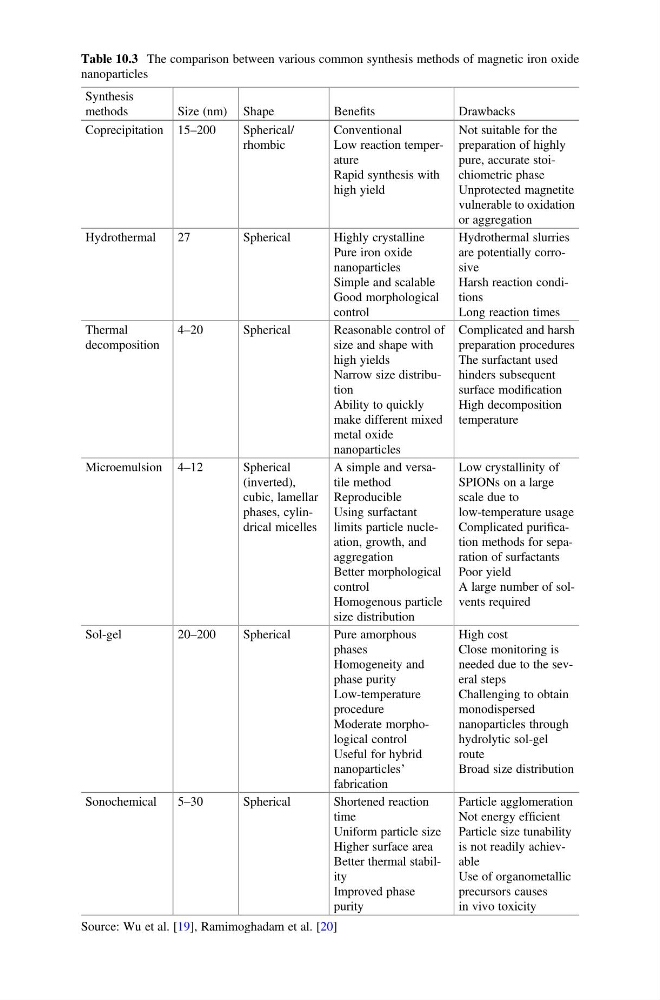
Table 10.3 The comparison between various common synthesis methods of magnetic iron oxide
nanoparticles
Synthesis
methods
Size (nm) Shape
Benefits
Drawbacks
Coprecipitation 15–200
Spherical/
rhombic
Conventional
Low reaction temperature
Rapid synthesis with
high yield
Not suitable for the
preparation of highly
pure, accurate stoichiometric phase
Unprotected magnetite
vulnerable to oxidation
or aggregation
Hydrothermal
27
Spherical
Highly crystalline
Pure iron oxide
nanoparticles
Simple and scalable
Good morphological
control
Hydrothermal slurries
are potentially corrosive
Harsh reaction conditions
Long reaction times
Thermal
decomposition
4–20
Spherical
Reasonable control of
size and shape with
high yields
Narrow size distribution
Ability to quickly
make different mixed
metal oxide
nanoparticles
Complicated and harsh
preparation procedures
The surfactant used
hinders subsequent
surface modification
High decomposition
temperature
Microemulsion 4–12
Spherical
(inverted),
cubic, lamellar
phases, cylindrical micelles
A simple and versatile method
Reproducible
Using surfactant
limits particle nucleation, growth, and
aggregation
Better morphological
control
Homogenous particle
size distribution
Low crystallinity of
SPIONs on a large
scale due to
low-temperature usage
Complicated purification methods for separation of surfactants
Poor yield
A large number of solvents required
Sol-gel
20–200
Spherical
Pure amorphous
phases
Homogeneity and
phase purity
Low-temperature
procedure
Moderate morphological control
Useful for hybrid
nanoparticles’
fabrication
High cost
Close monitoring is
needed due to the several steps
Challenging to obtain
monodispersed
nanoparticles through
hydrolytic sol-gel
route
Broad size distribution
Sonochemical
5–30
Spherical
Shortened reaction
time
Uniform particle size
Higher surface area
Better thermal stability
Improved phase
purity
Particle agglomeration
Not energy efficient
Particle size tunability
is not readily achievable
Use of organometallic
precursors causes
in vivo toxicity
Source: Wu et al. [19], Ramimoghadam et al. [20]
nanoparticles
Synthesis
methods
Size (nm) Shape
Benefits
Drawbacks
Coprecipitation 15–200
Spherical/
rhombic
Conventional
Low reaction temperature
Rapid synthesis with
high yield
Not suitable for the
preparation of highly
pure, accurate stoichiometric phase
Unprotected magnetite
vulnerable to oxidation
or aggregation
Hydrothermal
27
Spherical
Highly crystalline
Pure iron oxide
nanoparticles
Simple and scalable
Good morphological
control
Hydrothermal slurries
are potentially corrosive
Harsh reaction conditions
Long reaction times
Thermal
decomposition
4–20
Spherical
Reasonable control of
size and shape with
high yields
Narrow size distribution
Ability to quickly
make different mixed
metal oxide
nanoparticles
Complicated and harsh
preparation procedures
The surfactant used
hinders subsequent
surface modification
High decomposition
temperature
Microemulsion 4–12
Spherical
(inverted),
cubic, lamellar
phases, cylindrical micelles
A simple and versatile method
Reproducible
Using surfactant
limits particle nucleation, growth, and
aggregation
Better morphological
control
Homogenous particle
size distribution
Low crystallinity of
SPIONs on a large
scale due to
low-temperature usage
Complicated purification methods for separation of surfactants
Poor yield
A large number of solvents required
Sol-gel
20–200
Spherical
Pure amorphous
phases
Homogeneity and
phase purity
Low-temperature
procedure
Moderate morphological control
Useful for hybrid
nanoparticles’
fabrication
High cost
Close monitoring is
needed due to the several steps
Challenging to obtain
monodispersed
nanoparticles through
hydrolytic sol-gel
route
Broad size distribution
Sonochemical
5–30
Spherical
Shortened reaction
time
Uniform particle size
Higher surface area
Better thermal stability
Improved phase
purity
Particle agglomeration
Not energy efficient
Particle size tunability
is not readily achievable
Use of organometallic
precursors causes
in vivo toxicity
Source: Wu et al. [19], Ramimoghadam et al. [20]