

(4.0 km) since 1500. The end of the glacier currently has a negative glacier mass
balance and will continue to retreat due to that fact that the annual temperatures are
currently increasing, and the outlook is for this trend to continue due to global
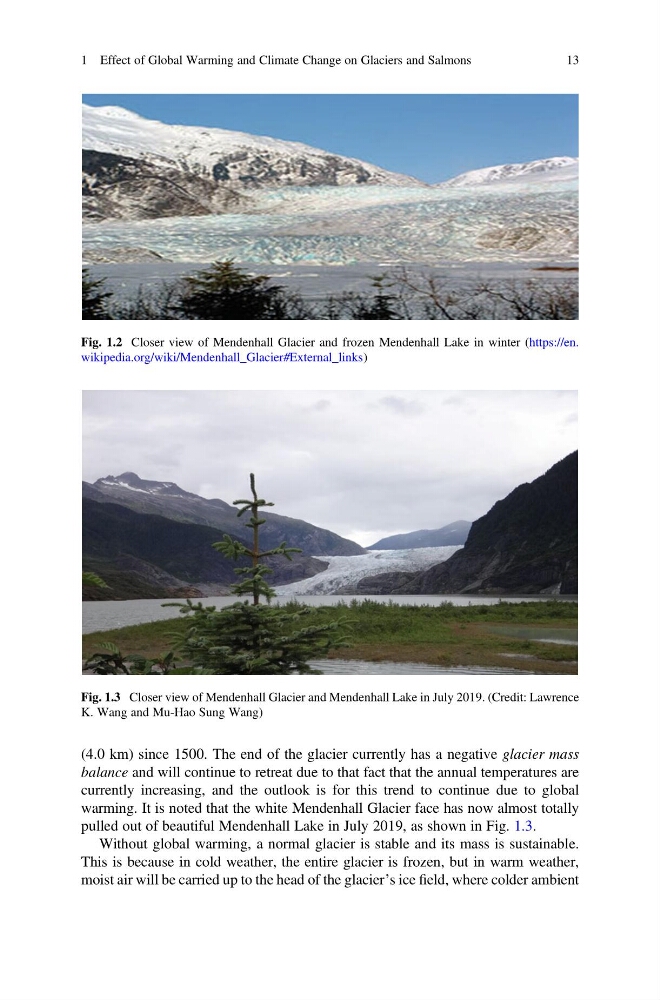
warming. It is noted that the white Mendenhall Glacier face has now almost totally
pulled out of beautiful Mendenhall Lake in July 2019, as shown in Fig. 1.3.
Without global warming, a normal glacier is stable and its mass is sustainable.
This is because in cold weather, the entire glacier is frozen, but in warm weather,
moist air will be carried up to the head of the glacier’s ice field, where colder ambient
Fig. 1.2 Closer view of Mendenhall Glacier and frozen Mendenhall Lake in winter (https://en.
wikipedia.org/wiki/Mendenhall_Glacier#External_links)
Fig. 1.3 Closer view of Mendenhall Glacier and Mendenhall Lake in July 2019. (Credit: Lawrence
K. Wang and Mu-Hao Sung Wang)
1 Effect of Global Warming and Climate Change on Glaciers and Salmons
13
balance and will continue to retreat due to that fact that the annual temperatures are
currently increasing, and the outlook is for this trend to continue due to global
warming. It is noted that the white Mendenhall Glacier face has now almost totally
pulled out of beautiful Mendenhall Lake in July 2019, as shown in Fig. 1.3.
Without global warming, a normal glacier is stable and its mass is sustainable.
This is because in cold weather, the entire glacier is frozen, but in warm weather,
moist air will be carried up to the head of the glacier’s ice field, where colder ambient
Fig. 1.2 Closer view of Mendenhall Glacier and frozen Mendenhall Lake in winter (https://en.
wikipedia.org/wiki/Mendenhall_Glacier#External_links)
Fig. 1.3 Closer view of Mendenhall Glacier and Mendenhall Lake in July 2019. (Credit: Lawrence
K. Wang and Mu-Hao Sung Wang)
1 Effect of Global Warming and Climate Change on Glaciers and Salmons
13