

1. Mean annual temperatures are close to the freezing point.
2. Winter precipitation produces significant accumulations of snow.
3. Temperatures throughout the rest of the year do not result in the complete loss of
the previous winter’s snow accumulation.
Over multiple decades this continuing accumulation of snow results in the
presence of a large enough mass of snow for the metamorphism from snow to
glacier ice process to begin. Glaciers are classified by their size (i.e., ice sheet, ice
cap, valley glacier, cirque glacier), location, and thermal regime (i.e.,
polar vs. temperate). Glaciers are sensitive indicators of changing climate. Prevention of global warming may protect the existing glaciers.
Both snow cover and glaciers are melting. Many glaciers have already
disappeared, while existing glaciers are retreating. Some are retreating faster than
predicted rates; according to a climate-based computer model, glaciers will vanish
by 2030 [22].
4.2 Mendenhall Glacier
A few figures are presented here for the purpose of illustration. Figure 1.2 shows a
closer winter view of Mendenhall Glacier (also Sitaantaagu), which is about
13.6 miles (21.9 km) long located in Mendenhall Valley, about 12 miles (19 km)
from downtown Juneau, Alaska, USA. The glacier has retreated 1.75 miles
(2.82 km) since 1929, when Mendenhall Lake was created, and over 2.5 miles
A World of Agreement: Temperatures are Rising
NASA Goddard Institute for Space Studies
Berkeley Earth
Japanese Meteorological Agency
NOAA National Climatic Data Center
Met Office Hadley Centre/Climatic Research Unit
Global Temperature Anomaly (°C)
1.0
0.5
0.0
–0.5
–1.0
1880 1890 1900 1910 1920 1930 1940 1950 1960 1970 1980 1990 2000 2010
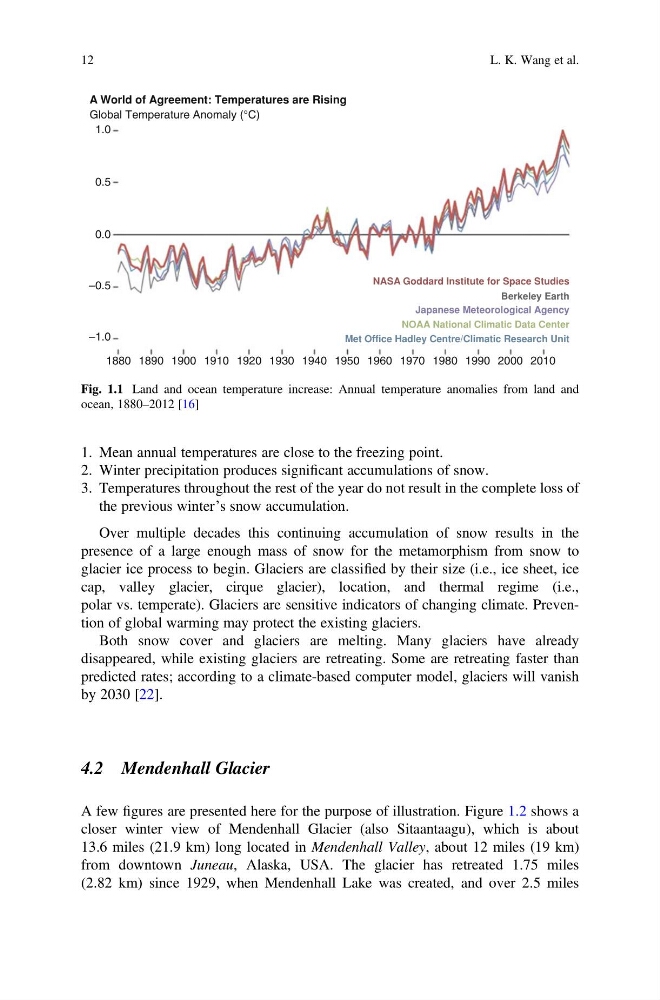
Fig. 1.1 Land and ocean temperature increase: Annual temperature anomalies from land and
ocean, 1880–2012 [16]
12
L. K. Wang et al.
2. Winter precipitation produces significant accumulations of snow.
3. Temperatures throughout the rest of the year do not result in the complete loss of
the previous winter’s snow accumulation.
Over multiple decades this continuing accumulation of snow results in the
presence of a large enough mass of snow for the metamorphism from snow to
glacier ice process to begin. Glaciers are classified by their size (i.e., ice sheet, ice
cap, valley glacier, cirque glacier), location, and thermal regime (i.e.,
polar vs. temperate). Glaciers are sensitive indicators of changing climate. Prevention of global warming may protect the existing glaciers.
Both snow cover and glaciers are melting. Many glaciers have already
disappeared, while existing glaciers are retreating. Some are retreating faster than
predicted rates; according to a climate-based computer model, glaciers will vanish
by 2030 [22].
4.2 Mendenhall Glacier
A few figures are presented here for the purpose of illustration. Figure 1.2 shows a
closer winter view of Mendenhall Glacier (also Sitaantaagu), which is about
13.6 miles (21.9 km) long located in Mendenhall Valley, about 12 miles (19 km)
from downtown Juneau, Alaska, USA. The glacier has retreated 1.75 miles
(2.82 km) since 1929, when Mendenhall Lake was created, and over 2.5 miles
A World of Agreement: Temperatures are Rising
NASA Goddard Institute for Space Studies
Berkeley Earth
Japanese Meteorological Agency
NOAA National Climatic Data Center
Met Office Hadley Centre/Climatic Research Unit
Global Temperature Anomaly (°C)
1.0
0.5
0.0
–0.5
–1.0
1880 1890 1900 1910 1920 1930 1940 1950 1960 1970 1980 1990 2000 2010
Fig. 1.1 Land and ocean temperature increase: Annual temperature anomalies from land and
ocean, 1880–2012 [16]
12
L. K. Wang et al.