

NO 2 þ OH • ! HNO 3
NO x and SO 2 can come from natural or human-made (anthropogenic) sources.
Volcanoes and sea spray are typical natural sources of SO 2 . Lightning is the most
common natural source of NO x . Contributions from natural sources are generally
small compared to those from anthropogenic sources.
US EPA classifies the sources of anthropogenic emissions of pollutants into three
groups: point (or stationary) sources, area sources, and mobile sources. Point sources
include factories, power plants, and any other large “smokestack” facilities. Area
sources consist of smaller facilities, which occur in greater numbers. These include
residential heating equipment, small industry, and other categories in which it is
impractical to analyze each individual emission source. Mobile sources include
anything that can move. They can be divided into on-road sources (including cars,
trucks, buses, motorcycles, etc.) and non-road (tractors, snowmobiles, boats, airplanes, lawnmowers, etc.).
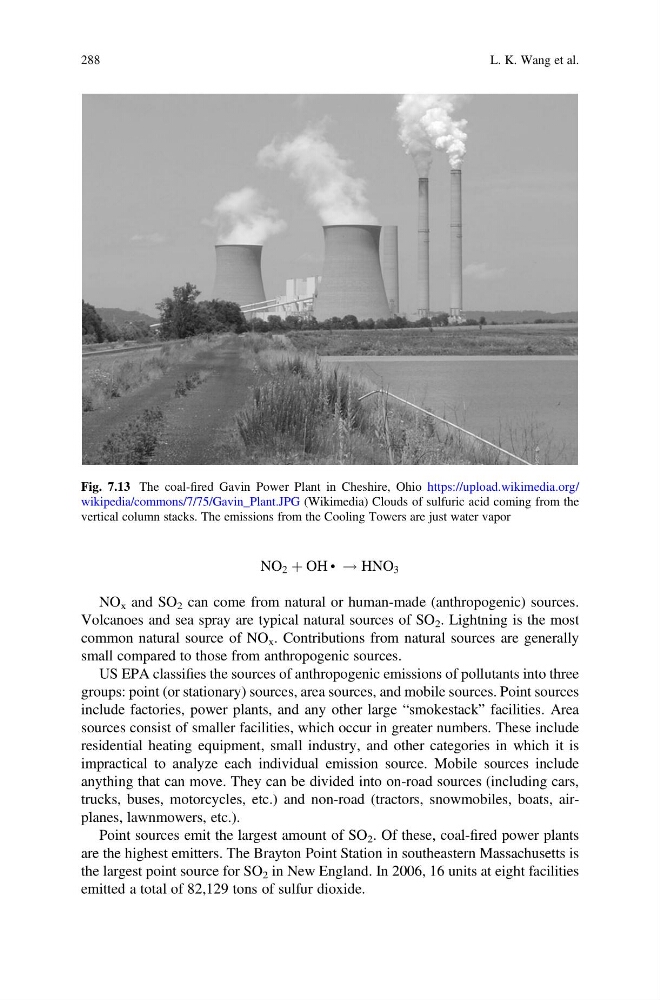
Point sources emit the largest amount of SO 2 . Of these, coal-fired power plants
are the highest emitters. The Brayton Point Station in southeastern Massachusetts is
the largest point source for SO 2 in New England. In 2006, 16 units at eight facilities
emitted a total of 82,129 tons of sulfur dioxide.
Fig. 7.13 The coal-fired Gavin Power Plant in Cheshire, Ohio https://upload.wikimedia.org/
wikipedia/commons/7/75/Gavin_Plant.JPG (Wikimedia) Clouds of sulfuric acid coming from the
vertical column stacks. The emissions from the Cooling Towers are just water vapor
288
L. K. Wang et al.
NO x and SO 2 can come from natural or human-made (anthropogenic) sources.
Volcanoes and sea spray are typical natural sources of SO 2 . Lightning is the most
common natural source of NO x . Contributions from natural sources are generally
small compared to those from anthropogenic sources.
US EPA classifies the sources of anthropogenic emissions of pollutants into three
groups: point (or stationary) sources, area sources, and mobile sources. Point sources
include factories, power plants, and any other large “smokestack” facilities. Area
sources consist of smaller facilities, which occur in greater numbers. These include
residential heating equipment, small industry, and other categories in which it is
impractical to analyze each individual emission source. Mobile sources include
anything that can move. They can be divided into on-road sources (including cars,
trucks, buses, motorcycles, etc.) and non-road (tractors, snowmobiles, boats, airplanes, lawnmowers, etc.).
Point sources emit the largest amount of SO 2 . Of these, coal-fired power plants
are the highest emitters. The Brayton Point Station in southeastern Massachusetts is
the largest point source for SO 2 in New England. In 2006, 16 units at eight facilities
emitted a total of 82,129 tons of sulfur dioxide.
Fig. 7.13 The coal-fired Gavin Power Plant in Cheshire, Ohio https://upload.wikimedia.org/
wikipedia/commons/7/75/Gavin_Plant.JPG (Wikimedia) Clouds of sulfuric acid coming from the
vertical column stacks. The emissions from the Cooling Towers are just water vapor
288
L. K. Wang et al.