

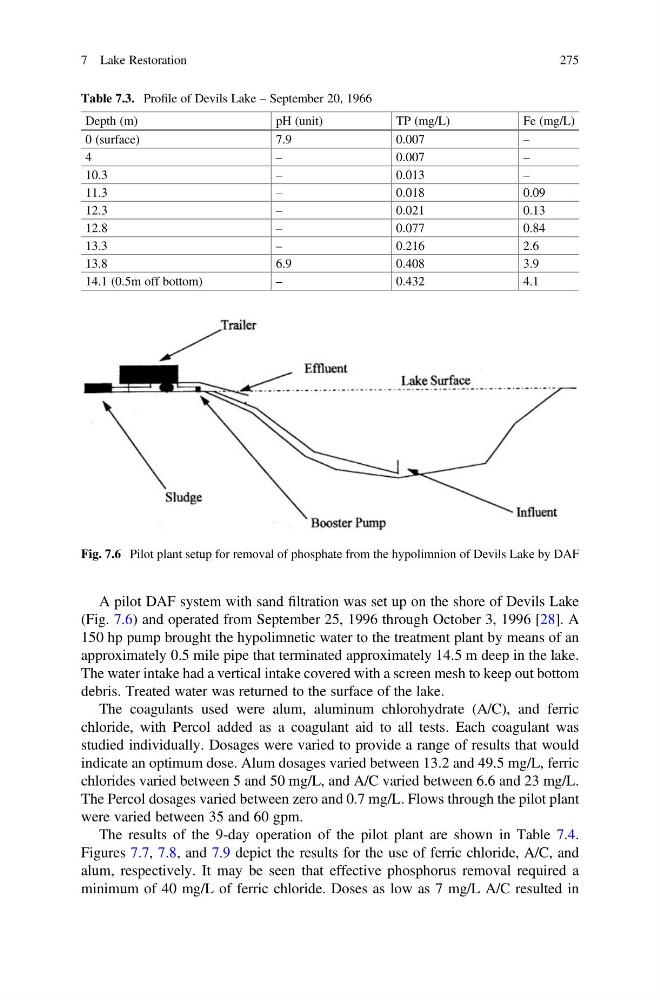
A pilot DAF system with sand filtration was set up on the shore of Devils Lake
(Fig. 7.6) and operated from September 25, 1996 through October 3, 1996 [28]. A
150 hp pump brought the hypolimnetic water to the treatment plant by means of an
approximately 0.5 mile pipe that terminated approximately 14.5 m deep in the lake.
The water intake had a vertical intake covered with a screen mesh to keep out bottom
debris. Treated water was returned to the surface of the lake.
The coagulants used were alum, aluminum chlorohydrate (A/C), and ferric
chloride, with Percol added as a coagulant aid to all tests. Each coagulant was
studied individually. Dosages were varied to provide a range of results that would
indicate an optimum dose. Alum dosages varied between 13.2 and 49.5 mg/L, ferric
chlorides varied between 5 and 50 mg/L, and A/C varied between 6.6 and 23 mg/L.
The Percol dosages varied between zero and 0.7 mg/L. Flows through the pilot plant
were varied between 35 and 60 gpm.
The results of the 9-day operation of the pilot plant are shown in Table 7.4.
Figures 7.7, 7.8, and 7.9 depict the results for the use of ferric chloride, A/C, and
alum, respectively. It may be seen that effective phosphorus removal required a
minimum of 40 mg/L of ferric chloride. Doses as low as 7 mg/L A/C resulted in
Table 7.3. Profile of Devils Lake – September 20, 1966
Depth (m)
pH (unit)
TP (mg/L)
Fe (mg/L)
0 (surface)
7.9
0.007
–
4
–
0.007
–
10.3
–
0.013
–
11.3
–
0.018
0.09
12.3
–
0.021
0.13
12.8
–
0.077
0.84
13.3
–
0.216
2.6
13.8
6.9
0.408
3.9
14.1 (0.5m off bottom)
–
0.432
4.1
Fig. 7.6 Pilot plant setup for removal of phosphate from the hypolimnion of Devils Lake by DAF
7 Lake Restoration
275
(Fig. 7.6) and operated from September 25, 1996 through October 3, 1996 [28]. A
150 hp pump brought the hypolimnetic water to the treatment plant by means of an
approximately 0.5 mile pipe that terminated approximately 14.5 m deep in the lake.
The water intake had a vertical intake covered with a screen mesh to keep out bottom
debris. Treated water was returned to the surface of the lake.
The coagulants used were alum, aluminum chlorohydrate (A/C), and ferric
chloride, with Percol added as a coagulant aid to all tests. Each coagulant was
studied individually. Dosages were varied to provide a range of results that would
indicate an optimum dose. Alum dosages varied between 13.2 and 49.5 mg/L, ferric
chlorides varied between 5 and 50 mg/L, and A/C varied between 6.6 and 23 mg/L.
The Percol dosages varied between zero and 0.7 mg/L. Flows through the pilot plant
were varied between 35 and 60 gpm.
The results of the 9-day operation of the pilot plant are shown in Table 7.4.
Figures 7.7, 7.8, and 7.9 depict the results for the use of ferric chloride, A/C, and
alum, respectively. It may be seen that effective phosphorus removal required a
minimum of 40 mg/L of ferric chloride. Doses as low as 7 mg/L A/C resulted in
Table 7.3. Profile of Devils Lake – September 20, 1966
Depth (m)
pH (unit)
TP (mg/L)
Fe (mg/L)
0 (surface)
7.9
0.007
–
4
–
0.007
–
10.3
–
0.013
–
11.3
–
0.018
0.09
12.3
–
0.021
0.13
12.8
–
0.077
0.84
13.3
–
0.216
2.6
13.8
6.9
0.408
3.9
14.1 (0.5m off bottom)
–
0.432
4.1
Fig. 7.6 Pilot plant setup for removal of phosphate from the hypolimnion of Devils Lake by DAF
7 Lake Restoration
275