

system could be installed at the lakeshore without the cost and obstruction of a
conventional sedimentation basin.
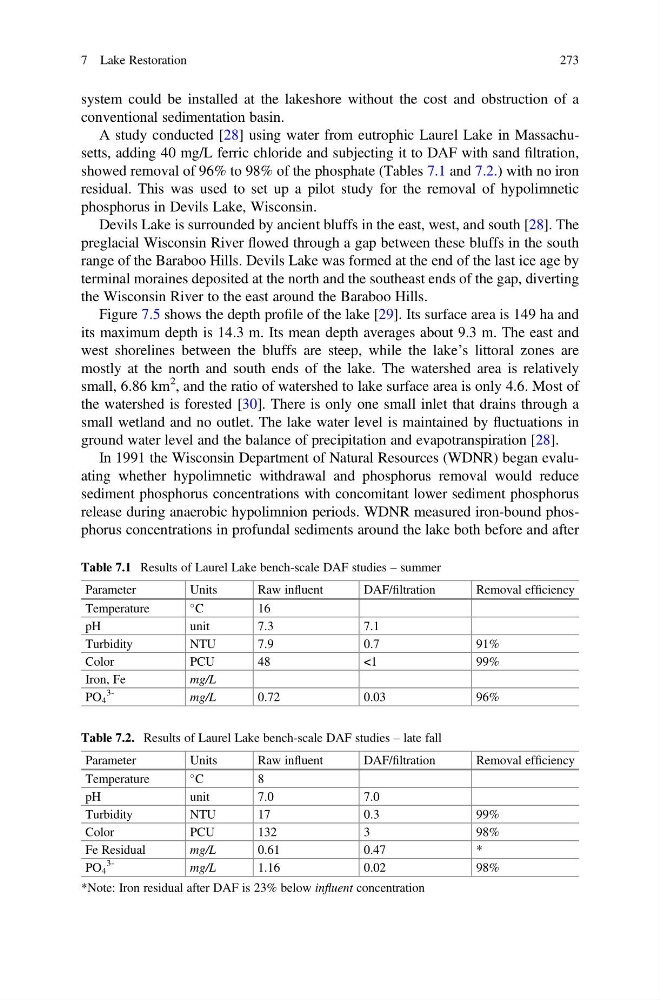
A study conducted [28] using water from eutrophic Laurel Lake in Massachusetts, adding 40 mg/L ferric chloride and subjecting it to DAF with sand filtration,
showed removal of 96% to 98% of the phosphate (Tables 7.1 and 7.2.) with no iron
residual. This was used to set up a pilot study for the removal of hypolimnetic
phosphorus in Devils Lake, Wisconsin.
Devils Lake is surrounded by ancient bluffs in the east, west, and south [28]. The
preglacial Wisconsin River flowed through a gap between these bluffs in the south
range of the Baraboo Hills. Devils Lake was formed at the end of the last ice age by
terminal moraines deposited at the north and the southeast ends of the gap, diverting
the Wisconsin River to the east around the Baraboo Hills.
Figure 7.5 shows the depth profile of the lake [29]. Its surface area is 149 ha and
its maximum depth is 14.3 m. Its mean depth averages about 9.3 m. The east and
west shorelines between the bluffs are steep, while the lake’s littoral zones are
mostly at the north and south ends of the lake. The watershed area is relatively
small, 6.86 km
2 , and the ratio of watershed to lake surface area is only 4.6. Most of
the watershed is forested [30]. There is only one small inlet that drains through a
small wetland and no outlet. The lake water level is maintained by fluctuations in
ground water level and the balance of precipitation and evapotranspiration [28].
In 1991 the Wisconsin Department of Natural Resources (WDNR) began evaluating whether hypolimnetic withdrawal and phosphorus removal would reduce
sediment phosphorus concentrations with concomitant lower sediment phosphorus
release during anaerobic hypolimnion periods. WDNR measured iron-bound phosphorus concentrations in profundal sediments around the lake both before and after
Table 7.1 Results of Laurel Lake bench-scale DAF studies – summer
Parameter
Units
Raw influent
DAF/filtration
Removal efficiency
Temperature
C
1 6
pH
unit
7.3
7.1
Turbidity
NTU
7.9
0.7
91%
Color
PCU
48
<1
99%
Iron, Fe
mg/L
PO 4
3mg/L
0.72
0.03
96%
Table 7.2. Results of Laurel Lake bench-scale DAF studies – late fall
Parameter
Units
Raw influent
DAF/filtration
Removal efficiency
Temperature
C
8
pH
unit
7.0
7.0
Turbidity
NTU
17
0.3
99%
Color
PCU
132
3
98%
Fe Residual
mg/L
0.61
0.47
*
PO 4
3mg/L
1.16
0.02
98%
*Note: Iron residual after DAF is 23% below influent concentration
7 Lake Restoration
273
conventional sedimentation basin.
A study conducted [28] using water from eutrophic Laurel Lake in Massachusetts, adding 40 mg/L ferric chloride and subjecting it to DAF with sand filtration,
showed removal of 96% to 98% of the phosphate (Tables 7.1 and 7.2.) with no iron
residual. This was used to set up a pilot study for the removal of hypolimnetic
phosphorus in Devils Lake, Wisconsin.
Devils Lake is surrounded by ancient bluffs in the east, west, and south [28]. The
preglacial Wisconsin River flowed through a gap between these bluffs in the south
range of the Baraboo Hills. Devils Lake was formed at the end of the last ice age by
terminal moraines deposited at the north and the southeast ends of the gap, diverting
the Wisconsin River to the east around the Baraboo Hills.
Figure 7.5 shows the depth profile of the lake [29]. Its surface area is 149 ha and
its maximum depth is 14.3 m. Its mean depth averages about 9.3 m. The east and
west shorelines between the bluffs are steep, while the lake’s littoral zones are
mostly at the north and south ends of the lake. The watershed area is relatively
small, 6.86 km
2 , and the ratio of watershed to lake surface area is only 4.6. Most of
the watershed is forested [30]. There is only one small inlet that drains through a
small wetland and no outlet. The lake water level is maintained by fluctuations in
ground water level and the balance of precipitation and evapotranspiration [28].
In 1991 the Wisconsin Department of Natural Resources (WDNR) began evaluating whether hypolimnetic withdrawal and phosphorus removal would reduce
sediment phosphorus concentrations with concomitant lower sediment phosphorus
release during anaerobic hypolimnion periods. WDNR measured iron-bound phosphorus concentrations in profundal sediments around the lake both before and after
Table 7.1 Results of Laurel Lake bench-scale DAF studies – summer
Parameter
Units
Raw influent
DAF/filtration
Removal efficiency
Temperature
C
1 6
pH
unit
7.3
7.1
Turbidity
NTU
7.9
0.7
91%
Color
PCU
48
<1
99%
Iron, Fe
mg/L
PO 4
3mg/L
0.72
0.03
96%
Table 7.2. Results of Laurel Lake bench-scale DAF studies – late fall
Parameter
Units
Raw influent
DAF/filtration
Removal efficiency
Temperature
C
8
pH
unit
7.0
7.0
Turbidity
NTU
17
0.3
99%
Color
PCU
132
3
98%
Fe Residual
mg/L
0.61
0.47
*
PO 4
3mg/L
1.16
0.02
98%
*Note: Iron residual after DAF is 23% below influent concentration
7 Lake Restoration
273